Prelims: (Economy + CA)
Mains: (GS 3 – Indian Economy, Global Markets, Resource Security, Industrial Demand, Inflation) |
Why in News ?
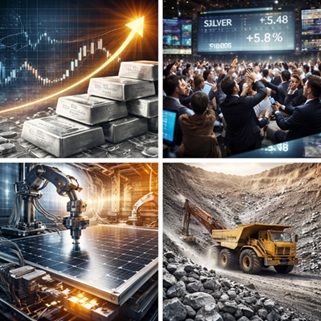
Despite a sharp one-day fall of nearly 10% in late December, silver staged a rapid recovery and closed December 2025 with gains exceeding 30%. Over the full year, silver prices surged by more than 160%, significantly outperforming gold and most other asset classes.
While global trade tensions and US Federal Reserve rate cuts supported precious metals broadly, silver’s rally was driven by distinct industrial, supply-side, and speculative factors, making it fundamentally different from gold’s traditional safe-haven rise.
Background: Silver and the Global Commodities Landscape
Historically, silver has occupied a hybrid position in the global economy—part precious metal, part industrial input. Unlike gold, which is primarily held as a store of value, silver’s demand is deeply embedded in manufacturing, energy transition technologies, electronics, and healthcare.
Over the past decade, structural changes such as the rise of renewable energy, electric vehicles, and advanced electronics have steadily increased silver’s industrial relevance. By 2025, these long-term trends converged with geopolitical disruptions and financial speculation, triggering an extraordinary price rally.
Why Silver’s Rally Is Structurally Different from Gold’s ?
- Dual Demand Structure: Silver derives value from industrial consumption, investment demand, and jewellery usage, whereas gold is dominated by investment and central bank demand.
- Critical Role in Future Technologies: Silver is indispensable in solar photovoltaic cells, EV batteries, semiconductors, medical equipment, and electronics, sectors that expanded rapidly in 2025.
- Higher Price Elasticity: Because silver markets are smaller and less liquid than gold, marginal changes in demand or supply produce outsized price movements.
- Broader Buyer Base: Industrial firms, ETF investors, retail buyers, and governments simultaneously competed for limited supplies, amplifying price volatility.
Supply Constraints and Geopolitics Fuel Silver’s Rally
Byproduct Production Bottleneck
Silver is largely mined as a byproduct of copper, zinc, and lead extraction, limiting the ability to scale supply quickly in response to rising demand.
US Designates Silver as a Critical Mineral
- In November 2025, the United States added silver to its Critical Minerals List, enabling:
- Strategic stockpiling
- Government financing support
- Potential trade and tariff interventions under Section 232
Tariff Fears and Stockpiling
- Anticipating trade restrictions, US buyers aggressively accumulated inventories.
- CME Group data showed US silver stocks rising to 531 million ounces by September 2025, far above historical norms.
China’s Export Restrictions
- China imposed two-year export curbs on several rare metals, including silver.
- These measures intensified global supply anxieties, particularly for manufacturers dependent on Chinese inputs.
Industrial Alarm
- Leading industrialists, including Tesla’s Elon Musk, highlighted silver’s irreplaceability in clean-energy and manufacturing processes, reinforcing long-term demand expectations.
Fear of Missing Out (FOMO) and Financialisation of Silver
Physical Shortages in Price-Setting Markets
- Heavy US stockpiling drained supplies from global hubs such as London, where benchmark prices are determined.
- Physical scarcity by October 2025 triggered sharp upward price revisions.
Retail and ETF Momentum
- According to the Bank for International Settlements, retail investors chasing gold’s rally increasingly turned to silver as a leveraged alternative.
India’s ETF-Led Demand
- India emerged as a major demand centre.
- In September 2025 alone, silver ETFs recorded ₹5,342 crore in inflows, significantly exceeding gold ETF investments.
- Creation of new ETF units required physical silver purchases, further tightening supply.
Self-Reinforcing Price Spiral
- Rising prices attracted more investors.
- Higher investment demand reduced physical availability.
- Scarcity drove prices even higher, reinforcing speculative momentum.
Broader Commodities Rally in 2025
Industrial Metals Boom
- Copper prices crossed $12,000 per tonne for the first time, driven by similar tariff fears and supply shortages.
Weak Dollar and the “Debasement Trade”
- The US dollar depreciated by around 10% in 2025.
- Investors increasingly favoured real assets—gold, silver, industrial metals, and even cryptocurrencies—as hedges against currency erosion.
Supportive Global Macro Environment
- US rate cuts
- Rising fiscal deficits
- Geopolitical instability
- Erosion of confidence in traditional financial assets
These conditions sustained the global commodities upcycle.
Outlook and Risks Ahead
- Analysts expect silver’s structural demand story to remain intact into early 2026.
- However, after a 160% annual surge, volatility risks are high.
- Any easing of geopolitical tensions, faster mine supply, or sharp tightening of financial conditions could trigger corrections.
FAQs
1. Why did silver outperform gold in 2025 ?
Because silver benefits from both investment demand and rapidly growing industrial usage, especially in clean energy and electronics.
2. How did geopolitics influence silver prices ?
US critical mineral designation, tariff fears, and China’s export curbs created supply insecurity, driving stockpiling and price spikes.
3. What role did ETFs play in the silver rally ?
ETF inflows required physical silver purchases, tightening supply and creating a feedback loop that pushed prices higher.
4. Why is silver supply slow to respond to price increases ?
Most silver is produced as a byproduct, limiting miners’ ability to expand output quickly.
5. Is silver’s price rise sustainable ?
Long-term fundamentals remain strong, but short-term volatility is likely due to speculative excess and potential policy shifts.
|






 Contact Us
  New Batch : 9555124124/ 7428085757
  Tech Support : 9555124124/ 7428085757