(Preliminary Examination: Current events of national importance, Indian polity and governance – Constitution, Panchayati Raj, public policy, economic and social development – sustainable development, poverty, inclusion, demography, social sector initiatives, etc.)
(Mains Examination, General Studies Papers 2 and 3: Government policies and interventions for development in various sectors and issues arising out of their design and implementation, Indian economy and planning, issues related to resource mobilization, growth, development, and employment, inclusive development and issues arising out of it) |
Context
- The Vikasit Bharat – Guarantee for Rozgar and Ajeevika Mission (Gramin): VB – G Ram G (Viksit Bharat – G Ram G) Bill, 2025 was introduced in the Lok Sabha on December 16, 2025 by the Union Minister of Rural Development.
- The President has given assent to the Vikasit Bharat-Employment and Livelihood Guarantee Mission (Gramin): VB-G Ram Ji (Vikasit Bharat-G Ram Ji) Bill, 2025 on December 21, 2025, which is a significant change in rural employment policy.
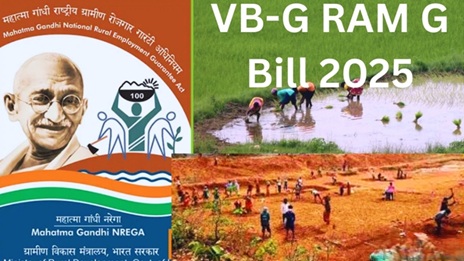
Rationale for the New Statutory Framework
- MNREGA was implemented in 2005, but rural India is now transforming. Poverty levels have declined from 27.1% in 2011-12 to 5.3% in 2022-23, supported by rising consumption, improved financial access, and enhanced welfare coverage.
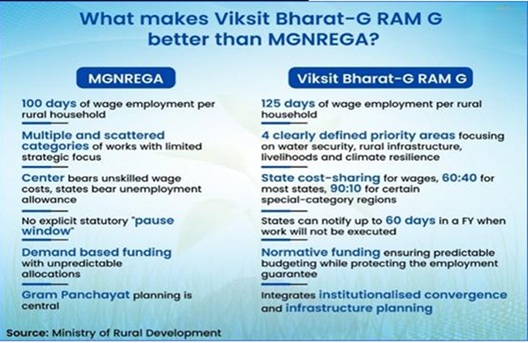
- As rural livelihoods become more diversified and digitally integrated, MNREGA's extensive and demand-driven structure no longer fully matches the reality of today's villages.
- Developed India – The Ramji Act, 2025 responds to this context by modernizing the rural employment guarantee, strengthening accountability, and linking job creation with long-term infrastructure and climate resilience goals.
Key Points
- The Developed India - Shri Ram Ji Bill, 2025 replaces MNREGA with a new statutory framework aligned with Developed India 2047.
- The employment guarantee has been increased to 125 days per rural household, strengthening income security.
- Links wage employment with sustainable rural infrastructure in four priority sectors.
- Developed India strengthens decentralized planning through nationally integrated and enhanced Gram Panchayat schemes through the National Rural Infrastructure Stack.
- The shift to benchmark-linked funding and a centrally sponsored structure improves predictability, accountability, and Centre-State partnerships.
|
Key Objectives
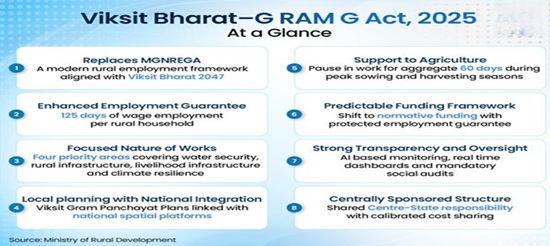
- The Act extends the statutory guarantee of wage employment to 125 days per financial year for rural households and seeks to advance empowerment, inclusive growth, convergence of schemes, and service delivery in a holistic manner, thereby strengthening the foundation of a prosperous, capable, and self-reliant rural India.
- Earlier, Parliament passed the Vikas Bharat - Employment and Livelihood Guarantee Mission (Rural) Bill, 2025, which paved the way for a decisive reform of India's rural employment and development framework.
- This Act replaces the Mahatma Gandhi National Rural Employment Guarantee Act, 2005 (Mahatma Gandhi NREGA) and provides a modern statutory framework to strengthen livelihood security.
- The Act elevates rural employment from a mere welfare scheme to an integrated vehicle for development, based on the principles of empowerment, development, convergence, and saturation.
- It strengthens the income security of rural households, modernises governance and accountability and links wage employment with the creation of durable and productive rural assets, thereby laying the foundation for a prosperous and resilient rural India.
Key Features of the Act
Increase in Statutory Guarantee of Employment
- The Act provides a statutory guarantee of at least 125 days of wage employment to every rural household in each financial year, provided that adult members of the household are willing to do unskilled manual work. (Section 5(1))
- This increase, compared to the previously available 100 days of employment, provides livelihood security to rural households, makes work more predictable, and provides more stable income.
Balanced Provisions Between Agricultural and Rural Labor
- The Act empowers states to notify a consolidated rest period of up to 60 days in a financial year to facilitate the availability of agricultural labor for agriculture-related activities during the sowing and harvesting seasons. (Section 6)
- The workers' entitlement to a total of 125 days of employment will remain unchanged and will be provided for the remaining period, ensuring a balanced balance between agricultural productivity and protection of workers' interests.
Timely Wage Payment
- The Act mandates payment of wages on a weekly basis or, in any case, within fifteen days of completion of work (Section 5(3)).
- However, in case of delay beyond the prescribed period, compensation for delay will be payable as per the provisions mentioned in Schedule II, thereby strengthening wage security and protecting workers from delays.
Employment Linked to Sustainable and Useful Rural Infrastructure
- The Act explicitly links wage employment to the creation of durable public assets in four priority thematic areas (Section 4(2)):
- Water security and water-related works
- Core rural infrastructure works
- Livelihood-related infrastructure works
- Works to mitigate the impact of extreme weather events
- All works are proposed from the village level using a bottom-up approach, and all assets created are integrated into the Develop India National Rural Infrastructure Stack. This ensures convergence of public resources, avoids fragmentation, and results-based planning based on saturation targets to create essential rural infrastructure as per local needs.
Decentralized Planning with National Convergence
- All actions begin with "Developed Gram Panchayat Plans," which are prepared through participatory processes at the Gram Panchayat level and approved by the Gram Sabha. (Sections 4(1) to 4(3))
- These plans are digitally and spatially integrated with national platforms, including PM Gati Shakti, to enable convergence of all plan-related activities under government oversight, while maintaining decentralized decision-making at the local level.
- This integrated planning framework will enable ministries and departments to plan and implement activities more effectively, while avoiding duplication and wastage of public resources.
Financial Structure
- The Act will be implemented as a Centrally Sponsored Scheme, which will be notified and implemented by the states in accordance with the provisions of the Act.
- The expenditure-sharing pattern under the Act is
- 60:40 between the Centre and the States,
- 90:10 for the North-Eastern and Himalayan States, and
- 100% Central funding for Union Territories without Legislative Assemblies.
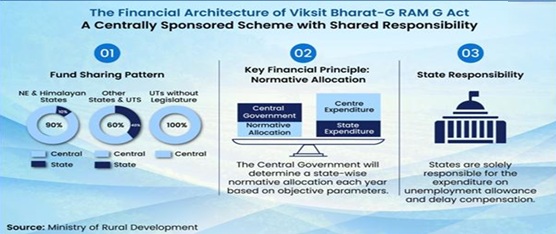
- Funds will be provided through state-wise standardized allocations based on objective parameters specified in the rules (Sections 4(5) and 22(4)) to ensure predictability, financial discipline, and sound planning.
Strengthening Administrative Capacity
- The maximum limit for administrative expenditure under the Act has been increased from 6% to 9%.
- This strengthens human resource availability, training, technical capacity, and field support, strengthening the ability of institutions to effectively deliver results.
- The Developing India – Employment and Livelihood Guarantee Mission (Rural) Act, 2025 represents a decisive step towards revamping and strengthening India's rural employment system.
- It integrates transparent, rules-based financing, accountable mechanisms, technology-enabled inclusion, and convergence-based development so that rural employment not only provides income security but also contributes to sustainable livelihoods, strong assets, and long-term rural prosperity.
Employment Guarantee and the Right to Demand Employment
- The Act does not weaken the right to demand employment. In contrast, Section 5(1) imposes a clear statutory obligation on the government to provide at least 125 days of guaranteed wage employment to eligible rural households.
- This increase in guaranteed days, combined with strengthened accountability and grievance redressal mechanisms, further strengthens the enforceability of this right.
Normative Financing and Employment Provision
- The shift to normative allocations relates to budgeting and fund flow arrangements and does not adversely impact the legal right to employment.
- Sections 4(5) and 22(4) ensure rule-based and predictable allocation, while the statutory obligation to provide employment or unemployment allowance remains unchanged.
Decentralization and the Role of Panchayats
- The Act does not centralize planning or implementation. Sections 16 to 19 vest planning, implementation, and monitoring powers at appropriate levels in Panchayats, program officers, and district authorities. National visibility, convergence, and coordination will be provided, but local decision-making will not be taken away.
Employment and Asset Creation
- The Act not only establishes a statutory guarantee of 125 days of enhanced livelihoods, but also ensures that employment contributes to the creation of productive, sustainable, and climate-resilient assets.
- Employment creation and asset creation are envisioned as complementary objectives that support long-term rural development and adaptation (Section 4(2) and Schedule I).
Technology and Inclusion
- Under the Act, technology is envisioned as an enabling tool, not a hindrance.
- Sections 23 and 24 of the Act provide for technology-enabled transparency through biometric authentication, geo-tagging, and real-time dashboards, while Section 20 strengthens social audits by Gram Sabhas, ensuring community monitoring, transparency, and inclusion.
Unemployment Allowance
The Act removes the previous disqualifying provisions regarding unemployment allowance and restores it as a meaningful statutory safeguard. Where employment is not provided within the stipulated period, unemployment allowance becomes payable after fifteen days.
Potential Impact of VB-G RAM G on the Rural Economy
- According to the government, this new law will play a significant role in increasing employment opportunities, stabilizing incomes, and strengthening infrastructure in rural areas.
- By prioritizing water conservation projects, rural roads, local markets, and climate-resilient assets, the scheme aims to increase agricultural productivity and reduce forced migration.
- Furthermore, the scheme's digital planning, payment, and monitoring system is expected to bring greater efficiency, transparency, and timeliness to implementation.
Its significance for farmers
- Allowing states to suspend public works for a maximum of 60 days will improve the availability of agricultural labor during the busy sowing and harvesting seasons.
- Wage rates are expected to be reduced during critical agricultural stages.
- Improvements in water management and irrigation facilities will increase the climate resilience of crops.
- Improved rural connectivity, storage, and transportation facilities will reduce post-harvest losses.
Expected benefits for rural workers
- 25% increase in employment guarantee days, now 125 days of work opportunity instead of 100.
- Digital wage payments and Aadhaar-based verification will prevent problems such as payment delays and wage cuts.
- Workers will receive mandatory unemployment allowance if work is not provided within the stipulated period.
- Roads, water structures, and other durable community assets will be constructed.
- Panchayat-led planning systems will enable advance assessment of employment availability.
Strengthening Accountability and Monitoring
To address past shortcomings, the Bill includes robust monitoring and accountability provisions:
- Artificial Intelligence (AI)-based fraud detection system
- Monitoring of works using GPS and mobile technology
- Weekly public publication of scheme-related data
- Biannual social audits at the Gram Panchayat level
- Establishment of dedicated monitoring committees at the central and state levels
Conclusion
- The passage of the Developing India – Employment and Livelihood Guarantee Mission (Rural) Act, 2025 represents a significant transformation of India's rural employment guarantee system.
- By expanding statutory employment to 125 days, embedding decentralized and participatory planning, strengthening accountability, and institutionalizing convergence and saturation-based development, the Act reestablishes rural employment as a strategic tool for empowerment, inclusive growth, and building a prosperous and capable rural India.






 Contact Us
  New Batch : 9555124124/ 7428085757
  Tech Support : 9555124124/ 7428085757