Prelims: (International Relations + CA)
Mains: (GS 2 – International Relations, Global Governance, Multilateralism, India–US Relations, West Asia) |
Why in News ?
India has chosen, for now, to stay away from US President Donald Trump’s proposed Board of Peace, unveiled at the World Economic Forum in Davos, adopting a cautious “wait and watch” approach despite an invitation extended to Prime Minister Narendra Modi.
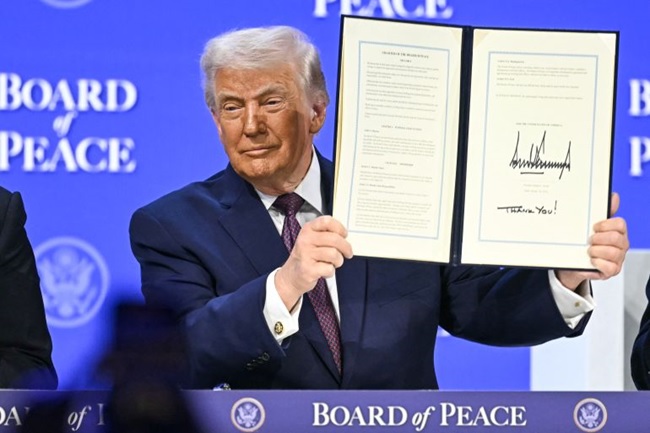
About Trump’s Board of Peace
The Board of Peace is a US-led intergovernmental body designed to manage global conflict resolution and post-war reconstruction.
Origin and Purpose
- Proposed in September 2025.
- Created to oversee “Phase Two” of the US-brokered ceasefire in Gaza following the 2023–2025 conflict.
Immediate Mandate
- Supervise the National Committee for the Administration of Gaza (NCAG) — a Palestinian technocratic authority.
- Manage:
- Gaza’s reconstruction,
- Disarmament of Hamas,
- Stabilisation and governance transitions.
Leadership and Composition
- Chair: Donald Trump.
- Key members: Jared Kushner, former UK Prime Minister Tony Blair, US Secretary of State Marco Rubio.
- Countries that have accepted invitations: Argentina, Saudi Arabia, Israel, UAE, Egypt, Turkey, Qatar, Pakistan, Indonesia, Vietnam, among others.
- Notable absentees: France, Germany, the UK, Italy; and permanent UNSC members — Russia, China, France, and the UK.
India’s Immediate Response on Joining the Board of Peace
- India has neither accepted nor declined the invitation.
- New Delhi is conducting a strategic, political, and diplomatic assessment before making a decision.
- The official posture reflects India’s preference for measured engagement in new and untested multilateral frameworks.
Why Trump’s Board of Peace Puts India in a Tight Spot
1. An Exclusive, Pay-to-Enter Peace Club
- Permanent membership reportedly requires a $1 billion contribution to a reconstruction fund.
- This effectively turns peace-making into a pay-to-enter arrangement, raising concerns about:
- Equity,
- Legitimacy,
- Influence-buying in global governance.
2. Unclear Scope, Expanding Concerns
- Although Gaza is the immediate focus, the board’s charter avoids explicit territorial limits.
- Broad phrases like “world peace” raise fears of:
- Mission creep,
- Expansion into other conflicts,
- Strategic overreach beyond its original mandate.
3. Fragmented Peace-Making Outside the UN System
- The board bypasses established multilateral institutions such as the UN General Assembly and UN Security Council.
- Its selective membership risks:
- Arbitrary decision-making,
- Fragmented global peace processes,
- Erosion of institutional legitimacy in conflict resolution.
4. India’s Multilateral Principles at Stake
- India has consistently defended:
- Multilateralism,
- The primacy of the United Nations,
- UN reform to reflect Global South realities.
- Joining a US-led forum perceived as bypassing the UN could:
- Undermine India’s credibility,
- Weaken its normative leadership among developing countries.
5. The Cost of Staying Out
- Avoiding the Board of Peace is not risk-free.
- India seeks a seat at platforms where:
- Global security,
- Conflict resolution,
- Post-war reconstruction are debated.
- Staying out could mean:
- Ceding strategic space,
- Appearing passive as new power structures emerge.
6. The فلسطين–Israel Balancing Act
- India has maintained:
- Support for a two-state solution and Palestinian rights,
- Deepening strategic ties with Israel.
- Joining a West-centric, Trump-driven Gaza platform risks:
- Upsetting this diplomatic balance,
- Complicating India’s positioning in the Global South.
7. Sharing the Platform with Pakistan
- Pakistan’s reported invitation presents a fresh dilemma.
- Sharing a high-profile forum with Islamabad could:
- Trigger domestic political backlash,
- Conflict with India’s stance on engaging with sponsors of terrorism.
- At the same time, staying out could exclude India from discussions affecting India–Pakistan crisis dynamics.
8. Security and Military Red Lines
- Reports suggest Pakistan may offer troops for a Gaza stabilisation force.
- India has ruled out participation in non-UN military missions, reinforcing its preference for:
- UN-mandated peacekeeping,
- Multilateral legitimacy over ad hoc coalitions.
A High-Stakes Strategic Choice
India is unlikely to ignore the platform entirely, yet joining carries reputational, diplomatic, and domestic political risks.
The strategic challenge lies in balancing engagement with caution — safeguarding India’s multilateral principles, domestic consensus, and global credibility in a Trump-led geopolitical forum.
FAQs
1. What is Trump’s Board of Peace ?
It is a US-led intergovernmental body aimed at managing post-war reconstruction and conflict resolution, starting with Gaza.
2. Why has India not joined the Board of Peace yet ?
India is assessing the strategic, diplomatic, and political implications, particularly regarding multilateralism, regional balance, and domestic considerations.
3. Why is the board controversial ?
It bypasses the UN system, has a pay-to-enter structure, and lacks clarity on its long-term mandate and geographic scope.
4. How does Pakistan’s involvement affect India’s decision ?
Sharing a high-profile peace platform with Pakistan creates domestic and strategic complications, given India’s security concerns.
5. What is at stake for India if it stays out ?
India risks losing influence in emerging global security frameworks and being excluded from key discussions on conflict resolution and reconstruction.
|






 Contact Us
  New Batch : 9555124124/ 7428085757
  Tech Support : 9555124124/ 7428085757