Prelims: (International Relations + CA)
Mains: (GS 2 - International Relations; GS 3 - Security) |
Why in News ?
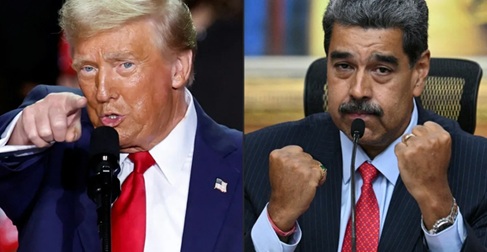
The United States has launched a large-scale military operation in Venezuela, capturing President Nicolás Maduro and transferring him and his wife to the US, where they have been charged in New York with drug trafficking and weapons-related offences. The operation marks a dramatic escalation in US–Venezuela tensions and raises serious questions about sovereignty, regime change, and international law.
Background & Context
Relations between the US and Venezuela have been adversarial for over two decades, particularly since the rise of Hugo Chávez and the consolidation of a socialist political order hostile to US interests. Under Nicolás Maduro, Venezuela has faced economic collapse, international sanctions, political repression, and mass migration.
The latest US action goes beyond sanctions and diplomatic isolation, signalling a shift towards direct coercive intervention, reminiscent of Cold War–era regime change strategies in Latin America.
Why Did the US Attack Venezuela ?
The US has cited migration, drugs, and narco-terrorism as the primary justifications for its operation against the Maduro regime.
Migration Crisis Narrative
- US President Donald Trump has repeatedly linked Venezuela to rising migration at the US southern border.
- Since 2013, nearly 8 million Venezuelans have fled economic collapse and political repression, mostly to Latin American neighbours.
- Trump has alleged that the Maduro government deliberately released prisoners and psychiatric inmates into migration flows—claims strongly denied by Caracas.
Drugs and ‘Narco-Terrorism’ Claims
- Washington claims Venezuela is a major transit hub for cocaine, contributing to the US fentanyl crisis.
- The US designated Tren de Aragua and the Cartel de los Soles as Foreign Terrorist Organisations (FTOs).
- Trump has accused Maduro himself of leading the Cartel de los Soles.
Venezuela’s Response
The Venezuelan government has rejected all allegations, arguing that the US is weaponising the “war on drugs” to justify regime change, rather than addressing root causes of migration or narcotics trafficking.
India’s Diplomatic Dilemma After US Action in Venezuela
The US operation has placed India in a delicate position between its partnership with Washington and its long-standing commitment to sovereignty, non-intervention, and international law.
- India generally avoids public positions on geographically distant conflicts.
- However, as a leading voice of the Global South, expectations are rising for India to articulate concerns over unilateral military actions.
- New Delhi is balancing principle with pragmatism amid ongoing strategic and economic engagements with the US.
US–India Context: Trade and Strategic Frictions
- India and the US are negotiating a bilateral trade deal amid tensions following 50% US tariffs, including a 25% penalty linked to India’s purchase of Russian oil.
- India has reduced Russian oil imports but feels selectively targeted, as similar penalties were not imposed on China or Europe.
MEA Advisory
The Ministry of External Affairs has issued an advisory urging Indian nationals in Venezuela to:
- Avoid non-essential travel
- Restrict movement
- Remain in contact with the Indian Embassy in Caracas
Given muted reactions from major G20 countries and ongoing negotiations with Washington, India has so far avoided an official statement.
India–Venezuela Ties: Limited but Historic
Energy-Centric Relationship
India once imported substantial volumes of Venezuelan crude oil. However, trade declined sharply after US sanctions.
Trade Trend:
- 2019–20: USD 6,397 million (imports: USD 6,057 million)
- 2020–21: USD 1,271 million (imports: USD 714 million)
- 2021–22: USD 424 million (imports: USD 89 million)
- 2022–23: USD 431 million (imports: USD 253 million)
High-Level Engagements
- 2005: Hugo Chávez visited India; met PM Manmohan Singh
- 2012: Nicolás Maduro visited India for India–CELAC Troika meet
- 2013: India sent Sachin Pilot to Chávez’s state funeral
- 2023: Venezuelan Vice President Delcy Rodríguez attended CII–LAC Conclave in India
Low Stakes, High Principles
- Indian diaspora in Venezuela is minimal (under 100 people).
- Yet, concerns over precedent-setting US interventionism elevate the issue’s diplomatic significance for India.
- Normative stakes outweigh material interests.
Global Reactions: Mixed Signals
- Russia: Condemned the US move as an act of armed aggression
- European Union: Called for respect for international law and the UN Charter
- Chile: Expressed concern and condemnation of US military action
- Colombia: Voiced deep concern over regional destabilisation
The absence of a unified global response highlights fractures in the international system.
What Lies Ahead for Venezuela After US Intervention ?
- President Trump stated that the US would temporarily run Venezuela until a “safe and judicious transition” is achieved.
- He dismissed opposition leader María Corina Machado, despite her party’s claim that Edmundo González Urrutia won the 2024 election.
- Trump emphasised an economic agenda:
- Entry of US oil companies
- Repair of infrastructure
- Oil extraction and global sales
- Cost recovery with revenue-sharing
He did not rule out the deployment of US troops, suggesting a potentially prolonged and force-backed transition.
Analysis: Why This Development Matters
- Raises serious questions about state sovereignty and international law
- Revives regime-change doctrines in contemporary geopolitics
- Sets precedents for unilateral interventions under security pretexts
- Tests India’s ability to balance partnerships with principled diplomacy
The episode reflects growing instability in the post–Cold War international order.
Way Forward
- Reaffirm commitment to the UN Charter and non-intervention
- Encourage multilateral mediation rather than unilateral action
- Protect Indian nationals and economic interests
- Use diplomatic channels to uphold global norms
- Strengthen Global South consensus on sovereignty and rule-based order
FAQs
Q1. Why did the US justify its action against Venezuela ?
The US cited migration pressures, drug trafficking, and alleged narco-terrorism links involving the Maduro regime.
Q2. How has Venezuela responded to US allegations ?
Venezuela has rejected them as baseless and accused the US of pursuing regime change.
Q3. Why is this development significant for India ?
It raises concerns over sovereignty and international law while testing India’s diplomatic balance with the US.
Q4. What is the status of India–Venezuela relations ?
Relations are limited but historically significant, primarily centred on energy and diplomatic engagement.
Q5. What are the possible outcomes for Venezuela ?
Potential scenarios include prolonged US oversight, economic restructuring led by US firms, or extended instability.
|






 Contact Us
  New Batch : 9555124124/ 7428085757
  Tech Support : 9555124124/ 7428085757