Prelims : (Polity + Current Affairs)
Mains : GS 2 – Governance, Elections, Representation of People, Constitutional Provisions |
Why in News ?
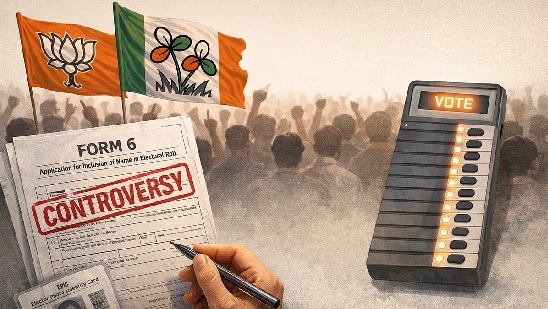
- Ahead of the freezing of electoral rolls for the April 23 and 29 West Bengal polls, allegations have emerged regarding a sudden surge in Form 6 applications for new voter enrolment.
- Concerns have been raised that large-scale submissions, allegedly involving applicants from states like Bihar and Uttar Pradesh, could alter the electoral composition of constituencies.
- Reports suggest that nearly 30,000 applications were submitted within a span of a few hours, raising questions about procedural compliance and transparency.
- The controversy has intensified due to the ongoing Special Intensive Revision of electoral rolls, making the timeline and verification process uncertain.
Background and Context
- Electoral rolls form the foundation of democratic elections, as they determine who is eligible to vote in a constituency.
- The process of voter registration in India is governed by the Representation of the People Act, 1950 and the Registration of Electors Rules, 1960.
- Form 6 serves as the primary mechanism for enrolling new voters into the electoral rolls.
- In recent years, allegations of irregularities in voter list revisions have surfaced in multiple states, highlighting concerns about electoral integrity.
- The West Bengal case gains significance due to the scale and timing of the applications, coinciding with the final stages of roll revision before elections.
- The involvement of judicial oversight in the revision process has further added complexity to the situation.
What is Form 6 ?
- Form 6 is the official application form prescribed for inclusion of a person’s name in the electoral roll of a constituency.
- It is submitted to the Electoral Registration Officer (ERO) of the relevant Assembly constituency, or Parliamentary constituency in Union Territories without legislatures.
- The form acts as the primary gateway for voter enrolment, combining document submission with a self-declaration by the applicant.
- While applicants provide necessary personal details, the responsibility for verification and final inclusion lies with the ERO.
Role of the Electoral Registration Officer (ERO)
- The ERO is an अधिकारी appointed by the Election Commission in consultation with the state government to manage electoral rolls at the constituency level.
- The officer is responsible for maintaining and updating electoral rolls, ensuring accuracy and inclusiveness.
- The ERO processes new voter applications, handles deletion requests, and conducts hearings in case of objections or disputes.
- The final authority to accept or reject applications for voter inclusion rests with the ERO after due verification.
Citizenship Requirement and Legal Framework
- Under Article 326 of the Constitution, only Indian citizens aged 18 years or above are eligible to be registered as voters.
- However, Form 6 does not mandatorily require documentary proof of citizenship at the time of application submission.
- Instead, the applicant provides a self-declaration regarding citizenship status, placing reliance on good faith and legal accountability.
- Any false declaration can attract penalties, including imprisonment of up to one year under relevant legal provisions.
Mode of Application
- Form 6 can be submitted through an online mode via the Election Commission’s ECINET portal, making the process more accessible and streamlined.
- Alternatively, applicants can submit the form offline to the ERO, who is typically a Sub-Divisional Magistrate or an अधिकारी of equivalent rank.
- The dual mode of application aims to balance accessibility with administrative control in voter enrolment.
Processing of Form 6 Applications
- Once an application is submitted, the Booth Level Officer (BLO) conducts field verification of the applicant’s details, including residence and identity.
- The ERO then evaluates whether the applicant meets key eligibility criteria such as age, citizenship, and ordinary residence in the constituency.
- If satisfied after verification, the ERO approves the application and includes the applicant’s name in the electoral roll.
Types of Voter Roll Updates
1. Special Summary Revision (SSR)
- This is a periodic revision process conducted annually or before major elections to update electoral rolls on a large scale.
- It allows for inclusion of new voters, deletion of ineligible names, and correction of existing entries in a structured manner.
2. Continuous Updation
- This process operates throughout the year, enabling individuals to apply for inclusion, deletion, or correction outside the revision cycle.
- However, it is suspended during the period between the last date of nomination and the declaration of election results to maintain electoral stability.
- In election years, an additional supplement is prepared to incorporate changes made during continuous updation up to the nomination deadline.
Objection and Verification Process
- The ERO is required to publicly display proposed additions to the electoral roll and provide a minimum of seven days for objections from stakeholders.
- This mechanism ensures transparency and allows verification by political parties and citizens.
- In the present case, this objection window has already closed, limiting the scope for further scrutiny under normal procedures.
Exceptional Situation in West Bengal
- The ongoing Special Intensive Revision in West Bengal has created an exceptional situation where standard timelines may not strictly apply.
- Judicial officers appointed under the supervision of the Supreme Court are involved in deciding disputes related to voter eligibility.
- This has led to uncertainty regarding the duration available for appeals and resolution of disputes in electoral rolls.
Allegations of Large-Scale Form 6 Submissions
- It has been alleged that thousands of Form 6 applications were submitted within a very short time frame at the Chief Electoral Officer’s office in West Bengal.
- Reports indicate that around 30,000 forms were filed within 6–7 hours, raising concerns about procedural feasibility and compliance.
- As per Election Commission guidelines, Booth Level Agents are permitted to submit only up to 50 forms per day, making such high volumes questionable.
- These developments have triggered concerns regarding possible violations of electoral norms and administrative oversight.
- Another major allegation is that some applicants were already registered as voters in other states such as Bihar and Uttar Pradesh.
- Since Form 6 requires a declaration that the applicant is not enrolled elsewhere, such duplication would violate provisions of the Representation of the People Act, 1950.
- Similar controversies related to voter roll manipulation have been reported in previous elections in states like Karnataka, Maharashtra, and Delhi.
Election Commission’s Response
- The Election Commission has not yet issued a detailed official response addressing the allegations of large-scale Form 6 submissions.
- The Chief Electoral Officer (CEO) of West Bengal stated that while documents were received, he was not aware of their specific contents.
- He clarified that the CEO does not have the authority to directly add or delete names from the electoral rolls.
- According to established procedures, complaints regarding fake or ineligible voters are forwarded to the ERO for verification and decision-making.
- The CEO’s role is primarily administrative, involving issuing directions and facilitating communication rather than direct intervention in voter enrolment.
Key Concepts
- Electoral Roll : An official list of eligible voters in a constituency, forming the basis of democratic elections.
- Form 6 : The prescribed application form for inclusion of new voters in electoral rolls.
- Ordinary Residence : A criterion used to determine whether a person is eligible to be registered in a particular constituency.
- Representation of the People Act, 1950 : The law governing the preparation and maintenance of electoral rolls in India.
- Duplicate Voting : The illegal act of being registered as a voter in more than one constituency or state.
Significance
- The issue highlights concerns regarding the integrity and transparency of electoral rolls, which are fundamental to free and fair elections.
- It underscores the challenges of balancing accessibility in voter registration with the need for strict verification mechanisms.
- The controversy raises questions about administrative capacity and procedural compliance during large-scale electoral revisions.
- It also reflects the increasing politicisation of voter enrolment processes in competitive electoral environments.
- Ensuring accurate voter rolls is essential for maintaining public trust in democratic institutions.
Core Analysis: Inclusiveness vs Electoral Integrity
Strengths
- The voter enrolment system, through Form 6, ensures inclusiveness by allowing easy access to registration for eligible citizens.
- The involvement of BLOs and EROs provides a multi-layered verification mechanism to ensure accuracy.
- Digital platforms have improved accessibility and efficiency in the voter registration process.
Concerns
- Reliance on self-declaration for citizenship increases the risk of false claims and misuse.
- Large-scale and last-minute applications can overwhelm verification mechanisms, reducing effectiveness.
- Possibility of duplicate enrolment undermines the principle of “one person, one vote.”
- Political misuse of voter registration processes can distort electoral outcomes and erode trust.
Way Forward
Short-Term Measures
- Immediate scrutiny and verification of suspicious applications should be conducted to ensure electoral integrity.
- Transparent disclosure of application data can help build public trust and reduce speculation.
Long-Term Measures
- Integration of voter databases with other government records can help prevent duplicate registrations.
- Strengthening digital verification mechanisms, including Aadhaar linkage (with safeguards), can improve accuracy.
Structural Reforms
- Enhancing the capacity and accountability of BLOs and EROs is essential for effective implementation.
- Introducing stricter penalties and enforcement mechanisms for false declarations can deter misuse.
- Continuous improvement in electoral roll management systems is necessary to balance inclusiveness with integrity.
Practice Questions
Prelims
Q. With reference to voter enrolment in India, consider the following statements :
- Form 6 is used for inclusion of new voters in electoral rolls.
- Documentary proof of citizenship is mandatory while submitting Form 6.
- A person can be registered as a voter in more than one constituency.
Select the correct answer :
(a) 1 only
(b) 1 and 2
(c) 2 and 3
(d) 1, 2 and 3
Mains
“Ensuring accuracy and inclusiveness in electoral rolls is a key challenge for Indian democracy.” Discuss in the context of recent controversies related to Form 6 enrolment.
FAQs
1. What is Form 6 ?
It is the official application form used for enrolling new voters in electoral rolls.
2. Who verifies Form 6 applications ?
The Booth Level Officer conducts field verification, while the ERO takes the final decision.
3. Can a person be registered in multiple states ?
No, duplicate voter registration is illegal under electoral laws.
4. Why is there controversy in West Bengal ?
Due to allegations of large-scale, last-minute voter enrolment that may violate rules.
5. What is the main concern ?
The potential impact on electoral integrity and fairness of elections.
|






 Contact Us
  New Batch : 9555124124/ 7428085757
  Tech Support : 9555124124/ 7428085757