A recent scientific study has revealed that NASA’s DART Mission (Double Asteroid Redirection Test) not only changed the motion of a small asteroid within its system but also slightly altered the orbit of the entire asteroid pair around the Sun. This achievement is considered a major milestone in the field of planetary defense and humanity’s ability to protect Earth from potential asteroid threats.
What is the DART Mission ?
- DART (Double Asteroid Redirection Test) was a space mission developed by NASA to test whether the trajectory of a potentially hazardous asteroid could be changed through a kinetic impact.
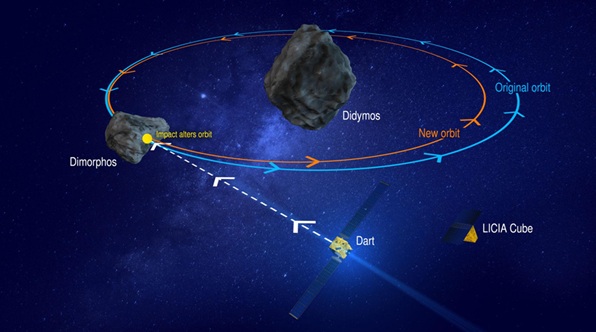
- In simple terms, a spacecraft was intentionally crashed into an asteroid to observe whether the collision could alter its speed or orbital path.
- The mission was historic because it was the world’s first planetary defense technology demonstration.
- Its main goal was to test a technique that could one day protect Earth by redirecting dangerous asteroids away from our planet.
Launch and Mission Design
- The DART mission was launched on 24 November 2021 from Vandenberg Space Force Base in California, USA.
- The spacecraft was designed as an autonomous system, capable of navigating and guiding itself to the target without real-time human control.
- It was equipped with advanced cameras and navigation systems that allowed it to identify and lock onto its target asteroid during the final stage of the mission.
Target: A Binary Asteroid System
The mission targeted a binary asteroid system, which consists of two celestial bodies:
- Didymos – the larger asteroid, about 780 meters wide.
- Dimorphos – the smaller moonlet, about 160 meters wide, orbiting Didymos.
Scientists selected this system because any change in the orbit of the smaller asteroid could be easily measured from Earth.
The idea was that since the two bodies are gravitationally bound, disturbing the orbit of Dimorphos would affect the entire system.
The Historic Impact (2022)
On 26 September 2022, the DART spacecraft successfully collided with Dimorphos at a speed of approximately 22,500 km/h.
After the impact, scientists observed that:
- The orbital period of Dimorphos around Didymos shortened by about 32 minutes.
- A measurable change occurred in the asteroid’s orbit.
- The collision produced a large plume of debris that spread into space.
This marked the first time in history that humans successfully altered the motion of a celestial object in space.
What Does the New Study Reveal ?
- Recent research indicates that the impact did not only affect the smaller asteroid.
- The energy and debris from the collision also caused a slight change in the entire Didymos–Dimorphos system’s orbit around the Sun.
- These findings help scientists understand the broader effects of asteroid deflection techniques.
Importance for Planetary Defense
- The DART mission represents a significant step toward protecting Earth from potential asteroid impacts.
- If a dangerous asteroid is detected in the future, kinetic impactor technology could be used to alter its trajectory and prevent a collision with Earth.
- To further analyze the results of the DART impact, the European Space Agency is planning the Hera Mission, expected to study the asteroid system around 2026.






 Contact Us
  New Batch : 9555124124/ 7428085757
  Tech Support : 9555124124/ 7428085757