|
Prelims : History + Culture + CA
Mains : GS 1 – Indian Culture, Ancient History, Religion
|
Why in News ?
- On the occasion of Mahavir Jayanti, the Prime Minister inaugurated the Samrat Samprati Museum in Gandhinagar, highlighting the legacy of Samprati, grandson of Ashoka.
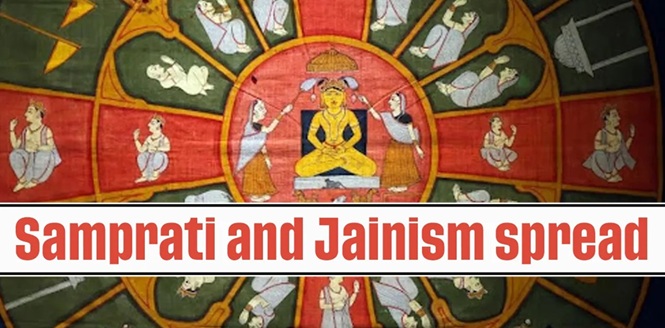
- While Ashoka is widely known for spreading Buddhism, Samprati is remembered in Jain traditions for actively promoting and expanding Jainism across India and beyond.
Background and Context: Mauryan Empire and Religious Traditions
- The Mauryan Empire (3rd century BCE) marked one of the most significant phases of political unification and cultural development in India.
- Ashoka (c. 269–232 BCE) :
- Expanded the empire extensively
- Promoted Buddhism through Dhamma, inscriptions, and missionary activities
- Influenced regions beyond India, especially Southeast Asia
- However, alongside Buddhism, Jainism also remained an important religious tradition during this period.
Jainism Within the Mauryan Era
- Jain traditions associate key Mauryan rulers with the faith:
- Chandragupta Maurya :
- Believed (in Jain traditions) to have adopted Jainism
- Migrated south during a famine
- Practised sallekhana (ritual fasting) at Shravanabelagola
- Padmavati (Ashoka’s wife) :
- Considered in some traditions to have been associated with Jainism
- After Ashoka’s death (232 BCE) :
- The empire is believed to have been divided between his grandsons :
Samprati: The Jain Counterpart to Ashoka
- Samprati (c. 230–220 BCE) is portrayed in Shvetambara Jain texts as one of the greatest royal patrons of Jainism.
- His role in Jain history is often compared to Ashoka’s role in Buddhism, as he :
- Promoted religious teachings
- Built institutions
- Expanded the geographical reach of the faith
Conversion and Religious Commitment
- According to Jain traditions :
- Samprati was initiated into Jainism under the monk Suhastin at Ujjain
- He adopted :
- Jain lay practices
- Daily rituals including icon worship
- His commitment is described as :
- Deeply personal and spiritual
- Not merely political or symbolic
Expansion of Jainism Across Regions
- Samprati is credited with systematically spreading Jainism across the Indian subcontinent through organised efforts.
- Key regions influenced :
- Southern India :
- Andhra Pradesh
- Tamil Nadu
- Karnataka
- Western and Central India :
- Maharashtra
- Gujarat
- Malwa
- Rajputana
- Some traditions even claim expansion beyond India to :
- Central Asia
- Afghanistan
- Nepal and Bhutan
- Myanmar and China
- His approach included :
- Sending Jain monks to distant regions
- Supporting missionary activities
- Promoting religious teachings among the masses
Temple Building and Religious Infrastructure
- Like Ashoka’s construction of stupas, Samprati is credited with institutionalising Jain religious practices through large-scale infrastructure development.
- Jain texts attribute to him :
- Construction of 1,25,000 temples
- Renovation of 36,000 temples
- Installation of millions of Jain icons (Jinas)
- Establishment of 700 charitable centres
- While these numbers may be symbolic or exaggerated, they indicate :
- The scale of his religious patronage
- The emphasis on institution-building in Jainism
Role in Consolidating Jainism
- Samprati’s contributions helped :
- Transform Jainism from a regional religious tradition into a wider organised faith
- Strengthen :
- Religious networks
- Monastic traditions
- Temple-based worship practices
- Embed Jainism deeply in :
- Western and Southern India
Legacy in Jain Tradition
- In many parts of western India :
- Ancient temples and icons without clear historical origins are often attributed to Samprati
- His legacy represents :
- A ruler who combined political authority with religious patronage
- A figure who ensured the continuity and expansion of Jain traditions
Historical Sources and Accounts
- Samprati’s life and contributions are described in Jain texts such as:
- Sampratikatha
- Parishistaparva
- Prabhavakcharita
- These texts, though written later, provide :
- Valuable insights into Jain traditions
- Religious memory of Mauryan rulers
Jainism Key Concepts
1. Founder of Jainism
- Mahavira (6th century BCE)
2. Core Principles
- Ahimsa (Non-violence)
- Aparigraha (Non-possession)
- Anekantavada (Multiplicity of viewpoints)
3. Sects of Jainism
- Digambara (sky-clad monks)
- Shvetambara (white-clad monks)
4. Sallekhana
- Ritual fasting unto death in Jain tradition
5. Jina
- Conqueror of inner passions; revered spiritual teacher
Significance
- Religious Expansion: Helped spread Jainism across vast regions
- Cultural Integration: Strengthened religious diversity in ancient India
- Institutional Development: Promoted temple culture and organised religious practices
- Historical Continuity: Demonstrates Mauryan legacy beyond Ashoka
Core Analysis: Ashoka vs Samprati
Ashoka
- Promoted Buddhism
- Used inscriptions and state policy
- Focused on moral governance (Dhamma)
Samprati
- Promoted Jainism
- Focused on temples and icon worship
- Emphasised grassroots religious expansion
- Together, they reflect :
- Plurality of religious patronage in ancient India
Practice Questions
Prelims :
Q. Which Mauryan ruler is associated with the spread of Jainism according to Jain traditions ?
(a) Ashoka
(b) Chandragupta Maurya
(c) Samprati
(d) Bindusara
Mains :
“Discuss the role of Samprati in the spread of Jainism and compare it with Ashoka’s contribution to Buddhism.”
FAQs
1. Who was Samprati ?
A Mauryan ruler and grandson of Ashoka known for promoting Jainism.
2. How did he spread Jainism ?
By sending monks, building temples, and installing Jain icons.
3. Which tradition highlights his role ?
Mainly Shvetambara Jain texts.
4. What is his significance ?
He expanded Jainism across India and institutionalised its practices.
5. How is he compared to Ashoka ?
As a Jain counterpart to Ashoka’s role in Buddhism.
|







 Contact Us
  New Batch : 9555124124/ 7428085757
  Tech Support : 9555124124/ 7428085757