
- UPSC Exam
- State PCS
- One Day Exam
- Current Affairs
- PT Quiz
- Downlaods
- About Coaching
- Blog
- Videos

| Prelims: (Polity & Governance + CA) Mains: (GS 2 – Representation of Women, Electoral Reforms, Democratic Participation) |
Recent analyses of electoral data show that women in India now vote at nearly the same rate as men, marking a major transformation in democratic participation.
However, despite this significant rise in voter turnout, women continue to remain underrepresented in legislatures, political parties, and campaign activities, highlighting a persistent gender gap in political power.
This situation creates a paradox in Indian democracy — high participation as voters but limited representation in decision-making institutions.
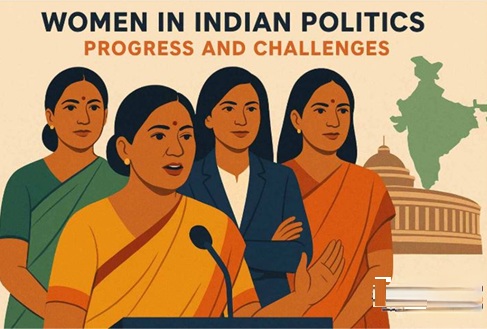
Women’s participation in India’s electoral politics has evolved dramatically since Independence.
In the early decades after 1947, women faced multiple barriers in accessing the electoral process, including low literacy rates, social restrictions, and limited political outreach.
Over the last six decades, however, India has witnessed a steady improvement in women’s electoral participation. Today, women constitute nearly half of the country’s electorate and have become a decisive voting bloc in many elections.
Despite this progress, women continue to face institutional and socio-cultural barriers that limit their representation in legislative bodies and political leadership.
In the decades following Independence, women voted at significantly lower rates than men.
For example, during the 1967 Indian general election:
This created a gender gap of more than 11 percentage points.
Several structural factors contributed to this gap:
From the 1980s onwards, the gap between male and female voter turnout began to narrow steadily.
By the 2009 Indian general election, the gender gap had reduced to around 4.4 percentage points.
The most dramatic shift occurred in the last decade:
This reflects a historic expansion of women’s participation in India’s democratic process.
The trend of rising female voter turnout is even more visible in State Assembly elections.
In the early 1990s, women’s turnout was typically 4–5 percentage points lower than men’s turnout.
However, by the late 2000s, this difference had almost disappeared.
After 2011, several states witnessed women voting at slightly higher rates than men.
Between 2015 and 2016:
Women’s turnout exceeded men’s by around 2.8 percentage points in multiple state elections.
Even during the 2020–2025 period, female voter turnout remained marginally higher than male turnout in several states, indicating a sustained shift in political engagement.
Although women have become more active as voters, their participation in other political activities remains relatively limited.
Across parliamentary elections between 2009 and 2024, men consistently reported higher involvement in campaign-related activities.
While these figures show gradual improvement, men’s participation in such activities remains roughly double that of women.
One key factor limiting women’s public political participation is family approval.
Surveys indicate that many women require permission from family members to attend rallies, political meetings, or campaign events.
Despite improvements in voter participation, women remain underrepresented in India’s legislatures.
In the first Lok Sabha election in 1952:
For several decades, the number of women Members of Parliament remained relatively small.
A gradual increase began in the 21st century:
Even at its peak, women constituted only about 14% of the Lok Sabha, far below their nearly 50% share of the electorate.
One major reason for women’s underrepresentation is the limited number of female candidates nominated by political parties.
In the 1957 Indian general election:
Over the decades, the number of women candidates has gradually increased:
However, these numbers remain small compared to male candidates, who number in the thousands.
Evidence also challenges the argument that women candidates are less likely to win elections.
In several elections, women have had equal or even higher success rates than men.
For example:
This suggests that when political parties nominate women candidates, they perform competitively.
Women’s underrepresentation in politics is shaped by multiple structural factors.
Survey findings reveal several perceptions about barriers to entry:
Several social and institutional challenges continue to limit women’s participation:
These barriers collectively restrict women’s entry into formal political leadership roles.
Enhancing women’s political participation requires both institutional reforms and societal change.
A major reform is the Nari Shakti Vandan Adhiniyam, which proposes 33% reservation for women in the Lok Sabha and State Assemblies.
Once implemented, the law could significantly increase women’s representation in legislatures.
Political parties must:
Local government institutions have already demonstrated the potential of reservation policies.
Women’s participation in Panchayati Raj institutions expanded significantly after the 73rd Constitutional Amendment and the 74th Constitutional Amendment, which reserved seats for women.
Long-term progress requires addressing structural issues such as:
The growing participation of women voters represents a major democratic transformation in India.
It reflects:
However, the gap between participation and representation highlights the need for deeper reforms to ensure that women play a larger role in political decision-making and governance.
FAQs1. How has women’s voter turnout changed in India over time ? Women’s voter turnout has increased significantly over the past decades and now stands almost equal to men’s turnout in national elections. 2. What is the current representation of women in the Lok Sabha ? Women constitute around 14% of Lok Sabha members, which remains far below their share in the electorate. 3. Why are fewer women elected to legislatures despite high voter turnout ? Factors include limited party nominations, patriarchal norms, financial barriers, and lower participation in political campaigning. 4. What reform aims to increase women’s representation in legislatures ? The Nari Shakti Vandan Adhiniyam (Women’s Reservation Bill) proposes 33% reservation for women in the Lok Sabha and State Assemblies. 5. How can women’s political participation be improved further ? Through greater political party support, legislative reservation, leadership training, and social empowerment of women. |



Our support team will be happy to assist you!

 Contact Us
  New Batch : 9555124124/ 7428085757
  Tech Support : 9555124124/ 7428085757