Context
- Recently, the Supreme Court agreed to consider an important constitutional question. The question is whether the Enforcement Directorate (ED) has the locus standi to file a writ petition under Article 226 of the Constitution.
- This question arises in the backdrop of a long-standing legal dispute between the Enforcement Directorate (ED) and the state governments of Kerala and Tamil Nadu. The outcome of this case could have wide-ranging implications for central-state relations, federal balance, and the autonomy of investigative agencies.
Background of the Case
- This dispute has its roots in the 2020 Kerala gold smuggling case, in which gold was smuggled through diplomatic baggage from the UAE at Thiruvananthapuram airport.
- In this context, the ED registered a case under the provisions of the Foreign Exchange Management Act, 1999 (FEMA) and the Prevention of Money Laundering Act, 2002 (PMLA). During the investigation, several senior officials of the Kerala government, including the then Chief Minister, were implicated.
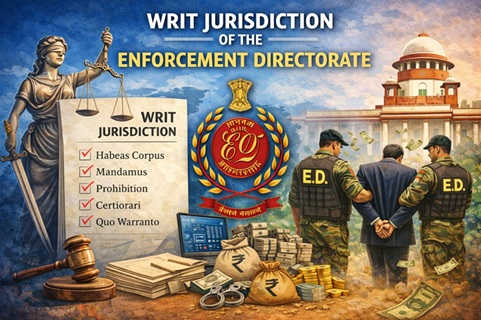
- The ED subsequently approached the Kerala High Court seeking a writ of mandamus to access essential records and a writ of certiorari to quash a state government notification on the grounds of lack of jurisdiction.
Meaning of a Writ Petition
- A writ petition is a constitutional remedy through which an order is obtained from a High Court (Article 226) or the Supreme Court (Article 32) for the protection of fundamental rights or for the correction of legal errors.
- This remedy is generally resorted to when other legal options prove ineffective. It directs public authorities to act in accordance with the law or to refrain from illegal activities.
Major Types of Writs
|
S. No.
|
Type of Writ
|
Meaning / Purpose
|
|
1.
|
Habeas Corpus
|
Issued to secure the release of a person from illegal or unlawful detention
|
|
2.
|
Mandamus
|
Command issued to a public authority to perform a statutory or public duty
|
|
3.
|
Prohibition
|
Issued to prevent a lower court or authority from exceeding its jurisdiction
|
|
4.
|
Certiorari
|
Issued to quash or cancel an illegal, improper, or erroneous order of a lower court or authority
|
|
5.
|
Quo Warranto
|
Issued to challenge the legality of a person’s claim to hold a public office
|
Exceptions
-
According to Article 361 of the Constitution, a writ of mandamus cannot be issued against the President or Governor in matters relating to the discharge of their constitutional duties.
-
Generally, writs are not admissible against private individuals or entities unless the allegation is that the State has colluded with a private party to violate constitutional or statutory provisions.
Central Constitutional Questions
Can the ED invoke writ jurisdiction under Article 226 ?
- Article 226 empowers High Courts to issue writs for the enforcement of fundamental rights and for “any other purpose.”
- Traditionally, this power has been exercised by citizens, juristic persons, and institutions with enforceable legal rights.
Can the Enforcement Directorate also be included in this category ?
High Courts' View (Kerala and Madras)
- The Kerala High Court (2021) and subsequently the Madras High Court held that the ED is a statutory body with independent powers.
- ED officers perform functions of a quasi-judicial nature. On this basis, the courts held that the ED cannot be considered merely a department of the Central Government and has the right to file a petition in court.
Arguments of the Kerala and Tamil Nadu governments (before the Supreme Court)
- The ED is not a juristic person (judicial body) but an administrative department of the Central Government.
- FEMA and PMLA do not explicitly authorize the ED to file suit.
- Allowing the ED to file a writ petition could undermine Article 131, which provides for the Supreme Court's exclusive original jurisdiction over central-state disputes.
- This would allow the Central Government to bypass constitutional safeguards.
- The Kerala government also argued that the High Court's dismissal of the ED's petition as a "minor technical defect" was unfair.
- They cited the decisions of State of Andhra Pradesh v. Union of India (2012) and Chief Conservator of Forests v. Collector (2003), which held that only juristic persons can file suits against governments.
Central Government/ED's Position
- The writ petitions were filed by the Deputy Director of the ED in his official capacity.
- ED officers are not ordinary civil servants but are vested with independent statutory powers under FEMA and PMLA.
- If the ED were deprived of writ jurisdiction, it would hinder effective law enforcement and create unnecessary procedural hurdles.
Supreme Court's Observations
The Supreme Court held that the question was not merely technical in nature but had constitutional and federal significance. Therefore, the matter was admitted for detailed hearing.
Key Challenges
- Unclear federal boundaries between the Centre and the states
- Expansion of the ED's powers without clear legislative support
- Fear of executive overreach through constitutional measures
- Adverse impact on the specificity of Article 131
Potential Impact
- If the ED is allowed to file a writ petition, it will be placed at the mercy of other constitutional authorities like the RBI.
- If this permission is not granted, center-state disputes will be limited to Article 131, which will provide greater protection to state autonomy.
Way Forward:
- The legal status of the ED under FEMA and PMLA should be clarified.
- Clear guidelines should be developed regarding the locus standi of central agencies.
- Cooperative federalism should be further strengthened.
- Effectiveness of investigations should be ensured while respecting constitutional norms.
Conclusion
- The Supreme Court's final decision will have far-reaching implications for the scope of writ jurisdiction, the institutional role of central investigative agencies, and the constitutional limits of federalism and executive power.
- This case is not merely a matter of procedure, but raises a crucial question concerning constitutional discipline, the federal structure, and the balance of power.





 Contact Us
  New Batch : 9555124124/ 7428085757
  Tech Support : 9555124124/ 7428085757