Prelims: (Polity + CA)
Mains: (GS-2 – polity) |
Why in the News?
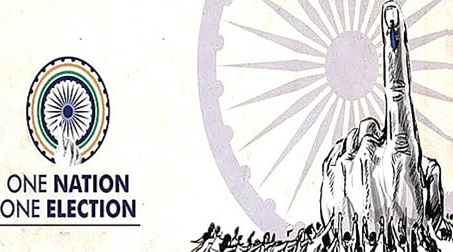
The 23rd Law Commission has presented its preliminary views to the Joint Parliamentary Committee examining two Bills—the Constitution (129th Amendment) Bill, 2024, and the Union Territories Laws (Amendment) Bill, 2024—both aimed at enabling One Nation One Election.
The Commission has concluded that the proposals do not violate the Constitution’s basic structure and that the Model Code of Conduct does not require statutory backing.
Background: 23rd Law Commission of India
- Law reform efforts in India began post-Independence, with the first Law Commission established in 1955.
- The 23rd Law Commission is constituted for a three-year term (1 September 2024 – 31 August 2027).
- Chairperson: Justice (Retd.) Dinesh Maheshwari.
- Composition includes:
- Full-time Chairperson
- Four full-time members
- Secretaries of Legal Affairs & Legislative Department (ex-officio)
- Up to five part-time members
- Mandate:
- Review and repeal obsolete laws
- Simplify legal language and procedures
- Align laws with contemporary economic conditions
- Advise the government on legal questions
- Assess the impact of globalisation on vulnerable communities
Law Commission’s Observations on One Nation One Election Bills
- The Commission held that synchronising elections does not damage the Constitution’s basic structure, as the principles of federalism and voter rights remain untouched.
- It emphasised that simultaneous polls only modify the timing and frequency, not the democratic right to vote.
- The Bills do not require state ratification, since they do not amend provisions under Article 368(2) clauses (a)–(e).
- The Commission endorsed simultaneous elections for their cost-saving and efficiency benefits.
Model Code of Conduct (MCC)
- The Commission advised against granting statutory status to the MCC.
- Codification would slow administrative decision-making during elections.
- The current flexible and consensus-driven framework enables quick action by the Election Commission.
Basic Structure Doctrine of the Indian Constitution
About the Doctrine
- Originates from the landmark Kesavananda Bharati v. State of Kerala (1973) judgment.
- Restricts Parliament from altering the core identity of the Constitution, even under Article 368.
- Elements evolve through judicial interpretation; not a closed list.
- The concept is inspired partly by the German Constitution (1949), created after WWII to prevent abuse of constitutional power.
Key Elements of the Basic Structure
- Supremacy of the Constitution
- Sovereign, democratic, republican form of government
- Secularism
- Federal character
- Rule of law
- Separation of powers
- Judicial review
- Independence of the judiciary
- Free and fair elections
- Parliamentary system
- Unity and integrity of the nation
- Primacy of Fundamental Rights
- Balance between Fundamental Rights and DPSPs
- Powers of Supreme Court (Arts. 32, 136, 141, 142) and High Courts (Arts. 226, 227)
Significance
- Preserves Constitutional Identity by safeguarding essential features.
- Checks majoritarian overreach during constitutional amendments.
- Protects Fundamental Rights from dilution.
- Strengthens judicial review and institutional accountability.
- Ensures free and fair elections, preventing manipulation of the democratic process.
- Keeps the Constitution a dynamic yet stable governing document.
One Nation, One Election: Concept and Rationale
About
- Refers to conducting Lok Sabha, State Assembly, and local body elections simultaneously.
- Recommended by a high-level committee headed by former President Ram Nath Kovind through two amendment Bills:
- Constitution (129th Amendment) Bill, 2024
- Union Territories Laws (Amendment) Bill, 2024
Historical Context
- India held synchronised elections from 1951 to 1967.
- Divergence occurred due to premature dissolutions, political instability, and defections during the 1960s.
Why Simultaneous Elections Are Proposed
- Ensures continuity of governance by reducing perpetual election cycles.
- Minimises the frequency of MCC enforcement, preventing policy paralysis.
- Reduces administrative and logistical burden on government machinery.
- Safeguards regional issues, ensuring they are not overshadowed by national politics.
- Lessens political disruption and encourages focused governance.
- Cuts fiscal expenditure by avoiding repeated election-related costs.
Here are the FAQs added in the same pattern and format as your reference file:
FAQs
1. Does One Nation One Election violate the basic structure of the Constitution?
No. The 23rd Law Commission has clarified that synchronising elections does not affect federalism, democratic rights, or other essential features of the Constitution.
2. Do the One Nation One Election Bills require ratification by states?
No. Since the Bills do not amend provisions listed under Article 368(2)(a)–(e), state ratification is not required.
3. Why does the Law Commission oppose giving statutory status to the Model Code of Conduct?
Because codifying the MCC would slow decision-making during elections. The current flexible, consensus-based model allows quicker action by the Election Commission.
4. What is the Basic Structure Doctrine?
It is a principle established in Kesavananda Bharati (1973) stating that Parliament cannot amend or destroy the fundamental features of the Constitution under Article 368.
5. What are the benefits of One Nation One Election?
It reduces election expenditure, improves administrative efficiency, prevents policy paralysis, and allows governments to focus more on development rather than continuous campaigning.
|






 Contact Us
  New Batch : 9555124124/ 7428085757
  Tech Support : 9555124124/ 7428085757