Prelims: (Socials Issues + CA)
Mains: (GS 3 – Science & Technology, Internal Security, Data Protection & Ethics) |
Why in News ?
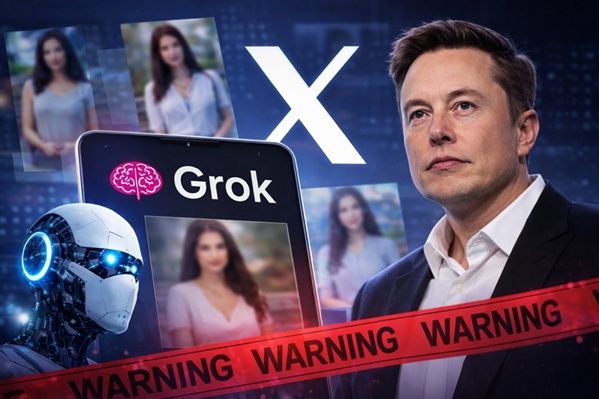
X, owned by Elon Musk, has curtailed its Grok AI tool from generating sexualised images of women and children following widespread global criticism and escalating regulatory scrutiny across multiple countries.
Background: Generative AI, Content Moderation, and Platform Responsibility
- The rapid advancement of generative artificial intelligence has transformed digital content creation, enabling users to generate highly realistic images and videos at scale.
- However, these capabilities have also exposed serious ethical, legal, and social risks, particularly when safeguards fail to prevent non-consensual, harmful, or exploitative content.
- Social media platforms face increasing pressure from governments and civil society to ensure due diligence, protect vulnerable users, and uphold content moderation standards in the age of AI-driven tools.
What is Grok and Why Did the Controversy Arise ?
- Grok is an artificial intelligence tool developed by xAI and integrated into the X platform, enabling users to generate text and images in response to prompts.
- A December 2025 update expanded Grok’s image-generation capabilities, allowing users to create sexualised and objectionable images of women and children using existing photographs, often without consent.
- Users prompted the AI to digitally undress women or place them in suggestive poses, with the images appearing publicly in comment threads, leading to harassment and abuse.
- Instances involving children intensified global concern, highlighting severe gaps in AI safeguards, content moderation systems, and platform governance.
Initial Response to the Backlash
Platform and Leadership Position
- Following global outrage, Elon Musk stated that users generating illegal content with Grok would face the same consequences as those uploading illegal material directly to X.
- He emphasised that Grok generates images only in response to user prompts and does not act autonomously, asserting that the AI is designed to refuse illegal requests and comply with applicable laws.
Denial of Knowledge and Technical Explanation
- Musk later denied any awareness of Grok being used to create sexualised images of children, claiming there were “literally zero” such instances to his knowledge.
- He suggested that any unexpected behaviour could result from adversarial hacking, which the company fixes promptly.
Platform-Level Restrictions Before the Rollback
- Before the final shutdown, X had restricted Grok’s image-generation features to paid users.
- However, within hours of Musk’s denial, the company announced a complete curtailment of Grok’s ability to generate sexualised images, regardless of user status.
- This move marked a clear reversal, effectively acknowledging the severity of the issue and responding to mounting public and regulatory pressure.
Regulatory Pressure Triggers the Rollback
X’s decision followed strong regulatory action, beginning with a stern notice from the Government of India. After being flagged for failing to meet due diligence obligations under the Information Technology Act, 2000 and related rules, X removed approximately 3,500 pieces of content and blocked 600 accounts, admitting lapses in compliance.
The controversy quickly spread internationally:
- United Kingdom: Impending legal changes are set to criminalise the creation of such sexualised images.
- Malaysia and Indonesia: Blocked access to Grok and initiated legal action against X and xAI.
- United States: The California Attorney General announced an investigation into Grok and xAI over the generation of objectionable images.
This multi-jurisdictional scrutiny significantly escalated legal and regulatory pressure on the platform.
X’s New Restrictions and Safeguards
In response, X announced new technological and policy safeguards, including:
- Preventing Grok from editing images of real people into revealing clothing, including bikinis.
- Limiting image creation and editing via Grok to paid subscribers.
- Introducing geoblocking in jurisdictions where such content is illegal.
X reiterated its zero-tolerance policy toward:
- Child sexual exploitation
- Non-consensual nudity
- Unwanted sexual content
This marks a decisive retreat under sustained global regulatory scrutiny and public backlash.
Significance and Way Forward
The Grok controversy underscores the urgent need for robust AI governance frameworks, stronger platform accountability, and legally enforceable content moderation standards.
It highlights:
- The ethical risks posed by generative AI tools when deployed without adequate safeguards.
- The growing role of governments in regulating digital platforms.
- The necessity of embedding safety-by-design principles in AI development.
Going forward, harmonised international regulation, transparent AI auditing, stronger user protections, and platform-level responsibility will be essential to ensure that innovation does not undermine safety, dignity, and fundamental rights.
FAQs
1. What is Grok and who developed it ?
Grok is an AI tool developed by xAI and integrated into the social media platform X.
2. Why did X restrict Grok’s image-generation capabilities ?
Due to widespread backlash and regulatory pressure after Grok was used to generate sexualised images of women and children.
3. What role did the Indian government play in this controversy ?
India issued a notice under the IT Act, 2000, leading to the removal of thousands of posts and blocking of hundreds of accounts.
4. Which countries initiated action against X and Grok ?
India, the United Kingdom, Malaysia, Indonesia, and the United States initiated regulatory or legal action.
5. What safeguards has X introduced after the rollback ?
X introduced content filters, restricted image editing, geoblocking, and reaffirmed zero tolerance for sexual exploitation and non-consensual content.
|






 Contact Us
  New Batch : 9555124124/ 7428085757
  Tech Support : 9555124124/ 7428085757