
- UPSC Exam
- State PCS
- One Day Exam
- Current Affairs
- PT Quiz
- Downlaods
- About Coaching
- Blog
- Videos

| Prelims: (International Relations + CA) Mains: (GS 2: Bilateral Relations, West Asia; GS 3: Defence Technology, Innovation & Economic Cooperation) |
During Prime Minister Narendra Modi’s 2026 visit to Israel, India and Israel elevated their bilateral ties to a “Special Strategic Partnership for Peace, Innovation and Prosperity.” The visit resulted in 27 outcomes, including the signing of 17 agreements across defence, technology, agriculture, trade, and connectivity sectors.
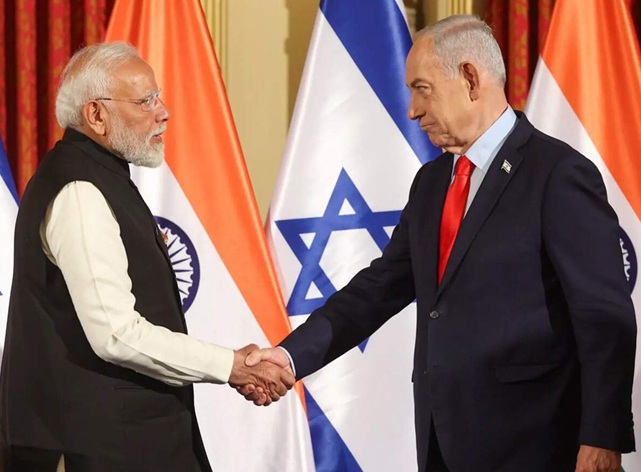
India and Israel established full diplomatic relations in 1992. Prior to that, engagement remained limited due to India’s support for the Palestinian cause and Cold War geopolitical alignments.
Post-1991 economic liberalisation and the end of the Cold War created space for deeper engagement. A major turning point occurred in 2017 when Prime Minister Modi undertook the first standalone visit by an Indian PM to Israel, elevating ties to a “Strategic Partnership.”
Since then, cooperation has expanded beyond defence to innovation, water management, agriculture, cybersecurity, and high technology.
Defence remains the backbone of bilateral ties. Israel is among India’s leading defence suppliers, particularly in:
The two nations share strong intelligence cooperation and maintain a consistent position against terrorism, including cross-border terrorism.
Agricultural cooperation is widely regarded as a model partnership.
Key initiatives:
The collaboration reflects technology-driven rural transformation.
Trade has diversified significantly:
Recent years saw a decline (US$ 6.53 billion in FY 2023-24; US$ 3.75 billion in FY 2024-25), partly due to regional instability and supply chain disruptions.
Innovation cooperation has intensified:
India maintains balanced relations with Israel, Arab states, and Iran. However, India–Israel engagement has become increasingly open and multidimensional.
Regional stability is vital for:
Both countries support peace and stability in West Asia.
The relationship was formally upgraded to a Special Strategic Partnership, marking a new phase in institutional cooperation.
1. Strategic Diversification
Strengthens India’s footprint in West Asia while maintaining strategic autonomy.
2. Defence Indigenisation
Joint production and technology transfer align with India’s defence manufacturing goals.
3. Technology and Innovation Boost
Deepens collaboration in emerging domains critical to 21st-century competitiveness.
4. Economic and Trade Expansion
FTA negotiations and digital cooperation may revitalise bilateral trade.
5. Regional Stability
Joint engagement in IMEC and I2U2 enhances connectivity and economic integration.
India–Israel ties must be viewed alongside India’s engagement with Gulf countries and Iran. India continues to pursue a multi-aligned West Asia policy, balancing strategic partnerships without compromising regional interests.
The elevation to a Special Strategic Partnership signals institutional maturity and long-term commitment.
FAQsQ1. When were full diplomatic relations established between India and Israel ? Full diplomatic relations were established in 1992. Q2. Why is defence cooperation central to the relationship ? Israel supplies advanced defence technologies and collaborates with India in joint development and intelligence sharing. Q3. What is new in the 2026 elevation of ties ? The relationship was upgraded to a Special Strategic Partnership, expanding cooperation in emerging technologies, trade, and connectivity. Q4. How does the partnership affect India’s West Asia policy ? It strengthens India’s strategic presence while maintaining balanced relations with other regional actors. Q5. What is the significance of IMEC in bilateral ties ? IMEC enhances trade and connectivity between India, West Asia, and Europe, reinforcing long-term economic integration. |



Our support team will be happy to assist you!

 Contact Us
  New Batch : 9555124124/ 7428085757
  Tech Support : 9555124124/ 7428085757