Prelims: (Geography + CA)
Mains: (GS 1 – Physical Geography; GS 3 – Environment, Disaster Management) |
Why in News ?
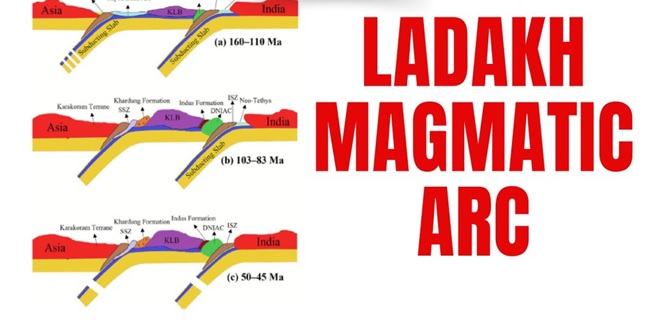
Recent scientific studies have traced the evolution and formation history of the Ladakh Magmatic Arc (LMA) in the north-western Himalaya, providing deeper insights into plate tectonics and mountain-building processes.
Background and Context
The Himalayan region is one of the most geologically active zones in the world, shaped by the collision between the Indian Plate and the Eurasian Plate.
Before this collision, a vast ocean called the Neo-Tethys Ocean existed between the two plates.
The Ladakh Magmatic Arc formed as a result of complex geological processes associated with this ocean’s closure.
About Ladakh Magmatic Arc (LMA)
- It is a belt of igneous rocks located in the Trans-Himalayan region
- Formed during the Jurassic to Eocene periods (~200 to 34 million years ago)
- Represents a long-extinct volcanic arc system
Process of Formation
The LMA was formed due to the process of Subduction.
Mechanism:
- The Indian Plate moved northward
- Oceanic crust of the Neo-Tethys Ocean subducted beneath the Eurasian Plate
- This led to:
- Melting of mantle material
- Formation of magma
- Rise of volcanic activity forming the arc
Phases of Evolution of LMA
1. Island Arc Formation Phase
- Early stage: Ladakh resembled volcanic island chains
- Represented by:
- Dras–Nidar Island Arc Complex
Characteristics:
- Magma originated mainly from the mantle
- Minimal contribution from sediments
- Typical of oceanic island arc systems
2. Crustal Enrichment and Batholith Formation
- As tectonic plates converged:
Developments:
- Formation of large granite bodies:
- Increased involvement of:
- Continental crust
- Recycled sediments
Significance:
- Indicates deep crustal processes and magma mixing
- Occurred during the approach of India–Eurasia collision
3. Post-Collision Magmatism
- After closure of the Neo-Tethys Ocean:
Features:
- Formation of mafic dykes (vertical volcanic rock sheets)
- Magma derived from enriched mantle sources
Interpretation:
- Suggests continued tectonic and magmatic activity even after collision
Significance of the Study
1. Understanding Himalayan Formation
- Provides insights into:
- Plate collision dynamics
- Mountain-building processes
2. Plate Tectonics Evidence
- Demonstrates real-world application of:
- Helps reconstruct Earth’s geological past
3. Resource Exploration
- Igneous and magmatic systems often host:
- Mineral deposits
- Metal resources
4. Seismic and Hazard Assessment
- Better understanding of tectonic history aids:
- Earthquake risk analysis
- Disaster preparedness
5. Academic and Scientific Importance
- Enhances knowledge in:
- Geology
- Geophysics
- Earth system science
Way Forward
- Promote advanced geological mapping and research
- Integrate findings into:
- Disaster management strategies
- Resource planning
- Encourage interdisciplinary studies in:
- Tectonics
- Climate–geology interactions
FAQs
1. What is the Ladakh Magmatic Arc ?
It is a belt of igneous rocks formed due to ancient volcanic activity in the Trans-Himalayan region.
2. How was the LMA formed ?
Through subduction of the Neo-Tethys Ocean crust beneath the Eurasian Plate.
3. What are the main phases of its evolution ?
- Island arc formation
- Batholith formation
- Post-collision magmatism
4. What is the Ladakh Batholith ?
It is a large granite formation created during crustal enrichment in the region.
5. Why is the study of LMA important ?
It helps understand plate tectonics, Himalayan formation, and geological history.
|







 Contact Us
  New Batch : 9555124124/ 7428085757
  Tech Support : 9555124124/ 7428085757