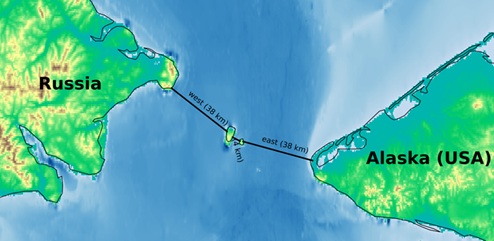
Amid the growing threat of climate change, scientists are now exploring large-scale geoengineering solutions. In this context, new research from Utrecht University offers an intriguing possibility: could damming the Bering Strait stabilize the Atlantic Meridional Overturning Circulation (AMOC) ?
What is the Atlantic Meridional Overturning Circulation (AMOC) and why is it important ?
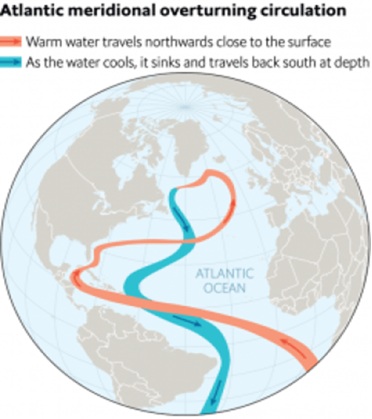
- The Atlantic Meridional Overturning Circulation (AMOC) is a vast system of ocean currents that circulates water in the Atlantic Ocean. Warm water flows northward and cold water southward.
Working Process
- The AMOC process works like a "conveyor belt" :
- Warm surface water (such as the Gulf Stream) moves toward the poles.
- It cools there and begins to form ice.
- Salt remains in the water as ice forms – making it saltier and denser.
- This heavier water sinks and flows southward through the depths.
- Eventually, this water rises to the surface, warms, and completes the cycle.
Importance of the AMOC
- Maintains the global heat balance (Heat Budget).
- Makes Western Europe's winters less harsh.
- Acts as a carbon sink by absorbing atmospheric CO₂.
Weakening of the AMOC
- It can take about 1,000 years for a water molecule to complete a full cycle.
- Climate models suggest that increased greenhouse gases may weaken the AMOC in the 21st century.
Causes:
- Warming of the ocean surface
- Water becomes less salty (fresh) due to melting ice and increased rainfall
- Water becomes lighter → sinking process decreases
- This slows down the “conveyor belt.”
Consequences of a Weak AMOC
- Effects on the Ocean :
- Decreased Marine Productivity in the North Atlantic
- Effects on Climate :
- More Storms in Northern Europe
- Less Rainfall in the Sahel Region
- Weakening of the Monsoon in South Asia
- Other Effects :
- Reduced Number of Tropical Cyclones in the Atlantic
- Sea Level Rise off the Coast of Northeastern North America
What does the research say ?
- PhD researcher Jelle Sunes used climate models to study how the AMOC would be affected if the Bering Strait were closed.
Key findings:
- Under some conditions, the AMOC remains more stable.
- Under other conditions, it may weaken.
- Results depend heavily on initial conditions and timing.
- The research is currently only a "proof of concept," not a practical solution.
Historical Background: Soviet Plan
- In the 1960s, Soviet engineer Petr Mikhailovich Borisov proposed an ambitious plan to melt Arctic sea ice.
- He believed this would allow large parts of the Soviet Union to be used for agriculture and settlement.
- Additionally, it could reclaim the Sahara Desert and moderate the global climate.
Proposed Plan
- Suggested building a dam across the Bering Strait
- Its purpose was to regulate the exchange between cold Arctic water and warm Pacific water.
- The potential result would be warm water flowing into the Arctic and melting most of the sea ice.
Is this really possible ?
- Technical challenges :
- The strait is approximately 80 km wide
- The area is extremely remote and underdeveloped
- Construction costs and logistics are extremely complex
Environmental impacts:
- Marine life migration routes will be affected
- Major changes to the ecosystem could occur.
The geoengineering debate
- This project is an example of geoengineering, which attempts to artificially control the climate.
- But questions arise: Who will make such a decision?
- Who will bear the risks?
- Will it undermine efforts to reduce emissions?
Conclusion:
This study shows that large-scale technological interventions may be potential solutions, but they are fraught with risks and uncertainties; therefore, geoengineering should be viewed as a last resort rather than the primary solution to climate change.






 Contact Us
  New Batch : 9555124124/ 7428085757
  Tech Support : 9555124124/ 7428085757