Why in News
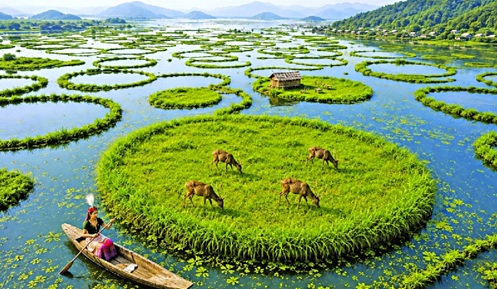
Loktak Lake was recently in the news because of its unique floating islands known as phumdis, which are considered one of the most remarkable ecological features in the world. Scientists and environmentalists have highlighted the need to conserve the lake due to increasing ecological pressures and changes in water flow patterns.
Geographical Features
- Loktak Lake is located in the Bishnupur district of Manipur and is the largest freshwater lake in Northeast India. It covers a large area that changes seasonally depending on rainfall and water levels.
- Several rivers, including the Imphal, Iril, Thoubal and Nambul rivers, drain into the lake and help maintain its hydrological system. The lake serves as an important source of water for irrigation, fisheries, and hydropower generation in the region.
Unique Ecological Features
- The most distinctive feature of Loktak Lake is the presence of phumdis, which are heterogeneous masses of vegetation, soil, and decomposed organic matter floating on the lake’s surface. These floating formations vary in thickness and support a unique ecosystem.
- The lake is also home to Keibul Lamjao National Park, the world’s only floating national park. This park provides habitat to the endangered Sangai deer, also known as the brow-antlered deer, which is the state animal of Manipur.
Ecological and Economic Importance
- Loktak Lake plays a vital role in maintaining biodiversity and supporting the livelihood of local communities. Thousands of people depend on the lake for fishing, agriculture, and transportation.
- The lake also helps regulate the regional climate and supports numerous species of birds, fish, and aquatic plants. However, pollution, excessive human activity, and the construction of the Ithai Barrage have adversely affected its ecological balance.
International Recognition
- Due to its rich biodiversity and ecological significance, Loktak Lake was designated as a Ramsar Convention on Wetlands Ramsar Site in 1990. Later, in 1993, it was included in the Montreux Record because of ecological degradation and environmental threats.
- Continuous conservation measures are being undertaken by the government and environmental organizations to restore and protect this important wetland ecosystem.






 Contact Us
  New Batch : 9555124124/ 7428085757
  Tech Support : 9555124124/ 7428085757