Prelims: (Defence Exercises + CA)
Mains: (GS 2 – International Relations; GS 3 – Security, Defence Cooperation) |
Why in News ?
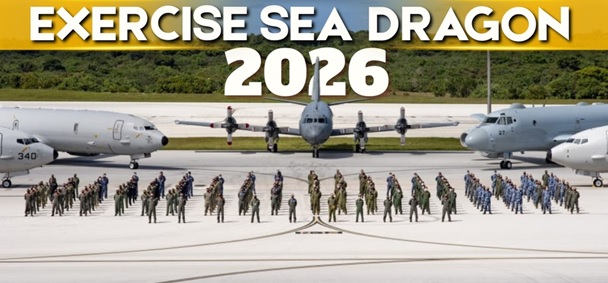
The Indian Navy is participating in Exercise Sea Dragon 2026, a United States Navy-led multinational anti-submarine warfare (ASW) exercise aimed at strengthening maritime security and interoperability among Indo-Pacific partner nations.
Background and Context
The Indo-Pacific region has emerged as a critical geopolitical and maritime zone, witnessing increasing naval activities, strategic competition, and concerns over sea-lane security.
With the rise in submarine deployments and underwater threats, nations are focusing on enhancing anti-submarine warfare (ASW) capabilities.
In this context, the United States has been conducting multilateral naval exercises to build coordination among like-minded countries, particularly in response to evolving maritime challenges.
Exercise Sea Dragon is one such initiative that reflects deepening defence cooperation among Indo-Pacific democracies.
About Exercise Sea Dragon
- It is a United States Navy-led multinational anti-submarine warfare (ASW) exercise
- Conducted annually since 2019
- Held at Andersen Air Force Base, Guam (Western Pacific)
- Focuses on:
- Maritime surveillance
- Submarine detection and tracking
- Coordinated ASW operations
Key Features
- Participation of long-range maritime patrol aircraft, such as the P-8 Poseidon
- Emphasis on:
- Interoperability among allied forces
- Standardisation of communication protocols and data-sharing systems
- Real-time tactical coordination
- Provides a structured operational environment simulating real-world naval scenarios
Sea Dragon 2026: Key Highlights
- Participating nations include:
- United States Navy
- Indian Navy
- Royal Australian Air Force
- Japan Maritime Self-Defence Force
- Royal New Zealand Air Force
- Focus areas:
- Speed and accuracy in ASW missions
- Coordinated execution of complex operations
- Progressive training from simulated targets to live submarine tracking
- Evaluation Mechanism:
- Each event is graded
- The top-performing nation is awarded the prestigious “Dragon Belt”
Operational Mechanism of ASW (Anti-Submarine Warfare)
ASW involves detection, tracking, and neutralisation of enemy submarines.
Mechanism
- Deployment of maritime patrol aircraft (e.g., P-8 Poseidon)
- Use of:
- Sonobuoys (underwater detection devices)
- Radar and acoustic sensors
- Data sharing between allied platforms
- Coordinated targeting and tracking of submarines
Significance of the Exercise
1. Strengthening Indo-Pacific Security
- Enhances collective capacity to address maritime threats
- Ensures security of vital sea lanes of communication (SLOCs)
2. Boosting India’s Maritime Capabilities
- Improves Indian Navy’s ASW proficiency
- Provides exposure to advanced technologies and tactics
3. Enhancing Interoperability
- Standardises communication protocols among partner navies
- Enables seamless joint operations in crisis scenarios
4. Strategic Signalling
- Demonstrates unity among Indo-Pacific democracies
- Acts as a deterrent against aggressive maritime behaviour
5. Technological and Tactical Advancement
- Promotes sharing of best practices
- Strengthens real-time data integration and surveillance capabilities
Way Forward
- Expand participation to include more Indo-Pacific nations
- Integrate advanced technologies like AI-driven surveillance and underwater drones
- Strengthen synergy with other multilateral frameworks like QUAD
- Enhance frequency and scale of joint exercises
- Focus on capacity building and joint training for emerging maritime threats
FAQs
1. What is Exercise Sea Dragon ?
It is a US Navy-led multinational anti-submarine warfare exercise conducted annually to enhance maritime security cooperation.
2. Where is Sea Dragon conducted ?
It is held at Andersen Air Force Base in Guam, located in the Western Pacific.
3. Which countries participate in Sea Dragon 2026 ?
The USA, India, Australia, Japan, and New Zealand are participating.
4. What is the main objective of the exercise ?
To improve anti-submarine warfare capabilities and interoperability among participating nations.
5. What is the Dragon Belt award ?
It is awarded to the nation that achieves the highest score based on performance during the exercise.
|






 Contact Us
  New Batch : 9555124124/ 7428085757
  Tech Support : 9555124124/ 7428085757