Prelims: (International Relations + CA)
Mains: (GS 2 – International Relations, Global Security Architecture) |
Why in News ?
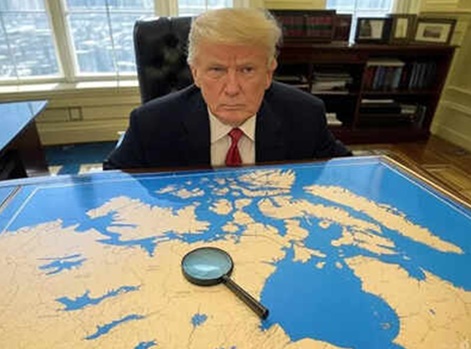
Reports suggesting the possibility of a U.S. military takeover or acquisition of Greenland have triggered global concern, as such a move could undermine international law, fracture NATO unity, alarm allies, and hand strategic advantage to rival powers in the Arctic.
Background: The Arctic’s Growing Strategic Significance
The Arctic is rapidly emerging as a key theatre of geopolitical competition due to:
- Melting ice opening new shipping routes
- Vast untapped reserves of hydrocarbons and rare earth minerals
- Increasing military activity by major powers, particularly Russia and China
Greenland, administered by Denmark but strategically located between North America and Europe, has thus become central to Arctic security calculations.
NATO at Risk: The Greenland Contradiction
- Any American military move into Greenland would strike at the very foundation of the North Atlantic Treaty Organization (NATO).
- NATO’s credibility rests on Article 5, which is designed to respond to external aggression, not a scenario where one member violates another’s territorial sovereignty.
- A U.S. action against Denmark, which administers Greenland, would create an unprecedented constitutional and moral crisis for the alliance, one it was never designed to resolve.
Denmark’s Sacrifice and the Irony of Article 5
- The contradiction is particularly stark because Denmark was among the first to invoke Article 5 following the 9/11 attacks, standing firmly with the United States.
- Danish troops fought alongside U.S. forces in Afghanistan and suffered significant casualties.
- A U.S. incursion into Greenland would thus nullify decades of alliance solidarity and hollow out NATO’s moral foundation.
A Strategic Gift to Russia and China
- Such a move would directly benefit Russia, which has long sought to fracture NATO unity and divert Western focus from Ukraine.
- Ironically, an action justified as countering Russian influence in the Arctic would weaken the very alliance created to contain Moscow.
- China, too, would gain diplomatically by highlighting Western hypocrisy on sovereignty and territorial integrity.
The Strategic Argument Falls Apart
- From a military and strategic standpoint, the case for a takeover is weak.
- The U.S. already enjoys extensive access rights in Greenland under a 1951 defence treaty and once operated 17 military bases there, most of which were voluntarily shut down by Washington.
- These facilities could be reactivated or expanded through diplomatic agreements without violating Danish sovereignty.
The Real Arctic Pressure Point
While some U.S. leaders cite rising Russian and Chinese activity in the Arctic, American defence assessments show that the primary pressure point lies near Alaska, not Greenland.
Pentagon briefings and the 2024 Arctic Strategy highlight:
- Infrastructure degradation in Alaska
- Intensifying China–Russia cooperation in Arctic waters adjacent to U.S. territory
A Greenland misadventure would therefore weaken NATO, empower adversaries, distract from Ukraine, and undermine U.S. credibility — while addressing the wrong Arctic problem in the wrong location.
The Backers Behind the Greenland Push
- The idea of acquiring Greenland has moved beyond speculation.
- The White House has not ruled out military options, and U.S. officials have reportedly discussed potential purchase scenarios with European counterparts.
- However, Denmark has categorically rejected any sale, and the issue is now so politically sensitive in Copenhagen and Nuuk that even discussing a commercial transaction could destabilise the Danish government.
Trump’s Domestic Constituencies
Support for the Greenland idea appears to come from figures close to former U.S. President Donald Trump:
- Tech investor Peter Thiel has floated the idea of libertarian, post-nation settlements in places like Greenland.
- Elon Musk has expressed interest in Greenland’s rare earth mineral resources.
- Billionaire Ronald Lauder reportedly first raised the Greenland idea with Trump.
- Trump himself is said to view the move through a real-estate and strategic asset lens, consistent with his business instincts.
Canada’s Security Anxiety
- The country most alarmed by a potential U.S. annexation of Greenland is Canada.
- American control of Greenland would effectively hem Canada in from the east, intensifying its strategic vulnerability.
- This has sparked renewed debate within Canada about revisiting its non-nuclear stance, with security experts urging a re-examination of national defence policies.
Nuclear Domino Effect and Global Implications
The implications could extend far beyond North America. If NATO were to fracture over Greenland:
- European countries such as Germany and Poland might reconsider nuclear deterrence options.
- Asian allies like South Korea and Japan could also reassess their security postures.
A Greenland takeover could thus trigger a wider nuclear arms race, reshaping global security architecture in unpredictable and destabilising ways.
FAQs
1. Why is Greenland strategically important ?
Greenland’s location between North America and Europe, along with its natural resources and Arctic access, makes it geopolitically critical.
2. Why would a U.S. move into Greenland weaken NATO ?
Because it would violate the sovereignty of Denmark, a NATO member, contradicting the alliance’s core principle of collective defence against external aggression.
3. Does the U.S. already have military access to Greenland ?
Yes. Under a 1951 treaty, the U.S. has extensive defence rights and previously operated multiple bases there.
4. Which country is most concerned about a U.S. takeover of Greenland ?
Canada is particularly alarmed, as such a move would significantly alter its security environment.
5. What could be the global impact of a Greenland takeover ?
It could fracture NATO, embolden adversaries, and trigger a broader nuclear arms race across Europe and Asia.
|






 Contact Us
  New Batch : 9555124124/ 7428085757
  Tech Support : 9555124124/ 7428085757