
- UPSC Exam
- State PCS
- One Day Exam
- Current Affairs
- PT Quiz
- Downlaods
- About Coaching
- Blog
- Videos

Recent medical studies are exploring new treatment options for Cushing Syndrome, including :
These developments are expected to make the treatment of this disease more effective in the future.
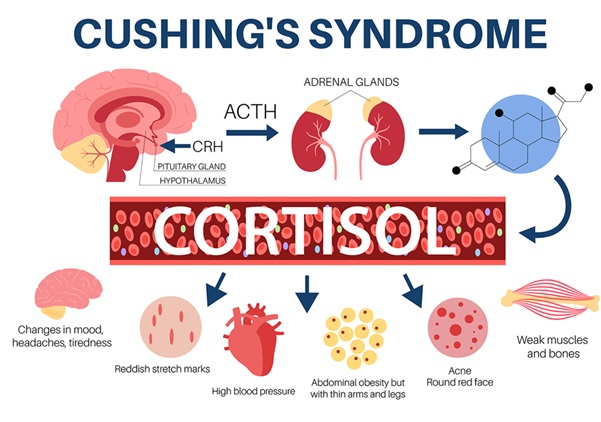
Cushing Syndrome is a hormonal disorder that occurs when the body is exposed to high levels of the hormone cortisol for a long period of time.
Cortisol is often called the “stress hormone” because it helps the body respond to stress.
Cortisol is produced by the adrenal glands, which are small glands located above the kidneys. This hormone regulates several important functions in the body, such as:
When the body produces too much cortisol, it can lead to several physical and psychological health problems, a condition known as Cushing Syndrome.
There are two main causes of Cushing Syndrome:
The most common cause is the long-term use of corticosteroid (steroid) medications. These drugs are commonly prescribed for conditions such as:
If these medicines are taken in high doses or for a long time, they can increase cortisol levels in the body.
In some cases, the body itself produces too much cortisol. The main causes include:
Most of these tumors are benign (non-cancerous).
The symptoms of Cushing Syndrome usually develop gradually and may resemble other diseases.
In naturally occurring cases of Cushing Syndrome:
However, when caused by steroid medications, it can occur at any age.
Doctors use several tests to confirm Cushing Syndrome, including:
Treatment for Cushing Syndrome depends on the underlying cause, and the main goal is to reduce cortisol levels to normal.
1. Adjustment of medications
If steroid medications are the cause, doctors gradually reduce the dosage under medical supervision.
2. Surgery
If a tumor is producing excess cortisol, surgery is usually the first treatment option to remove the tumor.
3. Radiation therapy
If surgery is not possible or the tumor cannot be completely removed, radiation therapy may be used.
4. Medications
Certain drugs are prescribed to reduce cortisol production in the body.



Our support team will be happy to assist you!

 Contact Us
  New Batch : 9555124124/ 7428085757
  Tech Support : 9555124124/ 7428085757