Why in the News ?
Recently, it was observed that GPS spoofing is creating a digital fog of war for aircraft flying near the United Arab Emirates and Iran.
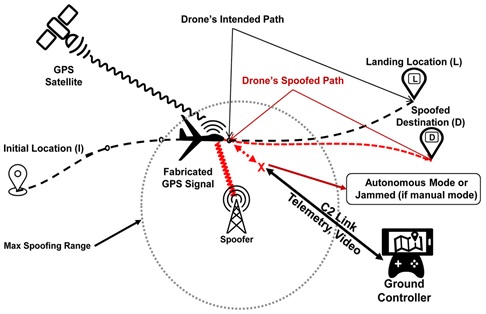
What is GPS Spoofing ?
- GPS spoofing, also known as GPS simulation, is a technique that deceives a real GPS receiver by sending fake GPS signals.
- This process involves manipulating navigation data with malicious intent.
- Different from blocking : Normal GPS jamming blocks the signal, while in spoofing, the fake signal overrides the real signal.
- How it works : The aircraft's navigation system misinterprets the fake signal as real and displays incorrect data on position, altitude, speed, and time.
- Purpose : To cause the target to make decisions based on inaccurate navigation information.
Where is this threat most prevalent ?
- GPS spoofing incidents are often reported in regions where political or military tensions are high:
- Black Sea region
- West Asia
- Middle East
Why are aircraft affected ?
- GPS satellite signals are very weak.
- If a fake signal is sent, the onboard receiver interprets it as real.
- Using special hardware and software, the fake signal overrides the real signal.
- As a result, the pilot and navigation system see a completely wrong position.
Impacts and Threats
- Interference with the proper operation of aircraft and drones
- Increased risk of collisions and accidents in the airspace
- Serious threat to military and civilian security
Preventative Measures and Solutions
- Anti-spoofing technology: Advanced receivers and encrypted signals
- Safety training: Training pilots and operators to recognize signs of spoofing
- Regular system audits: Regular checks of aircraft and navigation systems
- Cybersecurity measures: Digital filters to detect fake signals
Conclusion
As air and maritime traffic grows, the threat of GPS spoofing is also increasing. This is not just a technical problem, but a serious challenge to national and international security. This threat can only be minimized by adopting anti-spoofing technology and secure navigation protocols.





 Contact Us
  New Batch : 9555124124/ 7428085757
  Tech Support : 9555124124/ 7428085757