
- UPSC Exam
- State PCS
- One Day Exam
- Current Affairs
- PT Quiz
- Downlaods
- About Coaching
- Blog
- Videos

| Prelims : Geography + CA Mains : GS Paper 1 – Physical Geography; GS Paper 3 – Climate Change |
Recent scientific studies and climate assessments have raised serious concerns regarding the weakening of the Atlantic Meridional Overturning Circulation (AMOC), a crucial component of the Earth’s climate system.
Emerging evidence suggests that :
These developments have intensified global attention on the possibility of abrupt climate change.
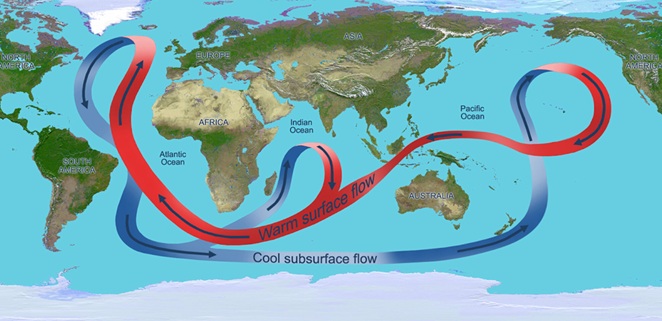
The Atlantic Meridional Overturning Circulation (AMOC) is a large-scale system of ocean currents in the Atlantic Ocean that operates like a global conveyor belt, continuously circulating water across different depths and latitudes.
It plays a central role in regulating global climate by :
The functioning of AMOC is governed by thermohaline circulation, which depends on variations in temperature and salinity.
Warm, saline water flows from the tropics toward the North Atlantic through surface currents such as the Gulf Stream. This process carries a large amount of heat energy, helping to moderate climates, especially in Western Europe.
As the warm water reaches higher latitudes, it loses heat to the atmosphere and becomes colder. At the same time, evaporation increases salinity, making the water denser.
The cold and saline water becomes sufficiently dense to sink in regions such as the Labrador Sea and the Greenland Sea, forming deep water masses known as North Atlantic Deep Water.
These deep waters then flow southward across the Atlantic Ocean at great depths, forming a return current that completes the circulation loop.
Over time, deep waters rise back to the surface in other ocean regions through upwelling, get warmed again, and re-enter the circulation cycle, maintaining continuity.
AMOC redistributes heat globally, ensuring that regions like Europe remain relatively warmer than other areas at similar latitudes, thereby stabilising global climate patterns.
It plays a vital role in the global carbon cycle by transporting carbon dioxide from the atmosphere into the deep ocean, acting as a long-term carbon sink.
The circulation helps in the movement of nutrients across ocean layers, supporting marine ecosystems and sustaining fisheries.
AMOC significantly affects rainfall patterns, monsoons, and storm systems across continents, including impacts on Africa, Europe, and Asia.
Rising global temperatures are warming ocean waters, reducing the temperature differences that drive circulation and weakening the overall system.
The influx of freshwater from melting ice reduces salinity in the North Atlantic, which decreases water density and inhibits the sinking process essential for AMOC.
Higher precipitation and Arctic ice melt further dilute ocean salinity, disrupting the thermohaline balance required for circulation.
Scientific evidence suggests that AMOC may already be weaker than at any time in the last thousand years, indicating a long-term declining trend.
A slowdown in heat transport could lead to colder climatic conditions in Europe despite overall global warming.
Changes in ocean circulation may alter rainfall patterns, particularly affecting monsoons in South Asia and Africa, with consequences for agriculture.
A weakened AMOC can cause sea levels to rise along certain coastlines, especially the eastern coast of North America.
The weakening circulation can contribute to :
Reduced nutrient circulation may adversely affect marine biodiversity, fisheries, and ocean productivity.
A complete collapse of AMOC could trigger abrupt and potentially irreversible climate changes across multiple regions.
Prelims
Q. The Atlantic Meridional Overturning Circulation (AMOC) primarily depends on :
(a) Wind patterns
(b) Temperature and salinity differences
(c) Earth’s rotation
(d) Tidal forces
Mains
“Discuss the mechanism of the Atlantic Meridional Overturning Circulation (AMOC) and examine the potential impacts of its weakening on global climate.”
FAQsQ1. What is AMOC ? It is a large-scale ocean circulation system in the Atlantic Ocean. Q2. What drives AMOC ? Differences in temperature and salinity. Q3. Why is it important ? It regulates climate and supports marine ecosystems. Q4. Why is it weakening ? Due to global warming and freshwater influx. Q5. What happens if it collapses ? It may lead to severe and abrupt climate changes globally. |



Our support team will be happy to assist you!


 Contact Us
  New Batch : 9555124124/ 7428085757
  Tech Support : 9555124124/ 7428085757