Meaning of Biodiversity Hotspots
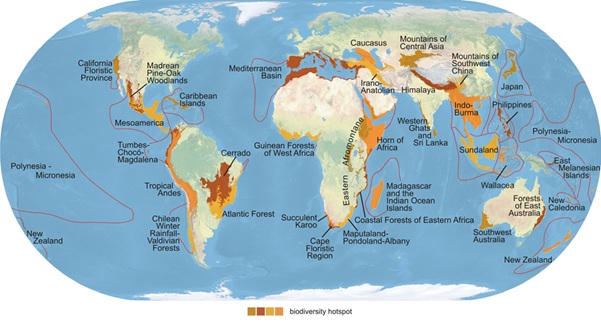
Biodiversity hotspots are biogeographic regions that are characterized by:
- Extraordinary richness of flora and fauna, especially a high number of endemic species, and
- Severe loss of natural habitat due to intense human activities.
Because of this combination of high biodiversity and high threat, these regions are considered ecologically fragile and top priorities for conservation.
Criteria for Declaring a Biodiversity Hotspot
A region must fulfill both of the following conditions:
- High Endemism
- The area must contain at least 1,500 endemic species of vascular plants.
- Severe Habitat Loss
- At least 70% of the original natural vegetation must have already been lost or degraded, indicating a critical level of threat.
Global Status
According to Conservation International, there are currently 36 recognized biodiversity hotspots worldwide. Although these hotspots together occupy only a small fraction of the Earth’s land surface, they:
- Harbor a disproportionately large share of the world’s plant and animal species, and
- Contain species that are found nowhere else on the planet.
Hence, their conservation is vital for global biodiversity survival.
Importance of Declaring Biodiversity Hotspots
- Global Conservation Priority
- Hotspot status places the region at the top of the international conservation agenda.
- Access to Resources
- Recognition helps attract greater financial support and technical assistance from:
- Governments
- Non-governmental organizations
- International institutions
- Scientific and Educational Value
- These regions act as natural laboratories for studying:
- Evolutionary processes
- Ecological balance
- The role of endemic species in ecosystems
Biodiversity Hotspots in India
India forms part of four of the world’s 36 biodiversity hotspots, highlighting its global ecological significance:
- Western Ghats – Sri Lanka
- Himalaya
- Indo-Burma
- Sundaland (includes Andaman & Nicobar Islands)
Challenges to the Western Ghats Biodiversity Hotspot
Major threats affecting biodiversity in the Western Ghats include:
- Deforestation
- Mining activities
- Large dams and infrastructure projects
- Unplanned and rapid urbanization
These pressures have led to habitat degradation and fragmentation, endangering endemic species.
Major Conservation Measures in the Western Ghats
Gadgil Committee (2011)
- Recommended declaring a large part of the Western Ghats as an Ecologically Sensitive Area (ESA).
- Proposed strict restrictions on mining, large construction projects, and deforestation.
Kasturirangan Committee (2013)
- Suggested reducing the ESA coverage to about 37% of the Western Ghats.
- Advocated protection of ecologically critical zones while allowing regulated development in other areas.
Joint Forest Management (JFM)
- Involves local communities as partners in forest conservation.
- Provides them with sustainable livelihood benefits from forest resources.
Biosphere Reserve Status
- Parts of the Western Ghats are designated as Biosphere Reserves.
- The objective is to balance ecological conservation with sustainable development.
Eco-Bridge (Eco-duct)
.jpg)
What are Eco-Bridges?
Eco-bridges (also known as eco-ducts) are specially designed structures created to reconnect wildlife movement routes (wildlife corridors) that have been disrupted by human-made barriers such as:
- Roads and highways
- Railway lines
- Mining activities
- Deforestation
These structures—either overpasses or underpasses—allow animals to cross obstacles safely and without direct human contact.
Structural Features
- Eco-bridges are usually covered with native vegetation so that they blend naturally with the surrounding landscape.
- This natural design encourages animals to use them as familiar, fear-free pathways, preventing stress or behavioral disruption.
Importance of Eco-Bridges
1. Wildlife Connectivity
Eco-bridges:
- Reconnect fragmented habitats
- Maintain continuity of natural wildlife corridors
- Enable species to move freely for feeding, breeding, and migration
As a result, they significantly reduce the negative impacts of habitat fragmentation.
2. Reduction in Road Accidents
- Wildlife mortality on highways and railways is a major threat to biodiversity.
- By providing safe alternative routes, eco-bridges substantially reduce human–wildlife conflicts and road/rail accidents.
3. Promotion of Sustainable Development
Eco-bridges help establish a practical balance between:
- Infrastructure and economic development, and
- Biodiversity conservation
This ensures that development continues while minimizing environmental damage.
Conclusion
Biodiversity hotspots represent the frontlines of conservation. Protecting them is not only essential for preserving unique species but also for maintaining ecosystem stability, climate resilience, and human well-being at both national and global levels.






 Contact Us
  New Batch : 9555124124/ 7428085757
  Tech Support : 9555124124/ 7428085757