
- UPSC Exam
- State PCS
- One Day Exam
- Current Affairs
- PT Quiz
- Downlaods
- About Coaching
- Blog
- Videos

| Prelims: Agriculture + Governance + CA Mains : GS Paper 3 – Agriculture, Food Security, Technology in Governance; GS Paper 2 – Governance, Welfare Issues |
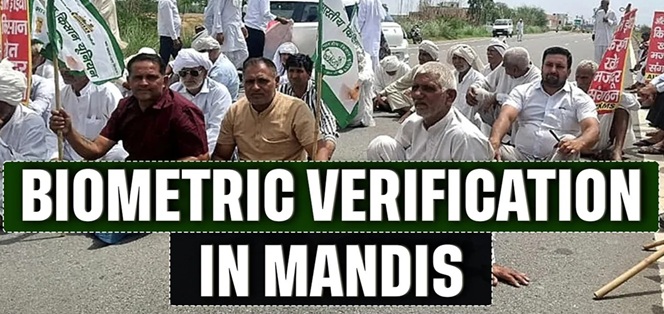
Farmers across Haryana have launched widespread protests against the introduction of a mandatory biometric verification system in mandis during the Rabi procurement season.
The protests have taken the form of prolonged sit-ins at procurement centres, road blockades, and coordinated mobilisation by farmer unions, indicating not just opposition to a specific policy but a broader dissatisfaction with how technological reforms are being implemented in agriculture.
Mandis in India are regulated agricultural markets established under state APMC laws, where farmers bring their produce for sale, particularly under the Minimum Support Price (MSP) system.
In these mandis, the procurement process typically involves multiple stakeholders, including government agencies, commission agents (arhatiyas), and traders, which historically has led to inefficiencies such as delays in payments, lack of transparency, and opportunities for malpractice.
The mandi system, therefore, represents both a critical support structure for farmers as well as a site of structural inefficiencies, which governments have increasingly tried to address through digital reforms.
The Haryana government introduced a technology-driven procurement mechanism aimed at digitising and authenticating the sale of agricultural produce in mandis.
Under the new system, farmers are required to authenticate their identity through Aadhaar-linked biometric verification, primarily using fingerprint scans, before they are allowed to sell their crops at procurement centres. This is intended to ensure that only genuine and registered farmers are able to participate in the procurement process.
The biometric system is integrated with the Meri Fasal-Mera Byora portal, which maintains a database of registered farmers, their landholdings, and crop details. This linkage ensures that the produce being sold corresponds with what has been officially registered, thereby reducing the scope for fraudulent transactions.
The system also mandates recording details such as vehicle registration numbers and capturing photographic evidence at the entry points of mandis. This step is aimed at creating a verifiable digital trail of crop movement and preventing the inflow of unauthorised produce.
Mandis and storage facilities have been brought under geofencing, allowing authorities to monitor the movement and storage of procured crops digitally. This enhances oversight and reduces the possibility of diversion or illegal stocking.
A three-tier verification system has been introduced to authenticate the identity of the farmer, the legitimacy of the crop, and the procurement transaction, thereby attempting to plug systemic loopholes that existed earlier.
The introduction of biometric verification is closely linked to the 2025 Karnal paddy procurement scam, which exposed large-scale irregularities in the mandi system.
In that case :
These irregularities resulted in significant financial losses to the government and raised serious concerns about the integrity of the procurement system.
Thus, the biometric system was envisioned as a reform measure to restore credibility, ensure accountability, and prevent recurrence of such frauds.
Farmers have argued that the biometric verification process is time-consuming and has significantly slowed down the procurement process. During peak harvest seasons, when timely sale of crops is critical, such delays lead to long queues in mandis and increase the risk of crop spoilage.
The system requires the registered farmer to be physically present for biometric authentication, which creates difficulties for elderly farmers, those with health issues, or those who rely on family members or labourers to carry out mandi transactions on their behalf. This requirement reduces operational flexibility that farmers traditionally enjoyed.
Several practical challenges have been reported, including fingerprint mismatches due to worn-out fingerprints of manual labourers, unreliable internet connectivity in rural areas, and frequent glitches in the digital portal. These issues disrupt the procurement process and create frustration among farmers.
Farmers perceive the new system as an additional bureaucratic layer that treats them with suspicion rather than as beneficiaries. The requirement of repeated verification and documentation is seen as an unnecessary burden imposed on already stressed agricultural communities.
Many farmers argue that previous scams were largely due to collusion among officials and traders, yet the burden of verification has now been shifted onto farmers. This has created a sense of injustice and mistrust towards the reform.
The protests are also influenced by underlying agrarian challenges such as crop losses due to unseasonal weather, delays in procurement, inadequate storage infrastructure, and payment-related issues. The biometric system has, therefore, acted as a trigger rather than the sole cause of discontent.
The government maintains that biometric verification is essential to ensure that only genuine farmers benefit from procurement at MSP and to prevent fraudulent practices that previously led to financial losses.
Authorities argue that digitisation of the procurement process will create a transparent and traceable system, reducing leakages and improving overall efficiency in agricultural marketing.
In response to farmer concerns, the government has allowed farmers to nominate a limited number of representatives who can act on their behalf, and has also relaxed certain procedural requirements to ease implementation.
Dedicated nodal officers and senior officials have been deployed at mandis to monitor the system’s functioning and address grievances in real time.
The controversy essentially reflects a mismatch between policy intent and ground-level execution.
While the government emphasises transparency, efficiency, and accountability through technological reforms, farmers experience these changes as cumbersome, exclusionary, and poorly implemented.
The issue highlights the increasing role of technology in agricultural governance and raises questions about how digital solutions can be effectively integrated into traditional systems.
The protests underscore a growing trust deficit, where farmers feel that policies are being imposed without adequate consultation or consideration of ground realities.
Since mandis play a crucial role in procurement under MSP, disruptions in their functioning can have broader implications for national food security and buffer stock management.
The situation illustrates the importance of inclusive policy design, stakeholder engagement, and phased implementation in ensuring the success of reforms.
A balanced approach is required to reconcile the objectives of transparency with the need for ease of access and inclusivity.
Prelims
Q. The “Meri Fasal-Mera Byora” portal is related to :
(a) Crop insurance
(b) Farmer registration for procurement
(c) Irrigation management
(d) Soil health monitoring
Mains
“Technological reforms in agriculture often face resistance at the ground level.” Discuss with reference to biometric verification in mandis in Haryana.
FAQsQ1. What is biometric verification in mandis ? It is an Aadhaar-based authentication system requiring farmers to verify their identity before selling crops. Q2. Why was it introduced ? To prevent fraud and ensure transparency after procurement irregularities. Q3. Why are farmers opposing it ? Due to procedural delays, technical issues, and increased burden. Q4. What is the main governance issue here ? Balancing transparency with accessibility and ease of use. Q5. What is the key takeaway ? Policy success depends on effective implementation and stakeholder trust. |



Our support team will be happy to assist you!

 Contact Us
  New Batch : 9555124124/ 7428085757
  Tech Support : 9555124124/ 7428085757