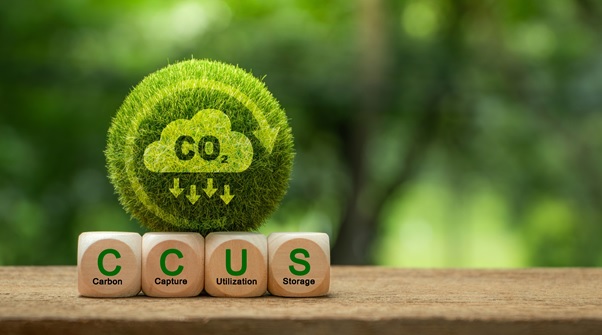
What is CCUS?
- Carbon Capture, Utilisation and Storage (CCUS) is a key pillar of modern climate strategy. Its main goals are:
- Reducing CO₂ emissions from major point sources (thermal power plants, steel, cement, chemical industries)
- Removing already-existing CO₂ from the atmosphere
- Converting captured CO₂ into usable products or storing it permanently
- According to the IPCC, CCUS technologies are essential for achieving global net-zero goals, particularly in hard-to-abate industrial sectors.
India’s First CCUS R&D Roadmap for Net-Zero
- India’s Department of Science & Technology (DST) launched its first CCUS R&D Roadmap in 2024–25.
- This is considered a major step toward India’s Net-Zero target (2070).
Key Objectives of the Roadmap
- Develop indigenous CCUS technologies
- Identify cost-effective and scalable solutions
- Provide a phased adoption pathway for industries
- Strengthen energy security and climate action through domestic innovation
Three-Stage CCUS R&D Programme
Stage 1: End-of-Pipe (EP) Solutions
- Integration of state-of-the-art CCUS technologies into existing industrial facilities.
- Aim → Immediate reduction of emissions from current power and industrial plants.
Major technologies:
- Solvent-based capture
- Membrane separation
- Oxy-fuel combustion
- Post-combustion capture
Stage 2: CCUS-Compliant Design (CCD)
- Design new industrial plants to be CCUS-ready.
- Purpose → Ensure future compatibility so that CCUS can be added with minimal cost.
Expected benefits:
- Lower long-term costs
- Near carbon-neutrality of new industries
Stage 3: CCUS in One Pot (COP) – Integrated Emerging Technologies
- Unified use of next-generation low-emission technologies such as photobiocatalytic and electrochemical conversion.
- Aim → Capture, convert, and utilise/store CO₂ at the same site.
Potential technologies:
- Artificial photosynthesis
- Electrochemical CO₂ conversion
- Bio-catalytic conversion
CCUS Process (Capture → Transport → Utilisation/Storage)

1. Capture
CO₂ is captured from:
- Coal/gas power plants
- Cement, steel, petrochemical industries
- Direct Air Capture (DAC) from the atmosphere
Types of capture:
- Post-combustion capture
- Pre-combustion capture
- Oxy-fuel combustion
2. Transport
Captured CO₂ is compressed and transported through:
- Pipelines
- Ships
- Trucks or rail (less common)
3. Storage (Sequestration)
CO₂ is stored permanently in geological formations such as:
- Saline aquifers
- Depleted oil and gas fields
- Basalt formations
4. Utilisation
Captured CO₂ can be used as feedstock to produce:
- Synthetic fuels (methanol, e-fuels)
- Fertilisers
- Building materials (carbonated concrete)
- Algae-based bio-products
Role of CCUS in Climate Change Mitigation
1. Emission Reduction in Hard-to-Abate Sectors
- Steel, cement, chemicals, refineries → difficult to decarbonise
- CCUS offers a practical and immediate solution
2. Low-Carbon Power and Hydrogen Production
- Coal, gas, and biomass plants with CCUS can supply low-carbon energy.
- Essential for Blue Hydrogen production.
3. Negative Emissions (Removing CO₂ from Air)
- Two major technologies:
- DACCS – Direct Air Capture + Storage
- BECCS – Bio-energy with CCS
BECCS provides true negative emissions because biomass absorbs CO₂ during growth and emissions are captured after combustion.
CCUS in India: Challenges and Opportunities
Challenges
- High cost (especially DAC)
- Identifying large-scale storage sites
- Lack of clear policy and regulation
- Public acceptance issues
- Slow industrial adoption
Opportunities
- India has large basalt formations and saline aquifers suitable for CO₂ storage
- Make in India can reduce technology cost
- Integration with the National Green Hydrogen Mission
- Enhances energy security and climate leadership
- Potential to become a global CCUS technology hub
Global Scenario
- The USA, Canada, and Norway lead in CCUS deployment.
- Norway’s Sleipner Project (1996) is a successful long-term storage model.
- USA supports CCUS through the 45Q Tax Credit.
- IPCC estimates 15–20% of global net-zero mitigation may come from CCUS.
Key CCUS Initiatives in India
- Pilot projects by ONGC, IOCL, NTPC
- CCUS-related R&D under the National Green Hydrogen Mission
- NITI Aayog’s India CCUS Roadmap (Draft 2022)
- ONGC’s CO₂ storage potential study in the Kutch Basin
Conclusion
DST’s first CCUS R&D Roadmap provides a scientific and phased pathway that can help India:
- Decarbonise industries
- Achieve Net-Zero by 2070
- Build advanced technological capabilities
CCUS is not the only solution, but it is an essential component of the net-zero strategy—especially in sectors where alternative green technologies are limited.







 Contact Us
  New Batch : 9555124124/ 7428085757
  Tech Support : 9555124124/ 7428085757