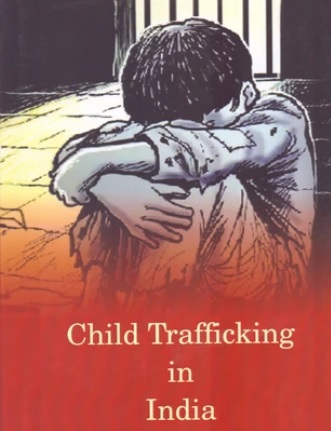
- Child trafficking remains a grave and persistent problem in India, affecting millions of children.
- Between April 2024 and March 2025, more than 53,000 children were rescued nationwide from trafficking, child labour and kidnapping.
- This crime violates children’s fundamental rights, including the right to life, dignity and freedom from exploitation.
- The Supreme Court, in K.P. Kiran Kumar v. State (2025), described child trafficking as a “deeply disturbing reality” and issued strict guidelines to address it.
How Should India Tackle Child Trafficking?
A multi-dimensional strategy is required, covering prevention, rescue, rehabilitation and legal enforcement.
1 Strong Legal Framework and Enforcement
Strict implementation of existing laws:
- Immoral Traffic (Prevention) Act, 1956 (ITPA)
- Juvenile Justice (Care and Protection of Children) Act, 2015
- Protection of Children from Sexual Offences (POCSO) Act, 2012
- Trafficking of Persons (Prevention, Care and Rehabilitation) Act, 2021
Additional measures:
- Establish fast-track courts and appoint special prosecutors to improve conviction rates.
2 Preventive Measures
- Address socio-economic vulnerabilities through education, poverty alleviation and awareness campaigns.
- Community-based monitoring, such as programs run by Childline/Child Protection organizations, with local vigilance committees.
- Increased surveillance in border areas and implementation of Standard Operating Procedures (SOPs) at transit points like railways and bus terminals.
3 Rescue and Rehabilitation
- Strengthen Anti-Human Trafficking Units (AHTUs).
- Implement SOPs for victim identification and connect survivors with rehabilitation schemes.
- Promote financial empowerment and skill development programs for rescued children.
4 Coordination and International Cooperation
- Enhance inter-state coordination, as trafficking networks operate across state borders.
- Partner with UNICEF and other international organizations to strengthen child protection systems.
5 Role of Community and Government
- Conduct awareness campaigns through radio, schools, street plays and local fairs.
- Regular training of police and judicial officers.
- A comprehensive approach, with prevention as the priority, can significantly reduce child trafficking.
What is the Palermo Protocol?
- Official name: “Protocol to Prevent, Suppress and Punish Trafficking in Persons, Especially Women and Children.”
- It is a supplement to the United Nations Convention against Transnational Organized Crime.
- Adopted in November 2000 and came into force on 25 December 2003.
- Objective: Prevent, suppress and punish human trafficking, especially of women and children.
- It provides the first internationally accepted definition of trafficking, based on three elements:
- Act – recruitment, transportation, transfer, harbouring, receipt of persons
- Means – threat, force, coercion, fraud, abuse of power
- Purpose – exploitation
- Requires member states to criminalize trafficking, protect victims and strengthen international cooperation.
- Based on the “3P Framework”: Prevention, Protection and Prosecution.
- India ratified the Protocol in 2011, strengthening its anti-trafficking legal regime.
Definition of Human Trafficking under Bharatiya Nyaya Sanhita (BNS), 2023
The BNS, 2023 replaces the Indian Penal Code (IPC).
Section 143 – Human Trafficking
- Definition: Recruitment, transportation, harbouring, transfer or receipt of a person for the purpose of exploitation.
- Exploitation includes: Physical or sexual exploitation, slavery, bonded labour, begging and organ removal.
- Means: Threat, force, abduction, fraud or abuse of power.
- Consent of the victim is irrelevant.
- Punishment:
- For adults: 7–10 years imprisonment + fine
- For children: 10 years to life imprisonment
- Harsher punishment for trafficking of multiple persons, repeat offenders or public servants.
Section 144
- Treats exploitation of a trafficked person as a separate offence.
- Trafficking is classified as an organized crime.
How Does the Indian Constitution Protect Children from Exploitation ?
- Article 23: Prohibits human trafficking, bonded labour and forced labour.
- Article 24: Prohibits employment of children below 14 years in factories, mines or hazardous work.
- Article 39(e) & (f): Protects children from exploitation and ensures healthy development.
- Article 21: Right to life and personal liberty, interpreted to include dignity, education and freedom from exploitation.
- Article 46: Protects weaker sections from social injustice and exploitation.
These provisions ensure a dignified and secure life for children.
Key Supreme Court Judgments on Child Trafficking
- K.P. Kiran Kumar v. State (2025): Trafficking violates the fundamental right to life; trafficked children are treated as “injured witnesses.”
- Vishal Jeet v. Union of India (1990): Recognized trafficking and child prostitution as socio-economic problems; emphasized prevention.
- Bachpan Bachao Andolan v. Union of India (2011): Issued guidelines on child protection and trafficking.
- M.C. Mehta v. State of Tamil Nadu: Guidelines on child labour linked with trafficking.
Courts have directed states on data collection, timely filing of charge-sheets and witness protection.
Why Strong Centre–State Coordination is Essential
- Concurrent responsibility: Law and order is a state subject, but policies and funding come from the Centre.
- Inter-state investigations: Trafficking networks cross borders; information sharing and joint operations are necessary.
- Resource allocation: Central support helps backward and vulnerable regions.
- National coordination: Inter-ministerial committees guide and monitor state efforts.
Strong Centre–State cooperation ensures a uniform and effective national response against child trafficking.





 Contact Us
  New Batch : 9555124124/ 7428085757
  Tech Support : 9555124124/ 7428085757