Prelims: (Polity + CA)
Mains: (GS 2 – poity) |
Why in the News?
Chief Justice of India (CJI) Surya Kant has proposed the formulation of a National Judicial Policy to standardise core judicial processes across courts and reduce inconsistency in judgments. He also stated that the Supreme Court will consider a plea seeking the revival of the National Judicial Appointments Commission (NJAC), which challenges the existing Collegium system.
Why is a National Judicial Policy Needed?
1. Address Divergent Judgments
- High Courts and even different Supreme Court benches often deliver conflicting rulings on matters such as bail or reservations.
- This creates legal uncertainty, inconsistency in constitutional interpretation, and encourages forum shopping.
- A unified policy would reinforce precedent, coherence, and judicial uniformity.
2. Improve Access to Justice
- India has over 5 crore pending cases, with long delays, high litigation costs, language barriers, and limited access for marginalised groups.
- A national policy can improve affordability, accessibility, and uniformity in judicial processes.
3. Strengthen Judicial Infrastructure
- The India Justice Report 2025 revealed that 33% of High Court judges’ posts remain vacant, with only one HC judge for every 18.7 lakh people.
- District courts suffer from overcrowded halls, inadequate staff, poor IT systems, and infrastructure deficits.
- A national policy can guide structured capacity-building and resource allocation.
4. Standardise Technology Adoption
- Courts vary in use of e-filing, virtual hearings, and digital case management.
- A unified digital framework ensures consistent litigant experience nationwide.
5. Promote Judicial Cohesion
- A national framework can help courts uphold shared constitutional values while maintaining judicial independence.

Concerns with a National Judicial Policy
- One-Size-Fits-All Issues: States differ in caseloads, infrastructure, digital readiness, and staffing.
- Risk of Executive Overreach: Any executive involvement may raise concerns about separation of powers.
- Implementation Constraints: Many courts lack funds, staff, or digital tools needed for uniform implementation.
- High Court Resistance: High Courts enjoy administrative autonomy under Articles 214–226.
- Data Limitations: Many states lack reliable real-time data on pendency and performance.
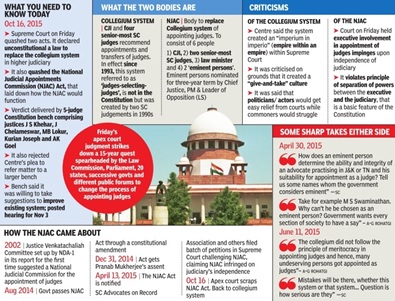
What is the National Judicial Appointments Commission (NJAC)?
About NJAC
Created through the 99th Constitutional Amendment (2014), NJAC aimed to replace the Collegium system for appointing judges of the Supreme Court and High Courts.
NJAC Composition
A 6-member body:
- CJI (Chairperson)
- Two senior-most SC judges
- Union Law Minister
- Two eminent persons (chosen by a panel of PM, CJI, Leader of Opposition)
Why NJAC Was Struck Down
In the Fourth Judges Case (2015), the SC struck down the 99th Amendment & NJAC Act as unconstitutional, holding:
- Executive veto undermines judicial independence—part of the basic structure.
- Selection of “eminent persons” lacked clear criteria, enabling political influence.
- Executive participation threatens judicial impartiality since government is the largest litigant.
The Collegium system was restored.
Collegium vs NJAC: A Comparison
|
Aspect
|
Collegium System
|
NJAC
|
|
Primacy
|
Judiciary has full primacy
|
Judicial primacy diluted
|
|
Transparency
|
Opaque; no published criteria
|
More diverse decision-makers
|
|
Veto Power
|
None
|
Any 2 members can veto
|
|
Risks
|
Nepotism, opacity
|
Political interference
|
|
Judicial Independence
|
Upheld (basic structure)
|
Seen as compromised
|
|
Efficiency
|
Delays due to govt clearance
|
Could improve timelines
|
Constitutional Basis for Judicial Appointments
- Article 124: Appointment of SC judges
- Article 217: Appointment of HC judges
- Article 127: Ad hoc SC judges
- Article 126: Appointment of Acting CJI
- Article 128: Requesting retired SC judges to sit in Court
Appointment Procedures
- CJI: Appointed by seniority, recommended by outgoing CJI.
- SC Judges: Recommended by Collegium; Law Ministry → PM → President.
- HC Judges: President appoints after consulting CJI, Governor, and HC Chief Justice.
What Reforms Can Strengthen India’s Judiciary?
- Judicial Policy with Flexible Federal Structure: Core national standards with local adaptability.
- Institutionalised Case Management: Common rules for filing, adjournments, and disposal timelines.
- Transparent & Timely Appointments: Through improved Collegium processes or future consensus-based mechanisms.
- Enhanced Access to Justice: Legal aid, ADR, regional courts, language services, and digital justice.
- Infrastructure Upgrade: Modern court halls, e-courts, trained staff, and robust IT systems.
FAQs
1. Why is the CJI calling for a National Judicial Policy?
To address conflicting judgments, streamline procedures, and ensure uniform access to justice nationwide.
2. Why was the NJAC struck down?
The SC ruled that NJAC diluted judicial independence by giving the executive and non-judicial members veto power.
3. Does a national judicial policy impact judicial independence?
Not necessarily—if framed by the judiciary itself. Issues arise only if the executive plays a substantial role.
4. What is the biggest challenge in judicial reforms today?
Vacancies, infrastructure gaps, lack of data, and non-uniform adoption of technology.
5. Can NJAC be revived?
Only through a constitutional amendment or a new model acceptable to both judiciary and legislature, ensuring independence is preserved.
|






 Contact Us
  New Batch : 9555124124/ 7428085757
  Tech Support : 9555124124/ 7428085757