Prelims: (Polity + CA)
Mains: (GS 2: Government Policies & Interventions, Constitution; GS 3: Digital Economy) |
Why in News ?
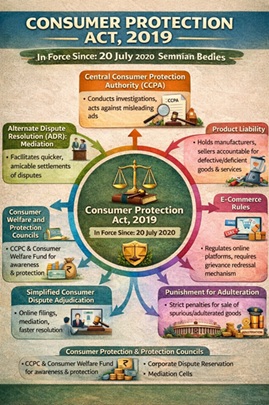
The Consumer Protection Act, 2019 came into force on 20 July 2020, replacing the Consumer Protection Act, 1986. The new law aims to empower consumers, strengthen grievance redressal mechanisms, and address emerging challenges such as e-commerce, misleading advertisements, and product liability, making consumer justice faster and more effective.
Background & Context
The Consumer Protection Act, 1986 was enacted at a time when consumer markets were relatively simple and dominated by physical transactions. Over the decades, the rapid expansion of:
- Digital marketplaces
- E-commerce platforms
- Complex supply chains
- Aggressive advertising practices
exposed significant limitations in the older law. The 1986 Act relied on single-point access to justice, resulting in prolonged litigation and delays.
To address these gaps, the Consumer Protection Act, 2019 was enacted to provide a consumer-centric, technology-enabled, and time-bound dispute resolution framework, aligned with the realities of a modern digital economy.
Key Features of the Consumer Protection Act, 2019
1. Central Consumer Protection Authority (CCPA)
The Act establishes the Central Consumer Protection Authority (CCPA) to promote, protect, and enforce consumer rights.
Powers and Functions of CCPA
- Conduct investigations into violations of consumer rights
- Institute complaints and initiate prosecution
- Order recall of unsafe goods and services
- Direct discontinuation of unfair trade practices
- Impose penalties on manufacturers, endorsers, and publishers for misleading advertisements
Significance: CCPA acts as a proactive regulatory body, shifting consumer protection from a purely grievance-driven system to preventive enforcement.
2. Product Liability Provisions
For the first time, the Act introduces product liability, making manufacturers, sellers, and service providers accountable for defective goods and deficient services.
Basis for Product Liability Action
- Manufacturing defects
- Design defects
- Deviation from manufacturing specifications
- Non-conformity with express warranty
- Inadequate instructions or warnings
- Faulty, imperfect, or deficient services
Significance: This ensures consumer safety, strengthens corporate accountability, and discourages negligent business practices.
3. E-commerce Rules and Unfair Trade Practices
The Consumer Protection (E-commerce) Rules, 2020 were notified under the Act to regulate digital marketplaces.
Key Provisions
- Mandatory disclosure of information on:
- Return, refund, exchange, warranty, and guarantee
- Delivery and shipment details
- Modes and security of payment
- Grievance redressal mechanism
- Country of origin of goods
- E-commerce platforms must:
- Acknowledge consumer complaints within 48 hours
- Redress complaints within one month
- Appoint a Grievance Officer
- Sellers cannot refuse refunds or returns for:
- Defective or deficient goods/services
- Late delivery
- Misrepresentation or mismatch with description
- Prohibition on price manipulation to gain unjustified profits
Significance: The rules ensure fair competition, transparency, and consumer trust in online markets.
4. Punishment for Adulterated and Spurious Goods
The Act introduces stringent penalties to deter harmful trade practices.
Key Provisions
- First conviction:
- Suspension of licence up to two years
- Second or subsequent conviction:
- Permanent cancellation of licence
Significance: Protects consumers from health and safety hazards and strengthens deterrence against unethical manufacturing.
5. Alternate Dispute Resolution: Mediation
The Act introduces mediation as an alternative dispute resolution mechanism.
Key Features
- Consumer Commissions may refer cases to mediation if:
- Scope for early settlement exists
- Both parties consent
- Mediation conducted through Mediation Cells under Consumer Commissions
- No appeal against settlement arrived through mediation
Significance: Promotes speedy, cost-effective, and amicable dispute resolution.
6. Simplification of Consumer Dispute Adjudication
The Act modernises and simplifies adjudication procedures.
Major Reforms
- State and District Commissions empowered to review their own orders
- Consumers can file complaints:
- Electronically
- In commissions having jurisdiction over their place of residence
- Provision for video conferencing hearings
- Complaints deemed admissible if not decided within 21 days
Significance: Enhances access to justice and reduces procedural delays.
7. Other Rules and Institutional Framework
- No fee for filing cases up to ₹5 lakh
- Amounts due to unidentifiable consumers credited to the Consumer Welfare Fund (CWF)
- State Commissions to submit quarterly data on:
- Vacancies
- Pendency
- Case disposal
8. Central Consumer Protection Council (CCPC)
The Act provides for the constitution of the Central Consumer Protection Council.
Key Features
- Advisory body on consumer issues
- Headed by the Union Minister of Consumer Affairs
- Minister of State as Vice-Chairperson
- 34 members from diverse fields
- Representation from all regions of India
- Tenure of three years
Significance: Facilitates cooperative federalism and participatory policymaking in consumer protection.
Analysis: Why the Act Matters
- Shifts consumer protection from reactive redressal to proactive regulation
- Addresses challenges of digital commerce and misleading advertisements
- Enhances corporate accountability through product liability
- Strengthens transparency, trust, and consumer confidence
- Aligns India’s consumer law with global best practices
Way Forward
- Strengthen enforcement capacity of CCPA
- Increase consumer awareness, especially in rural and digital markets
- Ensure timely appointment of members in Consumer Commissions
- Regular review of e-commerce rules to address evolving digital practices
- Promote mediation to reduce litigation burden
FAQs
Q1. How is the Consumer Protection Act, 2019 different from the 1986 Act ?
It introduces CCPA, product liability, e-commerce regulation, mediation, and technology-enabled dispute resolution.
Q2. Why are the e-commerce rules significant ?
They ensure transparency, accountability, and fair practices in online marketplaces.
Q3. What is product liability under the Act ?
It makes manufacturers, sellers, and service providers legally responsible for harm caused by defective goods or deficient services.
|






 Contact Us
  New Batch : 9555124124/ 7428085757
  Tech Support : 9555124124/ 7428085757