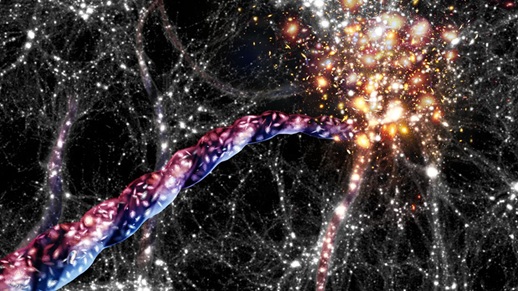
Recently, researchers at the University of Oxford reported the discovery of a cosmic filament approximately 50 million light-years long, strung by at least 14 galaxies.
About Cosmic Filaments
- Cosmic or galaxy filaments are the largest threads in the universe's cosmic web. A single cosmic filament structure extends for millions of light-years.
- These filaments are the largest structures known in the universe, vast, thread-like structures of galaxies and dark matter that form a cosmic scaffolding.
- These cosmic web filaments act as nurseries where galaxies grow by accumulating the pristine gas that fuels their star formation.
- It forms as a result of gravity pulling gas, dark matter, and galaxies into long, thin strands that connect massive clusters of galaxies.
- These filaments also surround vast, empty regions of space called voids. Where sheets of matter intersect and collapse, a filament forms. They also act as highways along which gas and small galaxies 'flow' toward larger clusters.
- These filaments help determine where galaxies form, how fast they grow, and how much fresh gas they receive over billions of years.






 Contact Us
  New Batch : 9555124124/ 7428085757
  Tech Support : 9555124124/ 7428085757