New
GS Foundation (P+M) - Delhi : 10th Feb. 2026, 10:30 AM Spring Sale UPTO 75% + 10% Off GS Foundation (P+M) - Prayagraj : 15th March 2026 Spring Sale UPTO 75% + 10% Off GS Foundation (P+M) - Delhi : 10th Feb. 2026, 10:30 AM GS Foundation (P+M) - Prayagraj : 15th March 2026

CPI Base 2024 Series: Modernising India’s Retail Inflation Framework

Prelims: (Economy + CA)
Mains: (GS 3 – Indian Economy, Monetary Policy, Inclusive Growth)

Why in the News ?

On February 12, 2026, the Ministry of Statistics and Programme Implementation (MoSPI) released India’s first retail inflation data under the new Consumer Price Index (CPI) series (Base Year: 2024=100).
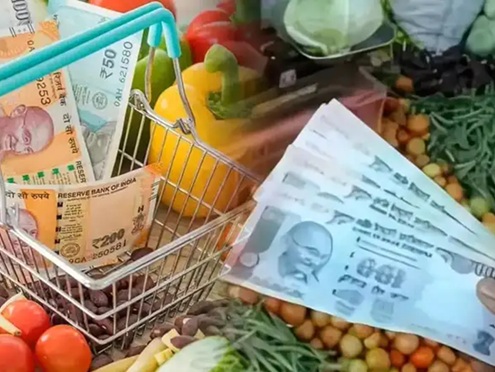
  • Retail inflation for January 2026: 2.75% (provisional)
  • This replaces the earlier 2012 base year.
  • The revision is based on findings of the Household Consumption Expenditure Survey (HCES) 2023–24.

This marks a structural overhaul of how India measures the cost of living.

Why a New CPI Series ?

India’s economy has undergone significant structural transformation over the past decade:

  • Rising share of services
  • Expansion of digital consumption
  • Shift toward cleaner fuels (CNG/PNG)
  • Changing dietary patterns
  • Growth of online marketplaces

The CPI is the primary inflation gauge for the Reserve Bank of India (RBI) and its Monetary Policy Committee (MPC), which operates under the inflation-targeting framework of 4% ± 2%.

The CPI is also used for:

  • Dearness Allowance (DA) revisions
  • Poverty estimation
  • Real income calculations
  • Welfare transfers
  • GDP deflation

Updating the base year ensures inflation measurement reflects current consumption realities and improves macroeconomic calibration.

Key Structural Changes in the New CPI

1. Updated Base Year

  • Changed from 2012=100 to 2024=100.
  • Enhances contemporary relevance.

2. International Classification Alignment

The new CPI adopts 12 consumption divisions in line with COICOP 2018 (Classification of Individual Consumption According to Purpose).

  • Earlier structure: 6 broad groups
  • Now: 12 granular divisions

This enhances global comparability and methodological robustness.

3. Expanded Basket of Items

  • Total items increased from 299 to 358
    • Goods: 259 → 308
    • Services: 40 → 50

Newly Added Items:

  • Rural house rent (introduced for first time)
  • Online media and streaming services
  • Value-added dairy products
  • Barley products
  • Pen drives and external hard disks
  • Attendant and babysitter services
  • Exercise equipment
  • Cleaner fuels (CNG/PNG)

Removed Items:

  • VCR/VCD/DVD players
  • Tape recorders and radios
  • CD/DVD cassettes
  • Second-hand clothing
  • Coir/rope

These changes reflect technological obsolescence and lifestyle shifts.

4. Wider Data Collection Network

  • Rural markets: 1,181 → 1,465
  • Urban markets: 1,114 → 1,395
  • Inclusion of 12 online marketplaces

The integration of digital price data represents a major methodological advancement.

Revised Weight Structure: Changing Consumption Patterns

Food and Beverages

  • Weight reduced from 45.86% → 36.75%
  • Implication: Reduced short-term volatility, as food prices are typically unstable.
  • Food remains the largest component.

Housing (Expanded Category)

  • Weight increased from 10.07% → 17.67%
  • Now includes:
    • Water
    • Electricity
    • Gas
    • Other fuels
    • Rural house rent

This significantly improves representativeness of household expenditure.

Inflation Numbers (January 2026)

Headline CPI Inflation: 2.75%

  • Rural: 2.73%
  • Urban: 2.77%

Food Inflation (CFPI): 2.13%

  • Rural: 1.96%
  • Urban: 2.44%

Housing Inflation: 2.05%

  • Rural: 2.39%
  • Urban: 1.92%

Since this is the first release under the new base, long-term historical comparison is limited. A linking factor has been provided to compute backward-compatible values up to 2013.

Significance of the New CPI Series

1. Improved Monetary Policy Signals

Lower food weight may reduce volatility, providing clearer inflation signals to the RBI.

2. Better Reflection of Modern Consumption

Captures:

  • Digital economy expansion
  • Services growth
  • Cleaner energy transition

3. International Comparability

Alignment with COICOP enhances global benchmarking and statistical credibility.

4. Enhanced Welfare Targeting

More accurate inflation measurement improves:

  • Real income assessment
  • Welfare transfer design
  • Fiscal policy calibration

5. Strengthening Statistical Architecture

Represents modernization of India’s macroeconomic measurement framework.

Challenges and Way Forward

1. Time Series Break

  • New base disrupts long-term comparability.
  • Linking factors may not perfectly replicate old trends.

Way Forward: Increase transparency in methodology and periodically update base years (every 5–10 years).

2. Food Weight Debate

  • India remains a lower-middle-income economy where food inflation significantly impacts welfare.
  • Way Forward: Maintain sensitivity to food price shocks in policy responses.

3. Rural Representation

  • Informal consumption may still be underreported.
  • Way Forward: Strengthen rural data infrastructure and survey mechanisms.

4. Online Price Volatility

  • Digital marketplace prices fluctuate dynamically.
  • Way Forward: Develop real-time digital price monitoring systems.

FAQs

1. What is the new base year for India’s CPI ?

The base year has been revised from 2012 to 2024.

2. Why was the CPI series revised ?

To reflect changes in consumption behaviour, digitalisation, services growth, and updated household expenditure data.

3. How has the weight of food changed ?

It has been reduced from 45.86% to 36.75%.

4. Why is CPI important for the RBI ?

It is the primary inflation measure used for monetary policy under the 4% ± 2% inflation-targeting framework.

5. What is the January 2026 inflation rate under the new series ?

Retail inflation stood at 2.75% (provisional).

Have any Query?

Our support team will be happy to assist you!

OR
X