Prelims : (Economy + CA)
Mains : (GS 3 – Indian Economy, Infrastructure, Energy Security, Industrial Growth) |
Why in News ?
- The Union government has recently granted customs duty exemption on around 40 critical petrochemical products till June 30, 2026, as a temporary relief measure to address supply disruptions.
- This decision has been taken in the backdrop of the ongoing West Asia geopolitical crisis, which has disrupted supply chains, increased crude oil prices, and raised input costs for multiple industries.
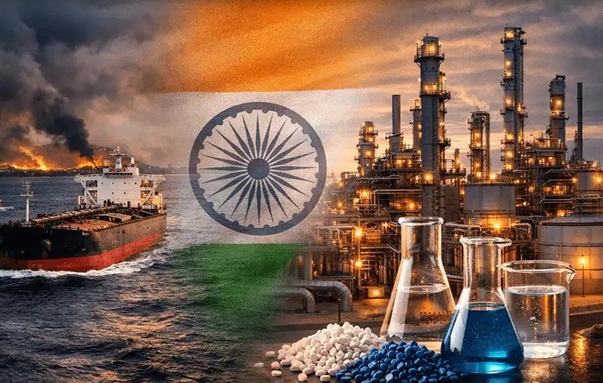
Petrochemical Industry in India: Background and Structure
Petrochemicals refer to chemical products derived primarily from crude oil and natural gas, and they form the backbone of modern industrial production. These chemicals act as essential inputs across a wide range of sectors, thereby creating strong forward and backward linkages in the economy.
- Major petrochemical products include polymers such as polyethylene and polypropylene, synthetic fibres, and chemicals like methanol and ammonia, along with intermediates such as styrene and toluene, all of which are indispensable in manufacturing processes.
- In India, the petrochemical sector is deeply integrated with industries like plastics, textiles, pharmaceuticals, fertilisers, and automobiles, while also being closely linked with refining and natural gas processing infrastructure.
Importance of Petrochemicals in the Economy
Petrochemicals play a crucial role in shaping industrial growth and economic development due to their widespread applicability and strategic importance.
- They act as a core feedstock for manufacturing, enabling the production of value-added goods across sectors such as packaging, infrastructure, and consumer products.
- The sector significantly contributes to employment generation, particularly in downstream industries like textiles and plastics, which are labour-intensive in nature.
- Additionally, petrochemicals have a direct bearing on inflation, as any disruption in their supply chain tends to increase input costs, which eventually translates into higher prices for final goods.
India’s Dependence on Petrochemical Imports
India is both a producer and importer of petrochemicals; however, domestic production has not kept pace with rising industrial demand, making imports essential.
- A significant share of India’s petrochemical imports originates from West Asia, owing to geographical proximity and established trade linkages, which makes the country vulnerable to geopolitical tensions in the region.
- This dependence is further aggravated by structural issues such as the diversion of feedstock like propane and butane towards LPG production, thereby reducing availability for petrochemical manufacturing.
- As a result, India’s petrochemical supply chain remains exposed to external shocks, price volatility, and logistical disruptions.
News Summary: Customs Duty Exemption
The government’s decision to exempt customs duty on key petrochemical products is a targeted and time-bound intervention aimed at stabilising supply and reducing cost pressures.
- The exemption covers critical inputs such as methanol, acetic acid, toluene, styrene, polypropylene, polyvinyl chloride, and polycarbonates, which are widely used across industries.
- It is expected to ensure adequate availability of raw materials, reduce production costs, and prevent supply bottlenecks during a period of global uncertainty.
- However, this measure comes with an estimated revenue loss of ₹1,800 crore, indicating a trade-off between fiscal considerations and industrial stability.
The policy decision is also closely linked to rising crude oil prices and disruptions in shipping routes caused by geopolitical tensions, including conflicts involving Iran, which have increased the cost of petrochemical inputs globally.
Impact on Key Industries
The exemption is expected to provide immediate relief to several industries by reducing input costs and ensuring supply continuity.
- In the textile sector, the reduction in prices of inputs such as Purified Terephthalic Acid (PTA) and Mono Ethylene Glycol (MEG) will support synthetic fibre production and improve export competitiveness.
- The automobile industry is likely to benefit from improved availability of chemicals used in paints and manufacturing processes, thereby stabilising production costs.
- In the pharmaceutical sector, better access to chemical intermediates will help maintain supply chains and prevent disruptions in drug manufacturing.
- Similarly, the packaging and plastics industry will experience lower raw material costs, which can indirectly benefit consumer goods by moderating prices.
Overall, the measure is aimed at preventing industrial slowdown and cushioning the economy from external supply shocks.
Significance of the Policy Decision
The customs duty exemption reflects a strategic policy response to external economic shocks and highlights the government’s focus on industrial stability.
- It helps in stabilising supply chains by ensuring uninterrupted availability of critical inputs during a period of global uncertainty.
- The measure contributes to inflation control, as reduced input costs can prevent a sharp rise in prices of final goods.
- It also supports industrial growth and competitiveness, particularly in sectors that are heavily dependent on petrochemical inputs.
Challenges and Concerns
Despite its immediate benefits, the policy raises several concerns that need careful consideration.
- The exemption results in a revenue loss of ₹1,800 crore, which may impact fiscal balances, especially if such measures are extended further.
- Being a temporary intervention, it does not address the underlying structural issues related to domestic production capacity and supply constraints.
- Continued dependence on imports exposes India to geopolitical risks and global price volatility, making the economy vulnerable to external shocks.
- Additionally, domestic production challenges, including limited feedstock availability and infrastructure gaps, remain unresolved.
Key Concepts
- Petrochemicals : Chemical products derived from hydrocarbons such as crude oil and natural gas, used extensively in manufacturing.
- Feedstock : Raw material used as input in industrial processes, particularly in petrochemical production.
- Customs Duty : Tax imposed on imports and exports, often used as a policy tool to regulate trade.
- Supply Chain Disruption : Breakdown or interruption in the production and distribution network affecting availability of goods.
Core Analysis: Short-Term Relief vs Long-Term Self-Reliance
The current policy reflects the classic dilemma between immediate crisis management and long-term structural reform.
- On one hand, there is a clear need for short-term relief to ensure industrial continuity, stabilise prices, and prevent economic slowdown during global disruptions.
- On the other hand, the situation underscores the importance of long-term self-reliance, which requires strengthening domestic production capacity, reducing import dependence, and enhancing energy security.
✔ Core Challenge : Balancing immediate economic stabilisation with sustainable industrial resilience and self-reliance
Way Forward
India needs to adopt a comprehensive and forward-looking strategy to strengthen its petrochemical sector and reduce vulnerability to external shocks.
- Expanding domestic production capacity through investment in petrochemical complexes and refining infrastructure will be crucial for long-term stability.
- Diversifying import sources beyond West Asia can reduce geopolitical risks and ensure more stable supply chains.
- Developing strategic reserves of critical petrochemical inputs can act as a buffer during global disruptions.
- Promoting research and innovation, including alternative and green materials, will help reduce dependence on traditional petrochemicals over time.
Practice Questions
Prelims
Q. Petrochemicals are primarily derived from :
(a) Coal and biomass
(b) Crude oil and natural gas
(c) Metallic minerals
(d) Agricultural produce
Mains
“Discuss the role of petrochemicals in India’s industrial economy. Examine how recent customs duty exemptions reflect the challenges of managing global supply disruptions.”
FAQs
1. Why has customs duty been exempted on petrochemicals ?
To address supply disruptions, reduce input costs, and stabilise industrial production amid global uncertainties.
2. Which sectors benefit the most ?
Textiles, automobiles, pharmaceuticals, and plastics are the major beneficiaries.
3. What is the duration of the exemption ?
The exemption is valid till June 30, 2026.
4. What is the key concern associated with this policy ?
The main concerns include fiscal loss and continued dependence on imports.
5. What is the long-term solution ?
Strengthening domestic production capacity and diversifying supply sources.
|






 Contact Us
  New Batch : 9555124124/ 7428085757
  Tech Support : 9555124124/ 7428085757