Prelims: (Science & Technology + CA)
Mains: (GS 2 - International Relations, Arms Control; GS 3 - Defence Technology) |
Why in News ?
The United States Army and Navy have recently completed integrated testing of the Dark Eagle Long-Range Hypersonic Weapon (LRHW), marking a key milestone in the US effort to deploy operational hypersonic strike capabilities amid intensifying great power competition.
Background & Context
Hypersonic weapons—capable of travelling at speeds greater than Mach 5 while maintaining high manoeuvrability—are emerging as game-changers in modern warfare. Countries such as China and Russia have already operationalised hypersonic systems, prompting the US to accelerate development to:
- Maintain strategic deterrence
- Counter Anti-Access/Area-Denial (A2/AD) strategies
- Ensure rapid, precision conventional strike options
The Dark Eagle LRHW forms a critical component of the US military’s conventional prompt strike capability, designed to deliver fast, accurate, and hard-to-intercept strikes without using nuclear warheads.
Dark Eagle Long-Range Hypersonic Weapon (LRHW): An Overview
- Dark Eagle LRHW is a ground-launched hypersonic missile system developed for the US Army, with joint testing involving the US Navy.
- It is a non-nuclear, conventional weapon system, intended for high-value strategic targets.
- The missile component is being developed by Lockheed Martin and Northrop Grumman.
- The system is designed to:
- Penetrate sophisticated air and missile defences
- Suppress long-range enemy strike capabilities
- Deliver time-sensitive precision effects across vast distances
Key Features of the Dark Eagle LRHW
1. Long-Range Strike Capability
- Maximum strike range of up to 2,735 km.
- Enables deep-strike operations well beyond conventional missile ranges.
2. Hypersonic Glide Vehicle (C-HGB)
- Equipped with a Common Hypersonic Glide Body (C-HGB).
- An unpowered, highly manoeuvrable glide vehicle capable of reaching speeds of Mach 17.
- Its unpredictable flight path makes interception extremely difficult.
3. Flight Profile
- The missile is powered by a solid-fuel, two-stage rocket booster.
- After launch:
- It ascends to the edge of space
- Re-enters the upper atmosphere
- Glides and manoeuvres toward the target at hypersonic speeds
- This trajectory keeps it outside the engagement envelope of most existing air defence systems.
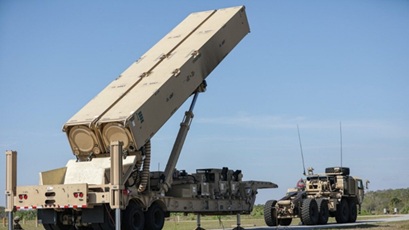
4. Mobile Ground-Based Deployment
- Operates through a mobile ground-based battery.
- Each battery includes:
- Transporter Erector Launchers (TELs)
- Command, control, and support vehicles
- Enhances survivability, flexibility, and rapid deployment.
Strategic Significance
- Penetration of A2/AD Defences: Designed to neutralise heavily defended zones that restrict access to adversary territory.
- Conventional Deterrence: Provides the US with a powerful non-nuclear deterrent, reducing reliance on nuclear escalation.
- Joint Force Integration: Integrated Army–Navy testing highlights interoperability and cross-service operational synergy.
- Arms Race Implications: Hypersonic weapons development raises concerns about strategic instability and challenges existing arms control frameworks.
Implications for Global Security
- Shortened decision-making timelines in conflicts
- Increased risk of miscalculation due to speed and ambiguity
- Weakening of traditional missile defence architectures
- Potential pressure on other powers to accelerate hypersonic programs
FAQs
Q1. What is the Dark Eagle LRHW ?
It is a US Army-operated, ground-launched, non-nuclear hypersonic missile system designed for long-range precision strikes.
Q2. What makes Dark Eagle difficult to intercept ?
Its hypersonic glide vehicle (C-HGB) travels at speeds up to Mach 17 and follows a highly manoeuvrable, unpredictable trajectory.
Q3. Is Dark Eagle a nuclear weapon ?
No, it is a conventional (non-nuclear) weapon system.
Q4. Which companies are involved in developing the Dark Eagle missile ?
Lockheed Martin and Northrop Grumman.
Q5. Why are hypersonic weapons strategically important ?
They can bypass missile defences, strike targets rapidly, and alter deterrence dynamics.
|






 Contact Us
  New Batch : 9555124124/ 7428085757
  Tech Support : 9555124124/ 7428085757