



Composition of the Boards:
The representation of organisations such as Bharatiya Mazdoor Sangh (BMS), Indian Federation of App-Based Transport Workers (IFAT), Zomato's parent company Eternal, Swiggy, Zepto and Urban Company reflects the participation of workers' organisations and platform companies.
The boards will perform advisory, monitoring and review functions to strengthen social security coverage.
Major functions include:
Important: The boards primarily perform advisory, monitoring and review functions. The responsibility for framing and implementing welfare schemes rests with the appropriate government authorities.
Under the Code on Social Security, 2020, the government can introduce welfare schemes covering several important areas.
Major areas of social security protection include:
These benefits aim to reduce the economic vulnerability of workers who are often excluded from traditional social security arrangements.
The Code on Social Security, 2020, provides for the creation of a Social Security Fund to finance welfare measures for gig and platform workers.
Contribution by Aggregators:
Other Sources of Funding:
The fund is intended to provide financial support for social security schemes covering gig and platform workers.
A national registration system will help identify and register gig and platform workers so that they can access applicable social security benefits.
Key Features:
Significance: Gig workers frequently migrate between cities and states in search of employment. A portable social security identification system can help them access eligible benefits even when their place of work changes.
Despite the institutional framework, several challenges may affect the effective delivery of social security benefits.
|
Q. With reference to the National Social Security Boards for unorganised and gig workers, consider the following statements:
Which of the statements given above are correct? (a) 1 and 2 only (b) 1, 2 and 3 only (c) 2, 3 and 4 only (d) 1, 2, 3 and 4 |
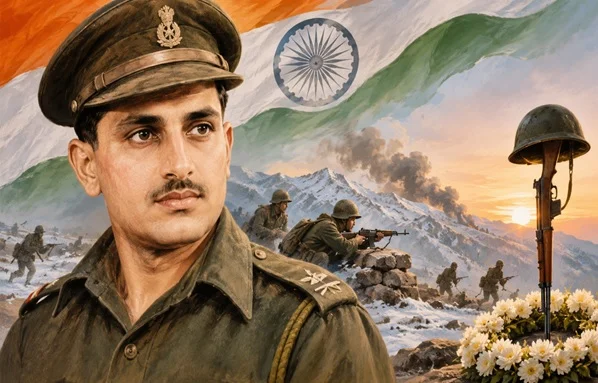
3 November marks the martyrdom anniversary of Major Somnath Sharma, who sacrificed his life during the Battle of Badgam on 3 November 1947.
|
Fact |
Details |
|
Personality |
Major Somnath Sharma |
|
Date of Birth |
31 January 1923 |
|
Birthplace |
Dadh, Kangra district, Himachal Pradesh |
|
Date of Martyrdom |
3 November 1947 |
|
Place of Martyrdom |
Badgam, Jammu and Kashmir |
|
Regiment |
Kumaon Regiment |
|
Battalion |
4th Battalion (4 Kumaon) |
|
Military Operation |
Battle of Badgam |
|
War |
India-Pakistan War (19448) |
|
Highest Gallantry Award |
Param Vir Chakra |
|
Award Status |
Posthumous |
|
First Recipient |
Major Somnath Sharma |
|
Medal Designer |
Savitri Khanolankar |
|
Fact |
Details |
|
Full Name |
Param Vir Chakra |
|
Abbreviation |
PVC |
|
Instituted |
26 January 1950 |
|
Retrospective Effect |
15 August 1947 |
|
First Recipient |
Major Somnath Sharma |
|
First Award |
Posthumous |
|
Designer |
Savitri Khanolankar |
|
Medal Material |
Bronze |
|
Category |
Wartime Gallantry Award |
Prelims MCQQ. With reference to Major Somnath Sharma, consider the following statements:
Which of the statements given above are correct? (a) 1, 2 and 4 only Mains Practice QuestionQ. Discuss about military preparedness in protecting national security. |
When is Major Somnath Sharma's martyrdom anniversary observed?3 November. Who was India's first Param Vir Chakra awardee?Major Somnath Sharma. When was Major Somnath Sharma born?31 January 1923. Which regiment did Major Somnath Sharma belong to?Kumaon Regiment (4th Battalion). Where did Major Somnath Sharma attain martyrdom?Badgam, Jammu and Kashmir. |
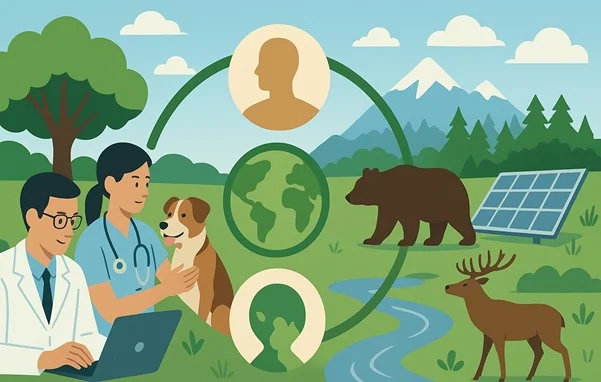
One Health Day is observed internationally on 3 November every year to highlight the interconnectedness of human, animal and environmental health.
|
Aspect |
Details |
|
Event |
One Health Day |
|
Observed on |
3 November |
|
First observed |
2016 |
|
Nature |
International awareness campaign |
|
Main concept |
Interconnectedness of human, animal and environmental health |
|
Global partners |
WHO, FAO, UNEP and WOAH |
|
Indian initiative |
National One Health Mission |
|
Implementing agency of National One Health Mission |
ICMR |
|
Nodal scientific coordination |
Office of the Principal Scientific Adviser |
|
Major focus |
Zoonotic diseases, AMR and pandemic preparedness |
|
Indian institutional initiative |
National Institute of One Health, Nagpur |
|
Organisation |
Major role |
|
WHO (World Health Organization) |
Human health and public health preparedness |
|
FAO (Food and Agriculture Organization) |
Food safety, agriculture and animal health |
|
UNEP (United Nations Environment Programme) |
Environmental protection and ecosystem health |
|
WOAH (World Organisation for Animal Health) |
Animal health and veterinary standards |
|
SDG |
Relevance |
|
SDG 2 (Zero Hunger) |
Healthy livestock and sustainable food systems |
|
SDG 3 (Good Health and Well-being) |
Disease prevention and public health |
|
SDG 6 (Clean Water and Sanitation) |
Prevention of waterborne diseases |
|
SDG 13 (Climate Action) |
Addressing climate-related health threats |
|
SDG 14 (Life Below Water) |
Protection of aquatic ecosystems |
|
SDG 15 (Life on Land) |
Wildlife and biodiversity conservation |
Prelims MCQQ. With reference to the One Health approach, consider the following statements:
Which of the statements given above are correct? (a) 1, 2 and 3 only Mains Practice QuestionQ. Discuss significance for India's public health security and examine the challenges in its implementation. |
When was the first One Health Day observed?2016. What are the three major pillars of One Health?Human health, animal health and environmental health. Which four international organisations form the Quadripartite?WHO, FAO, UNEP and WOAH. Which organisation implements India's National One Health Mission?Indian Council of Medical Research (ICMR). Where is the National Institute of One Health located?Nagpur, Maharashtra. |




