Why in news ?
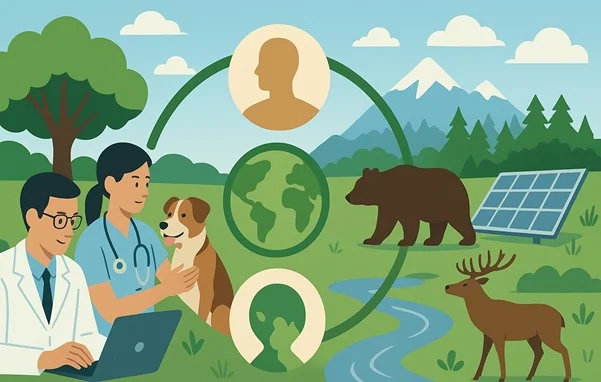
One Health Day is observed internationally on 3 November every year to highlight the interconnectedness of human, animal and environmental health.
Key Facts
|
Aspect
|
Details
|
|
Event
|
One Health Day
|
|
Observed on
|
3 November
|
|
First observed
|
2016
|
|
Nature
|
International awareness campaign
|
|
Main concept
|
Interconnectedness of human, animal and environmental health
|
|
Global partners
|
WHO, FAO, UNEP and WOAH
|
|
Indian initiative
|
National One Health Mission
|
|
Implementing agency of National One Health Mission
|
ICMR
|
|
Nodal scientific coordination
|
Office of the Principal Scientific Adviser
|
|
Major focus
|
Zoonotic diseases, AMR and pandemic preparedness
|
|
Indian institutional initiative
|
National Institute of One Health, Nagpur
|
What is One Health?
- One Health is an integrated, collaborative and multidisciplinary approach that recognises the close relationship between human health, animal health and environmental health.
- It aims to achieve optimal health outcomes by bringing together different sectors, including healthcare, veterinary science, agriculture, wildlife conservation and environmental protection.
- It recognises that diseases and health risks do not remain confined to one sector.
- It promotes coordination among governments, scientific institutions, healthcare professionals, veterinarians and environmental experts.
- It focuses on prevention, early detection, surveillance and coordinated responses to emerging health threats.
Why was the One Health Approach needed?
- Increasing Zoonotic Diseases: Diseases such as rabies, Nipah, avian influenza and brucellosis can spread between animals and humans.
- Risk of Pandemics: Emerging infectious diseases may originate in animal populations and subsequently spread among humans.
- Antimicrobial Resistance: Excessive and inappropriate use of antibiotics in humans and animals contributes to antimicrobial resistance.
- Environmental Degradation: Deforestation, habitat destruction and biodiversity loss can alter interactions between humans and wildlife.
- Fragmented Health Systems: Separate functioning of human healthcare, veterinary services and environmental agencies can delay disease detection and response
Three Pillars of One Health
- Human Health
- Prevention and control of infectious diseases.
- Strengthening public healthcare and disease surveillance.
- Ensuring safe drinking water and sanitation.
- Addressing antimicrobial resistance.
- Animal Health
- Prevention and control of livestock diseases.
- Monitoring diseases in domestic and wild animals.
- Strengthening veterinary healthcare.
- Ensuring food safety and animal welfare.
- Environmental Health
- Protection of biodiversity and ecosystems.
- Controlling air, water and soil pollution.
- Addressing climate change and habitat destruction.
- Maintaining ecological balance.
Major Components of the One Health Approach
- Integrated Disease Surveillance
- Monitoring infectious diseases across human, animal and environmental sectors.
- Early identification of emerging and re-emerging pathogens.
- Sharing disease-related information between different departments.
- Inter-sectoral Coordination
- Collaboration between health ministries, veterinary departments, wildlife authorities and environmental agencies.
- Joint investigation of disease outbreaks.
- Coordinated policy-making and emergency response.
- Research and Development
- Development of vaccines, diagnostics and therapeutics.
- Genomic sequencing and pathogen monitoring.
- Promoting interdisciplinary research.
- Antimicrobial Resistance Management
- Promoting responsible use of antibiotics in humans and animals.
- Monitoring antimicrobial resistance across different sectors.
- Strengthening laboratory surveillance and infection prevention.
- Environmental and Ecosystem Protection
- Monitoring environmental factors that influence disease transmission.
- Conserving wildlife habitats and biodiversity.
- Reducing pollution and ecological degradation.
Four Major International Organisations Associated with One Health
- These organisations work together to promote coordinated action on health risks at the human-animal-plant-environment interface.
- Their collaboration includes the One Health Joint Plan of Action (2022-2026), which provides a framework for strengthening One Health implementation globally.
|
Organisation
|
Major role
|
|
WHO (World Health Organization)
|
Human health and public health preparedness
|
|
FAO (Food and Agriculture Organization)
|
Food safety, agriculture and animal health
|
|
UNEP (United Nations Environment Programme)
|
Environmental protection and ecosystem health
|
|
WOAH (World Organisation for Animal Health)
|
Animal health and veterinary standards
|
India's Initiatives towards One Health
- National One Health Mission
- The National One Health Mission is an integrated initiative aimed at bringing different sectors together to address health challenges.
- It was developed under the guidance of the Prime Minister's Science, Technology and Innovation Advisory Council (PM-STIAC).
- The Indian Council of Medical Research (ICMR) is the implementing agency.
- The Office of the Principal Scientific Adviser provides scientific coordination.
- It promotes collaboration among more than 13 ministries and departments.
- Its main objective is to establish an integrated system for disease surveillance, early detection, research and coordinated outbreak response.
- Major Objectives:
- Strengthening integrated disease surveillance.
- Developing early warning systems for emerging infectious diseases.
- Promoting research on vaccines, diagnostics and therapeutics.
- Improving data-sharing between human, animal and environmental health sectors.
- Strengthening pandemic preparedness and response.
- Developing institutional and technical capacities.
- National Institute of One Health (NIOH), Nagpur
- The National Institute of One Health is located in Nagpur, Maharashtra.
- It functions under the Department of Health Research, Ministry of Health and Family Welfare.
- It is an important institutional component of India's One Health framework.
- It aims to promote research, disease surveillance, capacity-building and collaboration across human, animal and environmental health sectors.
- National One Health Programme for Prevention and Control of Zoonoses (NOHP-PCZ)
- It is a Central Sector Scheme under the Ministry of Health and Family Welfare.
- It is implemented through the National Centre for Disease Control (NCDC).
- It was originally approved in 2013 under the 12th Five-Year Plan.
- It was initially known as the Strengthening Inter-Sectoral Coordination for Prevention and Control of Zoonotic Diseases scheme.
- It aims to strengthen coordination among human health, veterinary, wildlife and environmental sectors.
- It promotes surveillance, laboratory capacity, joint outbreak investigations and community awareness.
- National Action Plan on Antimicrobial Resistance (NAP-AMR)
- India launched its first National Action Plan on Antimicrobial Resistance in 2017.
- It follows a multisectoral approach to address the growing threat of antimicrobial resistance.
- It promotes awareness, surveillance, infection prevention, research and responsible antimicrobial use.
- It is closely linked to the One Health approach because antimicrobial resistance can spread across humans, animals, food systems and the environment.
- National Action Plan for Dog Mediated Rabies Elimination
- India has adopted a National Action Plan for Dog Mediated Rabies Elimination by 2030.
- It emphasises mass dog vaccination, human rabies prevention, surveillance and inter-sectoral coordination.
- It reflects the One Health principle by linking animal vaccination with human disease prevention.
Major Developments and Achievements of India's One Health Mission
- National One Health Workshop (March 2026): The National Institute of One Health, Nagpur, organised a two-day national workshop on operational frameworks for One Health, focusing on translating national vision into state-level action.
- Fifth Scientific Steering Committee Meeting (May 2026): Discussions focused on integrated surveillance, genomics and metagenomics-based monitoring, a model governance framework and coordination between ministries.
- Sixth Scientific Steering Committee Meeting (September 2026): The committee reviewed progress in operationalising One Health beyond the initial convergence framework and emphasised institutional ownership, measurable targets and better coordination.
- AI-based Disease Detection: The National One Health Mission has invited proposals for AI-enabled tools for early detection of emerging and novel pathogens in humans, animals and the environment.
- Joint Outbreak Response: India has strengthened coordinated investigations involving multiple institutions to improve responses to zoonotic and emerging infectious disease threats.
Significance of the One Health Approach
- Pandemic Preparedness: Helps identify emerging pathogens before they develop into major public health emergencies.
- Disease Prevention: Improves early detection and control of zoonotic diseases.
- Agricultural Development: Protects livestock, improves animal productivity and reduces economic losses for farmers.
- Food Security: Promotes safer food production and consumption.
- Environmental Sustainability: Connects biodiversity conservation with public health protection.
- Economic Stability: Reduces the financial burden associated with disease outbreaks.
- Global Health Security: Strengthens international cooperation and preparedness against cross-border health threats.
Challenges in Implementing One Health
- Fragmented Governance: Human health, animal health and environmental protection are managed by different ministries and departments.
- Limited Coordination: Information-sharing and joint decision-making between departments remain challenging.
- Inadequate Infrastructure: Laboratories, veterinary facilities and disease surveillance networks require further strengthening.
- Financial Constraints: Integrated research and surveillance require sustained financial investment.
- Data-Sharing Gaps: Different institutions may maintain separate databases and reporting mechanisms.
One Health and Sustainable Development Goals (SDGs)
|
SDG
|
Relevance
|
|
SDG 2 (Zero Hunger)
|
Healthy livestock and sustainable food systems
|
|
SDG 3 (Good Health and Well-being)
|
Disease prevention and public health
|
|
SDG 6 (Clean Water and Sanitation)
|
Prevention of waterborne diseases
|
|
SDG 13 (Climate Action)
|
Addressing climate-related health threats
|
|
SDG 14 (Life Below Water)
|
Protection of aquatic ecosystems
|
|
SDG 15 (Life on Land)
|
Wildlife and biodiversity conservation
|
Prelims MCQ
Q. With reference to the One Health approach, consider the following statements:
- It recognises the interconnectedness of human, animal and environmental health.
- WHO, FAO, UNEP and WOAH are associated with the global Quadripartite partnership.
- India's National One Health Mission is implemented by the Ministry of Environment, Forest and Climate Change.
- Zoonotic diseases are an important area of focus under the One Health approach.
Which of the statements given above are correct?
(a) 1, 2 and 3 only
(b) 1, 2 and 4 only
(c) 2, 3 and 4 only
(d) 1, 2, 3 and 4
Mains Practice Question
Q. Discuss significance for India's public health security and examine the challenges in its implementation.
|
FAQs
When was the first One Health Day observed?
2016.
What are the three major pillars of One Health?
Human health, animal health and environmental health.
Which four international organisations form the Quadripartite?
WHO, FAO, UNEP and WOAH.
Which organisation implements India's National One Health Mission?
Indian Council of Medical Research (ICMR).
Where is the National Institute of One Health located?
Nagpur, Maharashtra.
|