New
Hindi Medium: (Delhi) - GS Foundation (P+M) : 6th July 2026, 6:00 PM Hindi Medium: (Prayagraj) - GS Foundation (P+M) : 5th July 2026, 8:00 AM English Medium: (Delhi) - GS Foundation (P+M) : 20th July 2026 English Medium: (Prayagraj) - GS Foundation (P+M) : 15th July 2026, 8:00 AM Hindi Medium: (Delhi) - GS Foundation (P+M) : 6th July 2026, 6:00 PM Hindi Medium: (Prayagraj) - GS Foundation (P+M) : 5th July 2026, 8:00 AM English Medium: (Delhi) - GS Foundation (P+M) : 20th July 2026 English Medium: (Prayagraj) - GS Foundation (P+M) : 15th July 2026, 8:00 AM

Current Affairs for 04 July 2026

Supreme Court Warns Against Unregulated Use of AI in Judicial Decisions

Why in news ?

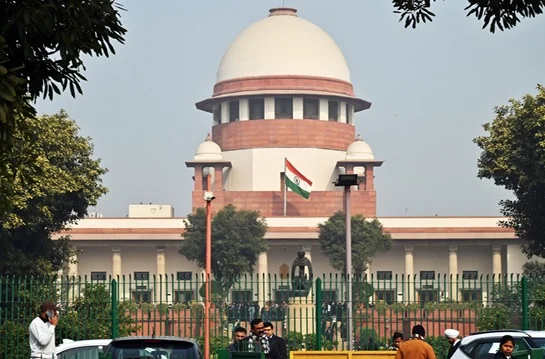
The Supreme Court set aside a judgment of the National Company Law Tribunal (NCLT) after finding that it relied on fake, non-existent, and AI-generated hallucinated judgments/precedents.
Key Observations of the Supreme Court

  • AI can assist judicial processes, but adjudication must remain under the complete control of human judges.
  • Reliance on AI-generated fake precedents undermines the credibility of the justice system.
  • The apex bar body has been directed to frame guidelines and disciplinary measures to regulate AI use in legal practice.

Draft Regulations on AI Use in the Judiciary

  • AI may be used only for administrative functions, such as :
    • Case management
    • Cause list preparation
    • Hearing scheduling
    • Court transcription
    • Translation of judgments
  • AI cannot be used for :
    • Risk scoring
    • Bail eligibility assessment
    • Predicting recidivism
    • Assessing witness credibility
  • Processing of personal data must comply with the Digital Personal Data Protection Act, 2023.
  • AI systems must not perpetuate bias based on race, religion, caste, gender, disability, language, or economic status.
  • AI adoption should not widen the digital divide.
  • A dedicated Apex Body is proposed at the Supreme Court to oversee AI adoption in the judiciary.

Current Use of AI in India's Judiciary

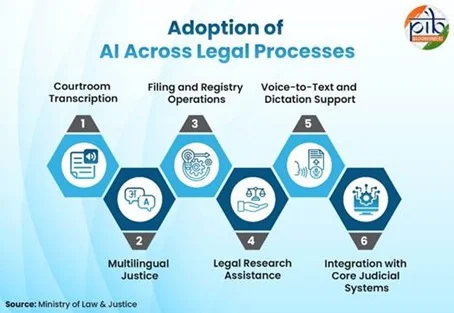
  • Transcription of oral arguments
  • Translation of judgments (SUVAAS)
  • Detection of defects in e-filing
  • Legal research
  • Metadata extraction
  • AI technologies such as Machine Learning (ML), Optical Character Recognition (OCR), and Natural Language Processing (NLP) are integrated into the e-Courts Project.

Significance of AI in the Judiciary

  • Helps reduce the backlog of pending cases.
  • Improves prison and investigation management.
  • Enhances multilingual access to judicial documents.
  • Increases efficiency and accuracy in legal research.
  • Improves access to justice through AI-powered legal assistance.

Key Concerns

  • AI hallucinations and fabricated legal precedents.
  • Algorithmic bias and over-reliance on AI.
  • Data privacy and security concerns.
  • Inadequate digital infrastructure.
  • Lack of human empathy and judicial discretion in sensitive cases.

Way Forward

  • AI should function only as a decision-support tool, not a decision-maker.
  • Robust regulatory, ethical, and data protection frameworks should be established.
  • Human oversight must remain central to ensure transparency, accountability, and fairness in judicial decision-making.

A New Strategy to Revitalize India's Tiger Reserves: A New Roadmap for Conservation

Why in the news ?

In a significant step in the history of tiger conservation in India, the central government has released two important reports to mark the 18th anniversary of tiger reintroduction into the Sariska Tiger Reserve in Rajasthan.

Key points of the report ?

  • A new roadmap for tiger conservation has been presented for the coming years.
  • Experiences and lessons learned from the 12 tiger reintroduction programs conducted so far across the country have been analyzed.
  • The key message of the new strategy is clear: the goal will no longer be simply to increase tiger numbers, but also to revive tiger reserves where tiger numbers have declined significantly or have been depleted.
  • Currently, there are 3,682 tigers in India, but given the challenge of maintaining a balanced distribution of tigers, the government has identified 25 priority tiger reserves where special attention will be given to habitat, prey base, and, if necessary, tiger reintroduction.

Tiger numbers have increased in India, but their distribution remains unbalanced.

  • India has become the world's largest tiger habitat.
  • Tiger numbers have increased significantly over the past decade and a half.

Year

Tiger Population

2006

1,411

2010

1,706

2014

2,226

2018

2,967

2022

3,682

  • Today, the country's 58 tiger reserves cover an area of ​​approximately 85,000 square kilometers.
  • However, despite the increase in total numbers, their distribution remains highly uneven.

Key Facts

  • Only 10-12 tiger reserves hold approximately 36% of the country's tigers.
  • There are 12 tiger reserves where fewer than three tigers are present.
  • Kawal (Telangana), Kamlang (Arunachal Pradesh), and Dampa (Mizoram) currently have no tigers left.

Why is uneven distribution a concern ?

  • Where tiger populations are high, several new problems are arising:
    • Young tigers are moving out of the forest in search of new territory.
    • Encroachment into cultivated areas and villages is increasing.
    • Human-tiger conflict is increasing.
    • Dependence on livestock is increasing.
    • Structures such as railway lines, national highways, and canals are increasing the risk of tiger mortality.
    • On the other hand, in tiger reserves where there are no tigers, the forests are safe, but sufficient prey species are not available, making tiger rehabilitation difficult.

New concept of 'source' and 'sink' populations

  • The new conservation policy is based on the concept of source population and sink population.

Source Population

  • Tiger reserves that have good habitat, sufficient prey species, high tiger numbers, and consistent natural reproduction.
  • Examples: Corbett, Bandipur, and Kaziranga. These reserves are considered sources of tigers for other areas.

Sink Population

  • Areas where tiger numbers are very low, breeding is not occurring, connectivity between forests is weak, and prey species are scarce.
  • If this situation is not improved, tigers may disappear completely from these areas in the future.

New Strategy of the Central Government

The following steps will be taken under the new plan :

1. Conservation of Strong Source Populations

  • Healthy tiger populations in 13 key tiger reserves will be further strengthened.

2. Revitalization of 25 Priority Tiger Reserves

  • Special attention will be given to habitat improvement, prey species enhancement, security enhancement, and tiger reintroduction, if necessary, in these reserves.

3. Identification of 'Recipient Sites'

  • Tiger reserves have been identified where tigers could be relocated in the future, based on scientific studies.

Emphasis on the 'Metapopulation' Model

  • Experts estimate that tiger numbers in India are increasing at a rate of approximately 6% annually.
  • However, if most tigers remain confined to a few areas, genetic diversity could decline in the future, increasing human-tiger conflict, and increasing the risk of local extinction.
  • Therefore, the objective now is not only to increase tiger numbers but also to ensure their natural movement across the landscape.
  • To achieve this, tiger reserves, reserved forests, and wildlife corridors (Wildlife Corridors), mixed-use forest areas, will be better connected to allow tigers to move safely between different populations.

Scientific Assessment of 58 Tiger Reserves

  • The National Tiger Conservation Authority (NTCA) and the Wildlife Institute of India (WII) conducted a scientific assessment of all 58 tiger reserves in the country. Habitat quality, prey species availability, and the current tiger population were the primary factors in this assessment.
  • Based on the study, 25 tiger reserves were identified as requiring improvement in one or more of these three aspects to develop a sustainable and healthy tiger population

Which areas need the most attention ?

  • Central India and the Eastern Ghats – This region is home to a cluster of high-priority tiger reserves, requiring extensive conservation interventions.
  • Northeast India and the Brahmaputra floodplains – These regions have vast forest areas. Tiger populations can increase rapidly if prey species, security systems, and forest connectivity are improved.

Key Lessons Learned from Tiger Reintroduction Programs

  • The new report analyzes reintroduction programs over the past decade.

Sariska Tiger Reserve (Rajasthan)

  • India's first successful tiger reintroduction program in 2008.
  • The first reintroduced tiger cubs were born here in 2012.

Panna Tiger Reserve (Madhya Pradesh)

  • Reintroductions were carried out after local tiger depletion.
  • The first successful breeding event was recorded in 2010.
  • A total of 10 tigers have been translocated since 2009.
  • It is considered one of India's most successful reintroduction programs.

Satkosia Tiger Reserve (Odisha)

  • This project failed due to opposition from local communities.
  • Attacks on livestock increased discontent.
  • A translocated male tiger died after being entangled in a snare.

Mukundra Hills (Rajasthan)

  • The reintroduction process here has been relatively slow as breeding success has not reached the expected level.

The biggest lesson

  • The central government has clarified that tiger reintroduction should be the last resort for conservation. It should only be implemented when the area has suitable habitat, sufficient prey species, strong security systems, support from local communities, and favorable socio-economic conditions. The government believes that scientific planning alone is not enough; the participation, trust, and support of local people are key to ensuring the long-term success of any tiger reintroduction program.

Chennai's data center boom: Can the city handle AI's rising water and power demands?

Why in the news ?

With Chennai's rapidly growing investment in AI and data center projects, widespread discussion has begun regarding their increasing power and water demands and their impact on the city's environmental sustainability.

AI and the Rising Energy Consumption of Data Centers

  • Traditional data centers were primarily built for data storage and general computing, but AI data centers rely on high-capacity graphics processing units (GPUs), which have significantly higher power consumption.
  • AI-ready server racks require significantly more power, advanced cooling systems, and uninterrupted power supply than traditional servers. This is putting pressure on energy plans worldwide.
  • Chennai already experiences a sharp increase in power demand during the summer due to air conditioning and industrial activity. The increase in the number of energy-intensive AI data centers could put additional strain on the power grid. Data centers also require large battery systems and diesel generators for uninterrupted power supply, increasing both costs and environmental impacts.

The Growing Challenge of Water

  • Water is a crucial resource for data centers, not just electricity. To control the heat generated by servers, many data centers use technologies like evaporative cooling, which requires large amounts of water.
  • Chennai has already faced a water crisis. In 2019, the city nearly reached a 'Day Zero' situation, requiring special trains to supply water. Although monsoons have raised reservoir levels in subsequent years, the city still relies heavily on rainfall, seawater desalination plants, and groundwater.
  • Climate change, which can lead to severe floods and prolonged droughts, is making it increasingly difficult to predict future industrial water demand.
  • Some modern data centers are reducing freshwater consumption by using air cooling, liquid cooling, and treated wastewater, but most projects do not provide public details of their actual water use. Experts are stressing the need for increased transparency.

A City Vulnerable to Climate Change

  • Chennai's geographical location makes it particularly vulnerable to climate risks. Located near the Bay of Bengal, the city faces challenges such as sea-level rise, cyclones, storm surges, extreme heat, and urban flooding.
  • The devastating floods of 2015 demonstrated that unplanned urbanization, wetland degradation, and poor drainage systems can exacerbate natural disasters.
  • Data centers require large land areas, power substations, transmission networks, and transportation infrastructure. Without proper planning, their development could conflict with urban priorities such as housing, ecological conservation, and flood management.

Employment vs. Resource Consumption

  • Data centers are crucial to India's digital economy, cloud computing, e-governance, AI, and telecommunications. They drive investment in manufacturing, electrical equipment, fiber networks, and renewable energy.
  • However, experts say hyperscale data centers consume large amounts of land, electricity, and water, while providing limited long-term employment opportunities.
  • For this reason, the Tamil Nadu government is reviewing its data center incentive policy. Instead of broad subsidies, the focus is on incentives that promote the use of renewable energy and appropriate location selection.

Can renewable energy be the solution ?

  • Many global IT companies are aiming to run their data centers on 100% renewable energy. Tamil Nadu is already among the leading states in solar and wind power generation.
  • However, renewable energy alone will not be enough, as AI data centers require 24x7 continuous power, while solar and wind power are weather-dependent.
  • Therefore, it will be necessary to develop battery storage, smart grids, improved transmission networks, and flexible power management systems.

The Way Forward

  • Experts believe that Chennai's digital ambitions should not come at the expense of environmental sustainability. The following steps are necessary:
    • Mandatory disclosure of data center electricity and water consumption.
    • Greater use of treated wastewater for cooling.
    • Increasing the share of renewable energy.
    • Regular environmental reporting and cumulative impact assessment.
    • Making data centers part of the city's climate adaptation strategy

Conclusion

If India wants to become a global AI power, a strong digital infrastructure is essential, but its development must also be sustainable. Chennai today symbolizes the challenges that many cities will face in the future. A city's success will not be determined solely by its capabilities.

« »
  • SUN
  • MON
  • TUE
  • WED
  • THU
  • FRI
  • SAT
Have any Query?

Our support team will be happy to assist you!

OR