Why in news ?
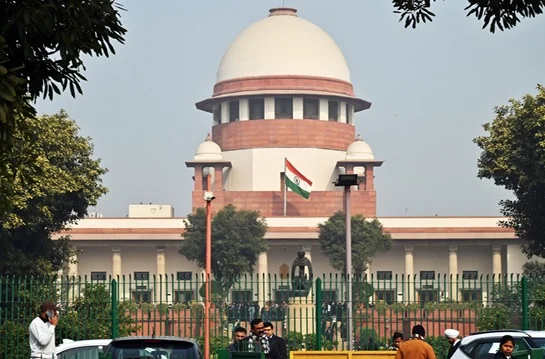
The Supreme Court set aside a judgment of the National Company Law Tribunal (NCLT) after finding that it relied on fake, non-existent, and AI-generated hallucinated judgments/precedents.
Key Observations of the Supreme Court
- AI can assist judicial processes, but adjudication must remain under the complete control of human judges.
- Reliance on AI-generated fake precedents undermines the credibility of the justice system.
- The apex bar body has been directed to frame guidelines and disciplinary measures to regulate AI use in legal practice.
Draft Regulations on AI Use in the Judiciary
- AI may be used only for administrative functions, such as :
- Case management
- Cause list preparation
- Hearing scheduling
- Court transcription
- Translation of judgments
- AI cannot be used for :
- Risk scoring
- Bail eligibility assessment
- Predicting recidivism
- Assessing witness credibility
- Processing of personal data must comply with the Digital Personal Data Protection Act, 2023.
- AI systems must not perpetuate bias based on race, religion, caste, gender, disability, language, or economic status.
- AI adoption should not widen the digital divide.
- A dedicated Apex Body is proposed at the Supreme Court to oversee AI adoption in the judiciary.
Current Use of AI in India's Judiciary
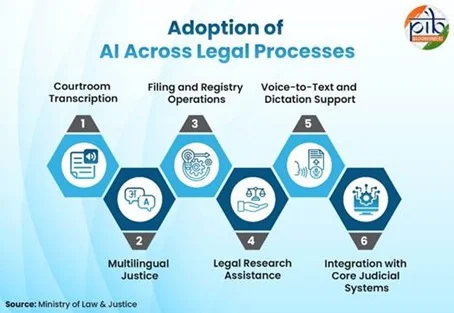
- Transcription of oral arguments
- Translation of judgments (SUVAAS)
- Detection of defects in e-filing
- Legal research
- Metadata extraction
- AI technologies such as Machine Learning (ML), Optical Character Recognition (OCR), and Natural Language Processing (NLP) are integrated into the e-Courts Project.
Significance of AI in the Judiciary
- Helps reduce the backlog of pending cases.
- Improves prison and investigation management.
- Enhances multilingual access to judicial documents.
- Increases efficiency and accuracy in legal research.
- Improves access to justice through AI-powered legal assistance.
Key Concerns
- AI hallucinations and fabricated legal precedents.
- Algorithmic bias and over-reliance on AI.
- Data privacy and security concerns.
- Inadequate digital infrastructure.
- Lack of human empathy and judicial discretion in sensitive cases.
Way Forward
- AI should function only as a decision-support tool, not a decision-maker.
- Robust regulatory, ethical, and data protection frameworks should be established.
- Human oversight must remain central to ensure transparency, accountability, and fairness in judicial decision-making.






 Contact Us
  New Batch : 9555124124/ 7428085757
  Tech Support : 9555124124/ 7428085757