
New
Hindi Medium: (Delhi) - GS Foundation (P+M) : 10th Aug 2026, 3:00 PM Hindi Medium: (Prayagraj) - GS Foundation (P+M) : 18th Aug 2026, 8:00 AM English Medium: (Delhi) - GS Foundation (P+M) : 6th Aug 2026 English Medium: (Prayagraj) - GS Foundation (P+M) : 19th Aug 2026, 8:00 AM Hindi Medium: (Delhi) - GS Foundation (P+M) : 10th Aug 2026, 3:00 PM Hindi Medium: (Prayagraj) - GS Foundation (P+M) : 18th Aug 2026, 8:00 AM English Medium: (Delhi) - GS Foundation (P+M) : 6th Aug 2026 English Medium: (Prayagraj) - GS Foundation (P+M) : 19th Aug 2026, 8:00 AM

National Biodiversity Authority Releases ₹15.52 Crore ABS Proceeds from Mustard Genetic Resources

Prelims: National Biodiversity Authority (NBA) | Access and Benefit Sharing (ABS) | Biological Diversity Act, 2002 | Nagoya Protocol | Kunming-Montreal Global Biodiversity Framework | People’s Biodiversity Registers | Biodiversity Management Committees
Mains: GS Paper III – Environment & Biodiversity | Conservation of Biological Resources | Access and Benefit Sharing | Community Participation
Keywords: Mustard Genetic Resources, ABS Proceeds, National Biodiversity Authority, Pioneer Overseas Corporation, State Biodiversity Boards, UT Biodiversity Councils, Biological Diversity Act 2002, Nagoya Protocol, Kunming-Montreal GBF

Why in News?

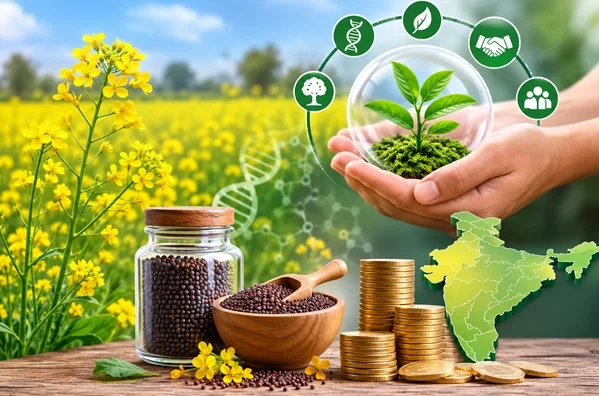
The National Biodiversity Authority (NBA) has released ₹15.52 crore as Access and Benefit Sharing (ABS) proceeds from M/s. Pioneer Overseas Corporation, which developed 10 commercial hybrid varieties of mustard (Brassica juncea) using India's biological resources.
Important Point

  • The amount will be distributed among 26 State Biodiversity Boards (SBBs) and 3 Union Territory Biodiversity Councils (UTBCs).
  • The distribution has been calculated according to the area under mustard cultivation in different States and Union Territories.
  • The move is significant because it demonstrates how the commercial use of India's biological resources can generate financial benefits for biodiversity conservation and local-level institutions.

What is Mustard?

Mustard is an important oilseed crop grown mainly for its seeds, which are used to produce edible mustard oil. Its seeds are also used as a spice and in food products.

  • Scientific name: Brassica juncea — Indian mustard 
  • Family: Brassicaceae (Cruciferae) 
  • Type: Mainly Rabi crop in India 
  • Sowing: Generally October–November 
  • Harvesting: Generally February–March 
  • Major producing states: Rajasthan, Uttar Pradesh, Madhya Pradesh, Haryana, West Bengal and Gujarat 
  • Major use: Edible oil, spice and animal feed/cake

What is Access and Benefit Sharing (ABS)?

Access and Benefit Sharing is the principle that benefits arising from the utilisation of biological resources and associated traditional knowledge should be shared fairly and equitably with the providers and custodians of those resources. In simple terms:

Biological Resource Commercial Use Economic Benefit Sharing with Conservation Institutions/Communities

ABS seeks to ensure that commercialisation of biological resources does not benefit only the user or company, but also contributes to conservation and sustainable use of biodiversity.

What Happened in the Mustard Case?

M/s. Pioneer Overseas Corporation developed 10 mustard hybrid varieties.

  • The company bred the varieties in-house.
  • However, the parental lines were sourced from open markets and traders.
  • It was therefore not possible to identify a particular farmer or community as the original source.
  • The NBA constituted an Expert Committee to determine how the ABS proceeds should be distributed.
  • The Authority approved the Committee's recommendations.
  • The ABS amount is being distributed among SBBs and UTBCs in areas where the biological resource is cultivated.

The NBA obtained mustard cultivation-area data from ICAR–Indian Institute of Rapeseed-Mustard Research (ICAR-IIRMR), Bharatpur, Rajasthan, and used this data to calculate the State-wise shares.

State-wise Distribution

Rank

State

Amount Released

1

Rajasthan

₹6.43 crore

2

Uttar Pradesh

₹2.28 crore

3

Madhya Pradesh

₹1.86 crore

4

Haryana

₹1.21 crore

5

West Bengal

₹1.10 crore

6

Jharkhand

₹0.73 crore

7

Assam

₹0.53 crore

8

Gujarat

₹0.48 crore

9

Bihar

₹0.15 crore

10

Punjab

₹0.08 crore

11

Others

₹0.67 crore

Rajasthan receives the largest share, accounting for nearly 42% of India's mustard cultivation, followed by Uttar Pradesh and Madhya Pradesh.

How Will the ABS Money Be Used?

The SBBs and UTBCs are required to utilise the funds for biodiversity-related activities under Section 32 of the Biological Diversity Act.

Major areas include:

  1. Conservation of biodiversity
  2. Preparation and updating of People’s Biodiversity Registers (PBRs)
  3. In-situ conservation of biological resources
  4. Ex-situ conservation
  5. Restoration of degraded ecosystems
  6. Strengthening Biodiversity Heritage Sites
  7. Capacity building of Biodiversity Management Committees (BMCs)
  8. Improving community livelihoods
  9. Other activities linked to conservation and sustainable utilisation of biodiversity

Why is this Important?

  • The mustard case is important because it addresses a practical challenge in ABS implementation: what happens when the original provider of a biological resource cannot be identified?
  • Instead of allowing the commercial benefit to remain disconnected from conservation, the NBA has adopted a resource-location-based distribution mechanism.
  • Thus, when resources are accessed through intermediaries such as traders or markets, the ABS proceeds can be channelled towards biodiversity institutions in areas where the resource is cultivated.

This creates a link between: Commercial utilisation ABS revenue State/UT biodiversity institutions Conservation Community livelihoods

India’s ABS Framework

The Biological Diversity Act, 2002 provides the legal framework for regulating access to India's biological resources and ensuring equitable sharing of benefits arising from their utilisation.

The National Biodiversity Authority is a statutory body functioning under the Ministry of Environment, Forest and Climate Change (MoEFCC).

The framework also involves:

  • National Biodiversity Authority (NBA)
  • State Biodiversity Boards (SBBs)
  • Biodiversity Management Committees (BMCs)
  • People’s Biodiversity Registers (PBRs)

Link with the Nagoya Protocol

  • India's ABS framework is aligned with the Nagoya Protocol on Access and Benefit-sharing, which is a supplementary agreement to the Convention on Biological Diversity (CBD).
  • The central idea is fair and equitable sharing of benefits arising from the utilisation of genetic resources.
  • The present release also supports the objectives of Target 13 of the Kunming-Montreal Global Biodiversity Framework, which focuses on ensuring fair and equitable sharing of benefits arising from the utilisation of genetic resources and associated traditional knowledge.

National Biodiversity Authority: Key Facts

The National Biodiversity Authority (NBA) was established under the Biological Diversity Act, 2002.

Key Functions

  • Regulates access to India's biological resources.
  • Facilitates fair and equitable benefit sharing.
  • Advises governments on biodiversity conservation.
  • Supports implementation of the Biological Diversity Act.
  • Facilitates implementation of the Nagoya Protocol.
  • Works towards conservation and sustainable utilisation of biological diversity.

ABS Disbursement: Key Figures

  • The NBA has released a total ABS amount of ₹182.5 crore so far.
  • Of this, ₹116.22 crore has been released to beneficiaries across the country during the last 12 months.
  • The latest ₹15.52 crore mustard-related release therefore represents another significant step in strengthening India's benefit-sharing mechanism.

Challenges in Access and Benefit Sharing

Despite the legal framework, ABS implementation faces several challenges:

  • Difficulty in identifying the original provider of biological resources.
  • Complex supply chains involving traders and intermediaries.
  • Limited documentation of biological resources and traditional knowledge.
  • Capacity constraints of local Biodiversity Management Committees.
  • Need for stronger monitoring of commercial utilisation.
  • Ensuring that benefits reach genuine local stakeholders.
  • Improving awareness among communities about biodiversity rights.

Way Forward

  • India needs to strengthen digital biodiversity documentation, improve coordination among NBA, SBBs and BMCs, and develop transparent mechanisms for tracing biological resources through supply chains.
  • Greater community participation in People’s Biodiversity Registers and better utilisation of ABS funds can ensure that benefit sharing becomes an effective tool for both biodiversity conservation and livelihood improvement.

Prelims MCQ

Q. With reference to Access and Benefit Sharing (ABS), consider the following statements:

  1. ABS seeks fair and equitable sharing of benefits arising from the utilisation of biological resources.
  2. The National Biodiversity Authority was established under the Biological Diversity Act, 2002.
  3. People’s Biodiversity Registers are unrelated to biodiversity conservation.

Which of the statements given above is/are correct?

A. 1 and 2 only
B. 2 and 3 only
C. 1 and 3 only
D. 1, 2 and 3

Mains Practice Question

Access and Benefit Sharing can transform biodiversity conservation from a regulatory obligation into a community-oriented economic mechanism. Discuss in the context of India’s Biological Diversity framework.

FAQs

Q1. What is Access and Benefit Sharing (ABS)?

ABS is the mechanism through which benefits arising from the utilisation of biological resources and associated knowledge are shared fairly and equitably with relevant stakeholders.

Q2. Why was ₹15.52 crore released in the mustard case?

The amount represents ABS proceeds from the commercial utilisation of Indian mustard genetic resources by Pioneer Overseas Corporation.

Q3. Why is Rajasthan receiving the highest share?

Rajasthan accounts for nearly 42% of India's mustard cultivation, so it receives the largest share under the cultivation-area-based distribution mechanism.

Q4. Which institution regulates India's biological resources under the Biological Diversity Act?

The National Biodiversity Authority (NBA) is the statutory national-level authority responsible for implementing the framework.

Q5. Why is ABS important for UPSC?

ABS connects biodiversity conservation, genetic resources, community rights, sustainable development and international environmental agreements, making it relevant to Environment, Ecology and International Relations sections of the UPSC syllabus.

Have any Query?

Our support team will be happy to assist you!

OR


