|
Prelims: Geography + Environment & Ecology + Current Affairs
Mains:
- GS Paper II – Governance; Government Policies & Interventions
- GS Paper III – Agriculture; Irrigation; Environment & Ecology
|
Why in News ?
- The 2026 Southwest Monsoon has shown significant regional variability, with several parts of north western, central, and southern India experiencing rainfall deficits, raising concerns over groundwater depletion, crop losses, and drinking water shortages.
- A recent editorial in The Hindu highlighted that India's water crisis is no longer just a drought issue but a long-term water security challenge, emphasizing the need for sustainable water governance, efficient irrigation, and climate-resilient policies.
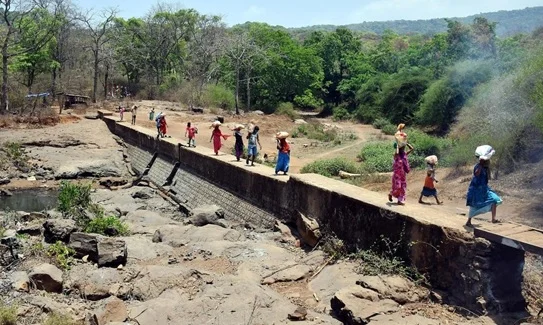
What is Water Security?
According to the United Nations, water security is the capacity of a population to safeguard sustainable access to adequate quantities of acceptable quality water for livelihoods, human well-being, socio-economic development, ecosystem protection, and resilience against water-related disasters.
It includes :
- Safe drinking water
- Reliable irrigation for agriculture
- Sustainable groundwater management
- Protection of rivers, lakes, and wetlands
- Flood and drought resilience
- Efficient urban water supply
Current Water Scenario in India
India receives nearly 4,000 Billion Cubic Metres (BCM) of annual rainfall, only about 1,123 BCM is considered utilisable due to uneven distribution, seasonal concentration, and inadequate storage infrastructure.
Climate change, rapid urbanisation, groundwater over-extraction, and inefficient water management have made India one of the world's most water-stressed countries.
1. High Dependence on Monsoon
- Around 75% of India's annual rainfall occurs during the four monsoon months (June–September).
- Any delay or uneven distribution directly affects agriculture and water availability.
2. Growing Water Stress
- India has only 4% of the world's freshwater resources but supports nearly 18% of the global population.
- Per capita water availability has declined sharply due to population growth.
3. Groundwater Crisis
- India is the largest user of groundwater in the world.
- More than 60% of irrigation and nearly 85% of rural drinking water depend on groundwater.
- Excessive extraction has caused falling water tables in many states.
4. Uneven Distribution
- Eastern and north eastern regions receive heavy rainfall.
- Western and peninsular India frequently face drought-like conditions.
Major Causes Behind India's Water Crisis
1. Climate Change
- Rising temperatures increase evaporation.
- Erratic rainfall leads to both floods and droughts.
- Longer dry spells reduce groundwater recharge.
2. Over-Extraction of Groundwater
- Free or subsidised electricity encourages excessive pumping.
- Water-intensive crops like paddy and sugarcane are cultivated even in water-scarce regions.
3. Inefficient Agricultural Practices
- Agriculture consumes nearly 80–85% of India's freshwater.
- Flood irrigation results in substantial water wastage.
4. Rapid Urbanisation
- Expanding cities reduce natural recharge areas.
- Concrete surfaces prevent rainwater infiltration.
- Increasing demand strains urban water supply systems.
5. Pollution
- Industrial discharge, untreated sewage, and agricultural chemicals contaminate rivers and groundwater.
- Pollution reduces the availability of usable freshwater.
6. Poor Water Governance
- Fragmented institutional responsibilities.
- Weak enforcement of groundwater regulations.
- Lack of integrated river basin management.
Challenges to Building Water Security
- Rain-fed agriculture remains highly vulnerable to rainfall variability.
- Conflicts over river water sharing delay effective management.
- Several aquifers are approaching unsustainable levels.
- Rapidly growing cities face recurring summer water crises.
- Pollution increases treatment costs and health risks.
- Frequent droughts and floods reduce water security.
Government Initiatives
1. Jal Jeevan Mission (JJM) – Launched: 15 August 2019
- Announced by the Government of India under the Ministry of Jal Shakti to provide Functional Household Tap Connections (FHTCs) to every rural household.
- Aims to ensure 55 litres of safe drinking water per person per day through sustainable water sources and village-level water management.
2. Atal Bhujal Yojana (ATAL JAL) – Launched: 25 December 2019
- A World Bank-assisted scheme focused on community-led groundwater management in seven water-stressed States.
- Encourages water budgeting, groundwater recharge, demand-side management, and sustainable use of aquifers.
3. Jal Shakti Abhiyan – Launched: 1 July 2019
- A nationwide campaign for water conservation and rainwater harvesting in water-stressed districts.
- Since 2021, it has continued annually as "Jal Shakti Abhiyan: Catch the Rain" with the slogan "Catch the Rain, Where it Falls, When it Falls."
4. Pradhan Mantri Krishi Sinchayee Yojana (PMKSY) – Launched: 1 July 2015
- Aims to improve irrigation efficiency under the vision of "Har Khet Ko Pani" and "Per Drop More Crop."
- Promotes micro-irrigation (drip and sprinkler systems), watershed development, and efficient water use in agriculture.
5. Atal Mission for Rejuvenation and Urban Transformation (AMRUT) – Launched: 25 June 2015
- Focuses on improving urban water supply, sewerage networks, stormwater drainage, and green spaces in cities.
- AMRUT 2.0, launched on 1 October 2021, expanded the mission with the objective of making Indian cities "Water Secure."
6. National Water Mission (NWM) – Launched: 2011
- One of the eight missions under the National Action Plan on Climate Change (NAPCC).
- Seeks to improve water-use efficiency by 20%, promote integrated water resource management, and enhance conservation of water resources.
Important Committees & Reports
- NITI Aayog Composite Water Management Index: Flags groundwater depletion across several Indian cities; shows better governance improves water security.
- Central Ground Water Board (CGWB): Monitors groundwater levels nationally.
- Central Water Commission (CWC): Manages surface water resources.
- UN-Water: Publishes global water security reports.
What More Needs to Be Done ? (Way Forward)
1. Shift towards Water-Smart Agriculture
- Promote crop diversification.
- Encourage millet cultivation in dry regions.
- Expand drip and sprinkler irrigation.
2. Strengthen Groundwater Governance
- Mandatory groundwater monitoring.
- Community-based aquifer management.
- Rational pricing of electricity for irrigation.
3. Scale up Rainwater Harvesting
- Make rooftop harvesting compulsory in urban areas.
- Restore traditional water bodies, tanks, ponds, and step wells.
4. Improve Water Use Efficiency
- Recycle and reuse treated wastewater.
- Reduce leakages in urban distribution systems.
- Promote water-efficient industries.
5. Integrated River Basin Management
- Manage rivers at basin level instead of administrative boundaries.
- Strengthen coordination among states.
6. Climate-Resilient Water Infrastructure
- Construct decentralized storage systems.
- Enhance floodwater capture for groundwater recharge.
- Improve watershed management.
7. Public Participation
- Encourage community-led water conservation.
- Promote behavioural changes for responsible water use.
- Strengthen local water governance through Panchayats and Urban Local Bodies.
PRELIMS QUICK-REVISION CAPSULE
Memorise Before the Exam
- Water Stress threshold = 1700 m³ / person / year
- Water Scarcity = 1000 m³ / person / year
- Absolute Scarcity = 500 m³ / person / year
- Agriculture uses ~80–85% of India’s freshwater
- India: 18% of world population, only 4% of freshwater resources
- India is the world’s largest extractor of groundwater (~25% of global total)
- Southwest Monsoon provides ~75–80% of India’s annual rainfall
|
Prelims Question
Q. With reference to Water Security in India, consider the following statements:
- India has 18% of the world's freshwater resources.
- Agriculture uses about 80–85% of India's freshwater.
- The National Water Mission is one of the eight missions under NAPCC.
- Atal Bhujal Yojana focuses on desalination of seawater.
Which of the statements are correct ?
A. 2 and 3 only
B. 1, 2 and 4 only
C. 1, 3 and 4 only
D. 1, 2, 3 and 4
UPSC Mains Question
"India's water crisis is no longer merely a scarcity issue but a challenge of ensuring long-term water security in the face of climate change and rising demand." Discuss the major challenges in achieving water security in India and suggest measures for sustainable water resource management.
Frequently Asked Questions (FAQs)
Q1. What is Water Security ?
Answer: Water security refers to ensuring adequate, safe, affordable, and sustainable water for drinking, agriculture, industry, ecosystems, and disaster resilience.
Q2. Why is India facing a water security crisis ?
Answer: Due to climate change, groundwater depletion, pollution, inefficient irrigation, rapid urbanisation, increasing population, and uneven rainfall distribution.
Q3. Which sector consumes the highest amount of water in India ?
Answer: Agriculture is the largest consumer, accounting for nearly 80–85% of total freshwater use.
Q4. Which government scheme focuses specifically on groundwater management ?
Answer: Atal Bhujal Yojana (ATAL JAL), launched in 2019, promotes community-led groundwater conservation and sustainable aquifer management.
|




 Contact Us
  New Batch : 9555124124/ 7428085757
  Tech Support : 9555124124/ 7428085757