|
Prelims : Science & Technology – Space Technology, ISRO Missions, Gaganyaan Programme
Mains : GS Paper III – Science & Technology: Developments and their Applications in Everyday Life; Achievements of Indians in Science & Technology
|
Why in News ?
- The Indian Space Research Organisation (ISRO) successfully conducted the first ground test of the Sub-Orbital Launch Vehicle for Experiments (SOLVE) on 3 July 2026 at the Satish Dhawan Space Centre (SDSC), Sriharikota.
- The successful test is a major step toward validating the Crew Module's parachute recovery system for India's ambitious Gaganyaan Human Spaceflight Mission, enhancing astronaut safety.
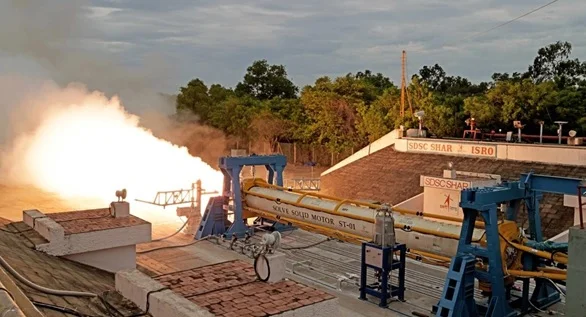
What is SOLVE ?
- SOLVE (Sub-Orbital Launch Vehicle for Experiments) is a specially designed solid motor-based experimental launch vehicle developed by ISRO to conduct Integrated Parachute Tests (IPTs) for the Gaganyaan mission.
- Its primary objective is to test the Crew Module's deceleration, parachute deployment, and safe recovery systems under realistic flight conditions before carrying astronauts into space.
- Unlike a full-fledged launch vehicle, SOLVE is a cost-effective sub-orbital platform that enables repeated testing of critical crew safety technologies.
Key Features
- Developed specifically for Gaganyaan Crew Module qualification tests.
- Carries the Crew Module to an altitude of 10–17 km before separation.
- Tests the deployment of 10 parachutes arranged in a carefully sequenced recovery system.
- Ensures controlled descent and safe splashdown in the sea.
- Uses a modified PSLV strap-on solid rocket motor.
- Equipped with Secondary Injection Thrust Vector Control (SITVC) for improved stability and trajectory control.
- Incorporates a slow-burning solid propellant suitable for sub-orbital missions.
- Enables multiple validation tests without requiring a complete orbital launch.
Why is it Important ?
- Enhances Crew Safety: Validates the parachute recovery system, one of the most critical safety components of any human spaceflight mission.
- Supports Gaganyaan Mission: Builds confidence before the upcoming uncrewed and crewed Gaganyaan missions.
- Cost-effective Testing: Allows repeated system validation without using expensive orbital launch vehicles.
- Reduces Mission Risk: Detects and rectifies technical issues before human missions.
- Strengthens Indigenous Capability: Demonstrates India's growing expertise in human-rated space technologies.
- Boosts India's Space Programme: Brings India closer to joining the select group of nations capable of independently sending humans into space.
About Gaganyaan Mission
- Gaganyaan is India's first indigenous human spaceflight programme.
- It is being developed by ISRO.
- The mission aims to send three astronauts (Vyomnauts) into Low Earth Orbit (LEO) at an altitude of around 400 km.
- The crew will remain in space for approximately three days before returning safely to Earth.
- The mission will be launched using the Human-rated LVM3 (Launch Vehicle Mark-3).
- Before the first crewed mission, ISRO is conducting multiple uncrewed test missions to validate crew escape systems, life support, parachutes, re-entry, and recovery technologies.
- The programme is expected to strengthen India's technological capabilities in human spaceflight, advanced manufacturing, robotics, life sciences, and aerospace engineering.
Previous Milestones
- 2018: Gaganyaan Programme officially announced.
- October 2023: Successful TV-D1 (Test Vehicle Demonstration-1) validated the Crew Escape System.
- Integrated Main Parachute Airdrop Tests (IMAT): Successfully qualified the main parachute system.
- Integrated Air Drop Tests (IADT-01 & IADT-02): Validated Crew Module recovery procedures.
- Service Module Propulsion System Hot Tests: Successfully completed.
- 2026: First successful SOLVE Ground Test (SOLVE-ST01) completed, validating the solid motor for future parachute qualification tests.
PRELIMS QUICK-REVISION CAPSULE
Memorise Before the Exam
- SOLVE – Sub-Orbital Launch Vehicle for Experiments.
- Developed by ISRO.
- Supports the Gaganyaan Human Spaceflight Programme.
- First ground test conducted on 3 July 2026.
- Test location: Satish Dhawan Space Centre (SDSC), Sriharikota, Andhra Pradesh.
- Crew Module reaches an altitude of 10–17 km during SOLVE missions.
- Recovery system uses 10 parachutes.
- Launch vehicle uses a modified PSLV strap-on solid motor.
- Employs Secondary Injection Thrust Vector Control (SITVC).
- Gaganyaan aims to send three astronauts into Low Earth Orbit (~400 km).
- Launch vehicle: Human-rated LVM3
|
Way Forward
- Conduct additional SOLVE flight tests to validate parachute performance under different conditions.
- Complete all remaining uncrewed Gaganyaan missions before the first crewed launch.
- Strengthen indigenous development of human-rated space technologies and life support systems.
- Expand collaboration with Indian industry and academia for advanced aerospace technologies.
- Use Gaganyaan as a foundation for future missions, including India's planned Bharatiya Antariksha Station and long-term lunar exploration.
Prelims MCQ
Q. With reference to the Sub-Orbital Launch Vehicle for Experiments (SOLVE), consider the following statements :
- It has been developed by ISRO to test the Crew Module recovery system for the Gaganyaan mission.
- It carries the Crew Module to an altitude of about 10–17 km before parachute deployment.
- It is powered by a modified PSLV strap-on solid motor.
- Its primary objective is to place satellites into Low Earth Orbit.
Which of the statements given above are correct ?
A. 1, 2 and 3 only
B. 1 and 4 only
C. 2, 3 and 4 only
D. 1, 2, 3 and 4
Mains Practice Question
Q. Discuss the significance of the Gaganyaan Mission in enhancing India's technological capabilities and strategic position in space. Examine the role of missions such as SOLVE in ensuring the success of human spaceflight.
FAQs
Q1. What is SOLVE ?
Answer: SOLVE (Sub-Orbital Launch Vehicle for Experiments) is an ISRO-developed experimental launch vehicle designed to test the Crew Module's parachute deployment and recovery systems for the Gaganyaan mission.
Q2. Why is the SOLVE test important ?
Answer: It validates the astronaut recovery system, reduces mission risks, and ensures that the Crew Module can safely return to Earth before India's first crewed spaceflight.
Q3. What is the objective of the Gaganyaan Mission ?
Answer: Gaganyaan aims to demonstrate India's capability to independently send astronauts into Low Earth Orbit and bring them back safely, making India one of the few nations with indigenous human spaceflight capability.
Q4. Why is Gaganyaan significant for India ?
Answer: The mission will strengthen India's space technology ecosystem, promote indigenous innovation, boost strategic capabilities, and pave the way for future projects such as an Indian space station and human lunar missions.
|






 Contact Us
  New Batch : 9555124124/ 7428085757
  Tech Support : 9555124124/ 7428085757