Prelims: Camizestrant (Etcamah), Breast Cancer, ESR1 Mutation, Circulating Tumour DNA (ctDNA), Liquid Biopsy, CDK4/6 Inhibitors, Companion Diagnostics, Guardant360 CDx, FDA Accelerated Approval, Precision Medicine
Mains: GS Paper II: Health, Government Policies & Interventions, Health Regulation
GS Paper III: Science & Technology, Biotechnology, Precision Medicine, Cancer Research, Genomics and Healthcare |
Why in News?
- The U.S. Food and Drug Administration (FDA) granted accelerated approval on 4 September 2026 to camizestrant, marketed under the brand name Etcamah by AstraZeneca.
Key Facts
|
Feature
|
Details
|
|
Drug
|
Camizestrant
|
|
Brand name
|
Etcamah
|
|
Company
|
AstraZeneca
|
|
Approval
|
FDA Accelerated Approval
|
|
Date
|
4 September 2026
|
|
Disease
|
Locally advanced/metastatic breast cancer
|
|
Cancer subtype
|
HR-positive, HER2-negative
|
|
Key mutation
|
ESR1
|
|
Type of drug
|
Estrogen receptor antagonist
|
|
Combination
|
CDK4/6 inhibitor
|
|
Companion diagnostic
|
Guardant360 CDx
|
|
Key technology
|
ctDNA blood testing
|
|
Major clinical trial
|
SERENA-6
|
|
Patients in trial
|
315
|
|
Median PFS
|
16 months vs 9.2 months
|
What is the FDA?
- An agency within the United States Department of Health and Human Services (HHS). It regulates and oversees areas including drugs, biological products, medical devices and several other health-related products.
Understanding Breast Cancer
- Breast cancer occurs when cells in breast tissue begin growing abnormally and uncontrollably. Modern treatment increasingly classifies breast cancer according to the molecular characteristics of tumour cells.
- Two important biomarkers are:
- Hormone Receptors (HR): determine whether hormones such as estrogen or progesterone help drive tumour growth.
- HER2: a protein that can promote cancer-cell growth when overexpressed.
- Breast cancers may be classified into groups such as HR-positive/HER2-negative, HER2-positive and Triple-negative breast cancer.
What is HR-Positive Breast Cancer?
- The cancer cells contain receptors for hormones such as estrogen and/or progesterone. Estrogen can bind to these receptors and stimulate tumour growth.
What is HER2-Negative Breast Cancer?
HER2 stands for Human Epidermal Growth Factor Receptor 2. It is a protein involved in cell growth. Some breast cancers contain unusually high amounts of HER2 and are classified as HER2-positive.
What is the ESR1 Gene?
- Estrogen Receptor 1 is the gene that encodes estrogen receptor-alpha. In HR-positive breast cancer, the estrogen-receptor pathway is often central to tumour growth.
- Patients are therefore commonly treated with endocrine therapies, including aromatase inhibitors. However, cancer cells evolve.
- During prolonged treatment, some tumours acquire ESR1 mutations. These mutations can enable estrogen-receptor signalling to continue even when estrogen production is being suppressed, contributing to resistance to endocrine treatment.
- The FDA notes that fewer than 5% of patients have this tumour mutation when HR-positive metastatic breast cancer is initially diagnosed. After progression on an aromatase inhibitor, however, the mutation is found in nearly 40% of patients.
What Are Aromatase Inhibitors (AIs)?
- An enzyme involved in estrogen production. It reduce estrogen production and are widely used as endocrine therapy for hormone-sensitive breast cancer.
Examples: Anastrozole and Letrozole.
What is Camizestrant?
- An oral estrogen receptor antagonist. Rather than continuing the aromatase inhibitor after an ESR1 resistance mutation is detected, the new treatment strategy switches the endocrine component to camizestrant while maintaining the patient's CDK4/6 inhibitor.
- HR+/HER2 (Breast Cancer) → Aromatase inhibitor + CDK4/6 inhibitor→ Regular ctDNA monitoring→ ESR1 mutation appears in blood→ Cancer has developed molecular resistance→ Switch AI (Camizestrant) → Continue CDK4/6 inhibitor→ Attempt to delay disease progression
What Are CDK4/6 Inhibitors?
- Cyclin-Dependent Kinases 4 and 6 are proteins involved in controlling the cell cycle. Cancer cells can exploit these pathways to multiply rapidly.
- These inhibitors interfere with this process and help slow cancer-cell proliferation.
- For the new camizestrant indication, the FDA permits combination with Abemaciclib, Palbociclib and Ribociclib.
- Traditionally, doctors may monitor advanced cancer through symptoms, imaging, laboratory tests and modify treatment when scans show that the cancer is progressing.
What is Circulating Tumour DNA (ctDNA)?
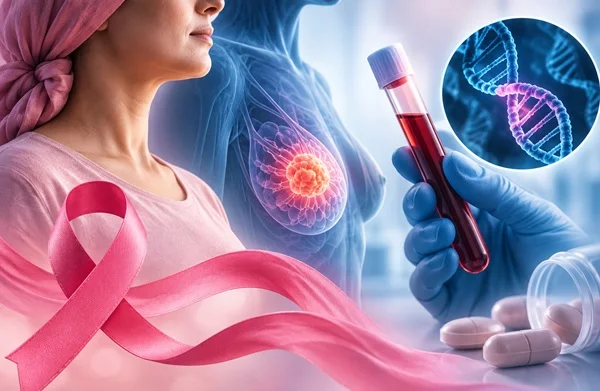
- Tumour cells can release small fragments of their DNA into the bloodstream. These fragments are known as ctDNA. A blood sample can be analysed for genetic alterations contained in these fragments.
- This offers the possibility of detecting molecular changes occurring inside a tumour without repeatedly taking tumour-tissue biopsies.
- The FDA explains that ctDNA consists of tiny pieces of tumour DNA released into blood and can enable earlier molecular detection of resistance mutations.
What is a Liquid Biopsy?
- Broadly refers to analysing tumour-related material circulating in body fluids, especially blood. It does not automatically replace conventional tissue biopsy or imaging in every clinical situation.
Guardant360 CDx: The Companion Diagnostic
- The FDA also authorized Guardant360 CDx as a companion diagnostic for the new treatment. Its role is to identify patients whose breast cancer has developed an ESR1 mutation and who may therefore be eligible for camizestrant treatment.
What is a Companion Diagnostic?
- A companion diagnostic is a test used to determine whether a particular patient is suitable for a specific targeted therapy.
SERENA-6 Clinical Trial
- The FDA's decision was based on evidence from the SERENA-6 trial (NCT04964934). It was a randomized, double-blind, placebo-controlled, multicentre trial in patients with ER-positive, HER2-negative locally advanced or metastatic breast cancer whose blood tests detected ESR1 mutations during first-line treatment.
- A total of 315 patients were randomized 1:1. One group switched to Camizestrant + CDK4/6 inhibitor while the comparison group continued Aromatase inhibitor + CDK4/6 inhibitor.
What Did the Trial Find?
- The key endpoint was Progression-Free Survival (PFS). The reported hazard ratio was 0.44, with a highly statistically significant result. At the time of the PFS analysis, overall-survival data were not yet mature.
- PFS is the length of time during and after treatment in which a patient's disease does not worsen. It is different from Overall Survival (OS) which measures how long patients remain alive.
What is FDA Accelerated Approval?
- It allows earlier approval of therapies for serious conditions with unmet medical needs based on a surrogate or intermediate endpoint that is expected to predict clinical benefit. However, accelerated approval is not the end of the evidence-gathering process.
- Companies must generally conduct confirmatory studies to verify the anticipated clinical benefit. If the benefit is confirmed, the indication may receive traditional approval. If benefit is not confirmed, regulatory procedures can potentially lead to withdrawal.
Why Did FDA use Accelerated Approval?
- The ESR1 mutation can be detected in blood before conventional imaging demonstrates tumour progression. The trial suggests benefit from changing treatment at this earlier molecular stage.
- However, the FDA states that it is not yet confirmed whether intervening at this point, rather than waiting for confirmed disease progression, ultimately translates into a clinically meaningful benefit. Confirmatory studies are therefore required.
Significance of the Approval
- First-of-its-Kind ctDNA-Guided FDA Cancer Approval: According to the FDA, it is the first cancer therapy approval guided by detecting a resistance mutation in ctDNA before imaging shows progression.
- Earlier Detection of Treatment Resistance: Molecular resistance can potentially be detected before conventional scans show worsening disease.
- Advances Precision Oncology: Treatment is selected according to a specific genetic alteration ESR1 mutation.
- Demonstrates the Potential of Liquid Biopsy: The approval highlights how blood-based genomic testing can increasingly influence cancer-management decisions.
- Biomarker-Drug Co-development: The importance of camizestrant + Guardant360 CDx demonstrates how modern therapies and companion diagnostics increasingly work together.
Limitations and Concerns
- Overall-survival data were not mature at the primary PFS analysis.
- The FDA specifically states that additional evidence is needed to establish whether intervention when a mutation is detected before radiographic progression produces a clinically meaningful benefit.
- Precision oncology requires access to advanced molecular diagnostics, which can raise questions of cost, laboratory infrastructure and equitable access.
- Targeted treatments can themselves eventually encounter further mechanisms of resistance as tumours evolve.
Safety Concerns
- The prescribing information includes a boxed warning concerning the risk of abnormal heart rhythm associated with QTc interval prolongation when camizestrant is taken with certain QTc-prolonging medications.
- Warnings and precautions also include Bradycardia (abnormally slow heart rate) and embryo-fetal toxicity.
Role of Project Orbis
- Project Orbis provides a framework for the concurrent submission and review of oncology drugs among international regulatory partners.
- For this review, the FDA collaborated with regulators in Australia, Brazil, Canada, Singapore and Switzerland. Other agencies' reviews may still be ongoing.
Prelims MCQ
Q. With reference to camizestrant (Etcamah), recently in the news, consider the following statements:
- It is an estrogen receptor antagonist used for certain breast cancers.
- ESR1 mutations can contribute to resistance to endocrine therapy.
- Circulating tumour DNA can be detected through blood testing.
Which of the statements given above are correct?
A. 1 and 2 only
B. 2 and 3 only
C. 1 and 3 only
D. 1, 2 and 3
Mains Practice Question
Q. How can circulating tumour DNA (ctDNA) and companion diagnostics transform cancer treatment? Discuss their role in the emerging field of precision medicine.
|
FAQs
What new breast cancer treatment has the FDA approved?
The FDA granted accelerated approval to camizestrant (Etcamah) in combination with a CDK4/6 inhibitor for certain adults with HR-positive, HER2-negative advanced or metastatic breast cancer carrying an acquired ESR1 mutation.
What is ESR1?
A gene encoding an estrogen receptor. Certain acquired mutations can contribute to resistance to endocrine therapy.
What is ctDNA?
Circulating tumour DNA consists of small fragments of DNA released by tumour cells into the bloodstream.
What makes this FDA approval special?
The first cancer-therapy approval guided by detection of a resistance mutation in ctDNA before imaging shows disease progression.
What is a liquid biopsy?
It analyses tumour-derived material, such as ctDNA, in blood or another body fluid to obtain molecular information about a cancer.
|







 Contact Us
  New Batch : 9555124124/ 7428085757
  Tech Support : 9555124124/ 7428085757