|
Prelims: National Social Assistance Programme, Pradhan Mantri Samajik Sahayata Yojana, Social Pensions, Article 41, Directive Principles of State Policy, Disability Pension.
Mains: GS Paper II – Welfare Schemes for Vulnerable Sections, Social Justice, Government Policies and
Interventions; GS Paper III – Inclusive Growth and Public Expenditure.
Keywords: NSAP Renamed 2026, Pradhan Mantri Samajik Sahayata Yojana, ₹53,428 Crore Social Assistance Programme, Old Age Pension, Widow Pension, Divyangjan Pension, Social Security, Pension Reforms.
|
Why in News?
- On 14 October 2026, the Union Cabinet approved ₹53,428 crore for continuing the National Social Assistance Programme (NSAP) during 2026-27 to 2030-31.
- The programme will be renamed Pradhan Mantri Samajik Sahayata Yojana, while the “Indira Gandhi” prefix will be removed from three pension schemes.
- The decision also expands disability pension eligibility and revises assistance rates.
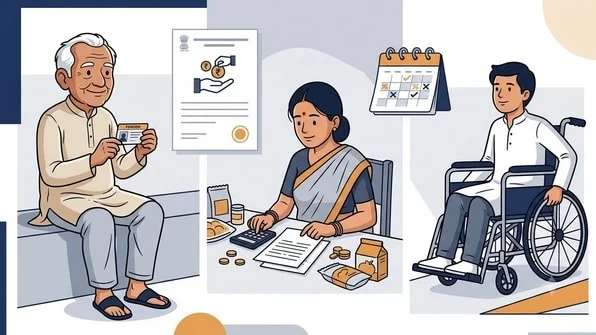
What Is the National Social Assistance Programme?
- The National Social Assistance Programme, launched on 15 August 1995, provides assistance to poor households facing vulnerabilities such as old age, widowhood, disability and the death of a breadwinner.
- It is administered by the Ministry of Rural Development and reflects the social assistance objectives of Article 41 of the Constitution.
- The programme provides central assistance, while States may supplement benefits or extend coverage through their own schemes. Consequently, the total support received by beneficiaries can vary across States.
Five-Year Financial Approval
|
Parameter
|
Details
|
|
Approved outlay
|
₹53,428 crore
|
|
Financial period
|
2026–27 to 2030–31
|
|
Duration
|
Five years
|
|
Principal changes
|
Renaming, revised disability pension provisions and programme continuation
|
|
Old-age, widow and family benefits
|
Continue in their existing form, apart from renaming
|
The approved amount is a five-year programme outlay, not an annual allocation or a payment directly available to each beneficiary.
New Names of the Programme and Sub-Schemes
|
Existing name
|
Approved new name
|
|
National Social Assistance Programme
|
Pradhan Mantri Samajik Sahayata Yojana
|
|
Indira Gandhi National Old Age Pension Scheme
|
Pradhan Mantri Vridhavastha Pension Yojana
|
|
Indira Gandhi National Widow Pension Scheme
|
Pradhan Mantri Vidhawa Pension Yojana
|
|
Indira Gandhi National Disability Pension Scheme
|
Pradhan Mantri Divyangjan Pension Yojana
|
|
National Family Benefit Scheme
|
Pradhan Mantri Parivar Labh Yojana
|
The renaming therefore covers both the umbrella programme and its listed sub schemes.
Changes in Disability Pension
|
Parameter
|
Previous Criteria
|
Approved New Criteria
|
|
Disability Threshold
|
80% or more
|
Reduced to 40% (aligned with benchmark disability)
|
|
Minimum Eligible Age
|
18 years
|
From Birth (no minimum age limit)
|
|
Assistance (Ages 0–79)
|
₹300 / month
|
₹375 / month
|
|
Assistance (Ages 80+)
|
₹500 / month
|
₹625 / month
|
The Cabinet release connects the changes to the Rights of Persons with Disabilities Act, 2016. Revised implementation guidelines are to be issued and implemented within three months; Cabinet approval should therefore be distinguished from completed rollout.
Coverage: Existing Figures and the New Announcement
The figures refer to different contexts and should be read separately:
- Earlier central coverage: The supplied news report identifies a ceiling of 3.09 crore beneficiaries under the three pension schemes.
- State-supported coverage: It cites the Economic Survey 2024–25 as recording an additional 5.86 crore beneficiaries supported by States, bringing combined coverage to 8.95 crore.
- New announcement: The Cabinet release states that the approval will benefit 3.20 crore people across 36 States and Union Territories.
- The new headline figure should not be treated as a revised count of all beneficiaries under central and independent State pension programmes combined.
Significance
- Continuity of Social Assistance: The five-year approval provides a planning framework for continuing support to vulnerable households.
- Wider Disability Inclusion: A lower disability threshold and eligibility from birth can extend assistance to people previously excluded by disability severity or age requirements.
- Household Income Security: Social pensions can help beneficiaries meet basic expenses, including food, transport and healthcare, while reducing dependence on relatives.
- Greater Dignity and Autonomy: Regular assistance can strengthen the ability of elderly persons, widows and persons with disabilities to make every day financial decisions.
Relevance for India
- Ageing population: Social protection must respond to increasing demand for old-age support.
- Informal employment: People without employment-linked pensions depend more heavily on household resources and public assistance.
- Gender vulnerability: Widow Pensions can provide an independent source of support to women facing income insecurity.
- Inclusive development: Disability assistance can help address additional living costs and barriers to participation.
- Centre–State coordination: Central support and State supplements together shape the adequacy and reach of social pensions.
Challenges
- Inflation and Inadequate Benefits: When pension amounts remain unchanged, rising prices reduce their purchasing power. Formal continuation of a scheme does not necessarily preserve the real value of its benefits.
- Coverage Ceilings: A fixed beneficiary ceiling can exclude eligible applicants. The handbook Realising Rights: A Handbook of Welfare in India, cited in the supplied report, highlights the gap between meeting eligibility conditions and actually receiving assistance.
- Demographic Changes: Funding requirements depend on both benefit levels and the number of eligible people. A five-year framework needs mechanisms to respond to changes in these factors.
- Differences Across States: State supplements can improve support, but differences in fiscal capacity and policy choices may produce unequal assistance across regions.
Way Forward
- Review benefits periodically: Assess pension amounts against inflation and essential living costs.
- Update coverage estimates: Use current demographic and eligibility information to identify unmet demand.
- Allow responsive funding: Review expenditure requirements during the five-year period as beneficiary numbers change.
- Improve access: Simplify applications and provide assistance to elderly and disabled applicants.
- Ensure timely payments: Strengthen payment tracking and grievance resolution.
- Publish clear implementation information: Explain revised eligibility, benefit levels and rollout dates in accessible language.
Conclusion
The continuation and restructuring of NSAP provide an opportunity to strengthen social assistance, particularly for persons with disabilities. Its effectiveness will depend on adequate benefits, inclusive coverage and reliable delivery. Renaming should be accompanied by measurable improvements in beneficiaries’ financial security and dignity.
Prelims Practice Question
The National Social Assistance Programme primarily reflects the objectives of which Article of the Indian Constitution?
(a) Article 21A
(b) Article 32
(c) Article 41
(d) Article 280
Mains Practice Question
“The effectiveness of social pensions depends on benefit adequacy and inclusive coverage as much as budgetary continuity.” Discuss in the context of the recent restructuring of the National Social Assistance Programme.
|
FAQs
1. What is the new name of NSAP?
The approved new name is Pradhan Mantri Samajik Sahayata Yojana.
2. How much funding has the Cabinet approved?
The Cabinet approved ₹53,428 crore for five years, covering 2026–27 to 2030–31.
3. Have old-age and widow pension benefits been increased under this decision?
The announcement continues these schemes in their existing form, apart from renaming. The specified benefit revisions concern disability pensions.
4. What is the main change in disability pension eligibility?
The disability threshold has been reduced from 80% to 40%, and the minimum age requirement has been changed to allow eligibility from birth.
5. Why has the allocation attracted criticism?
Critics question whether the funding adequately reflects inflation, demographic changes and the needs of eligible people outside existing coverage.
|






 Contact Us
  New Batch : 9555124124/ 7428085757
  Tech Support : 9555124124/ 7428085757