
- UPSC Exam
- State PCS
- One Day Exam
- Current Affairs
- PT Quiz
- Downlaods
- About Coaching
- Blog
- Videos

|
Prelims : Government Schemes + Infrastructure + CA |
The Sagarmala Programme has been in news due to recent progress in port modernisation, connectivity enhancement, and coastal economic zone development.
The government has reviewed implementation status and emphasised accelerating project execution.
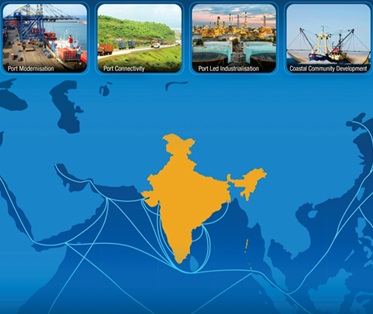
The Sagarmala Programme was launched in 2015 by the Government of India.
It aims to promote port-led development by leveraging India’s long coastline and strategic maritime location.
Prelims
Q. The Sagarmala Programme is primarily associated with :
(a) Agriculture development
(b) Port-led development
(c) Rural housing
(d) Renewable energy
Mains
“Discuss the role of the Sagarmala Programme in transforming India’s logistics sector and promoting economic growth.”
FAQsQ1. What is the Sagarmala Programme ? A port-led development initiative by the Government of India. Q2. When was it launched ? 2015. Q3. What are Coastal Economic Zones ? Industrial zones developed near ports to boost manufacturing and trade. Q4. Why is Sagarmala important ? It reduces logistics costs and enhances trade efficiency. Q5. What are its major challenges ? Environmental concerns and implementation delays. |
| Prelims : Defence Exercises + International Relations + CA Mains : GS Paper 3 – Defence Cooperation, Security; GS Paper 2 – Bilateral Relations |
The latest edition of Exercise Dustlik has been conducted, further strengthening defence cooperation and military interoperability between India and Uzbekistan.
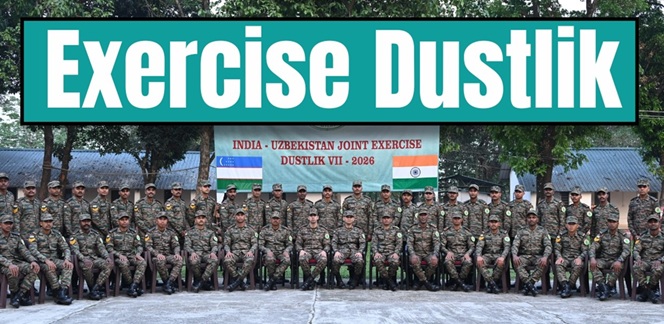
Exercise Dustlik is a joint military exercise conducted between the armed forces of :
It is an annual bilateral exercise, alternately hosted by both countries.
The primary objectives of Exercise Dustlik include :
Prelims
Q. Exercise Dustlik is conducted between India and which country ?
(a) Kazakhstan
(b) Uzbekistan
(c) Kyrgyzstan
(d) Tajikistan
Mains
“Joint military exercises play a crucial role in strengthening bilateral relations and enhancing combat readiness.” Discuss with reference to Exercise Dustlik.
FAQsQ1. What is Exercise Dustlik ? A joint military exercise between India and Uzbekistan. Q2. What is its main focus ? Counter-terrorism operations and military cooperation. Q3. How often is it conducted ? Annually. Q4. Why is it important ? It strengthens defence ties and regional security. Q5. Which forces participate ? Primarily the armies of India and Uzbekistan. |
| Prelims : International Relations + CA Mains : GS Paper 2 – International Relations, Global Geopolitics |
High-level negotiations between the United States and Iran held in Islamabad collapsed after nearly 21 hours of continuous discussions, failing to produce a ceasefire or de-escalation agreement.
The talks were seen as a crucial diplomatic effort amid escalating tensions in West Asia, but ended without any breakthrough.
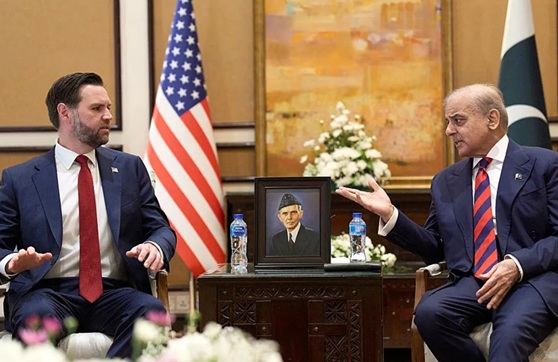
Relations between the United States and Iran have remained adversarial since the 1979 Iranian Revolution.
Key issues in bilateral tensions include :
The Islamabad talks marked a rare attempt at direct high-level engagement, facilitated in a neutral setting to address immediate conflict escalation.
Despite being reportedly “close to a deal” at certain stages, negotiations ultimately broke down.
The most significant obstacle was disagreement over Iran’s nuclear programme.
This remained the primary deal-breaker.
Negotiations were undermined by deep mistrust :
Iranian negotiators explicitly stated that the US failed to build sufficient trust during the talks.
Both sides held rigid positions :
This rigidity prevented compromise even after prolonged discussions.
A major disagreement emerged over sequencing :
The inability to agree on “who acts first” resulted in a stalemate.
Given that a large share of global oil trade passes through this route, the disagreement added a critical geopolitical dimension.
This reduced the credibility of negotiations and weakened diplomatic space.
The collapse reflects :
Even prolonged negotiations could not overcome structural differences.
Prelims
Q. The Strait of Hormuz connects :
(a) Red Sea and Mediterranean Sea
(b) Persian Gulf and Gulf of Oman
(c) Arabian Sea and Bay of Bengal
(d) Caspian Sea and Black Sea
Mains
“Discuss the reasons behind the failure of Iran–US talks and its implications for global peace and energy security.”
FAQsQ1. Where were the talks held ? n Islamabad, Pakistan. Q2. How long did the talks last ? Approximately 21 hours. Q3. What was the main issue ? Disagreement over Iran’s nuclear programme. Q4. Why is the Strait of Hormuz important ? It is a key global oil transit route. Q5. What is the main takeaway ? Deep mistrust and rigid positions prevented any agreement. |
| Prelims : Environment + Polity + CA Mains : GS Paper 3 – Environment, Conservation; GS Paper 2 – Governance, Tribal Rights |
A recent case before the Supreme Court of India has highlighted the conflict between :
This has revived the debate on Forest Rights vs Conservation Laws.

Key Features :
Example :
Houses for tribal communities vs restriction on forest land use
-This shows need for harmonisation of both laws
Prelims
Q. Which of the following Acts recognises community forest rights ?
(a) Forest Conservation Act, 1980
(b) Forest Rights Act, 2006
(c) Wildlife Protection Act, 1972
(d) Environment Protection Act, 1986
Mains
“Discuss the conflict between the Forest Rights Act, 2006 and the Forest (Conservation) Act, 1980. How can India balance tribal rights with environmental conservation?”
FAQsQ1. What is the main aim of FRA ? To recognise rights of forest-dwelling communities. Q2. What is the main aim of FCA ? To conserve forests and regulate land diversion. Q3. Why is there a conflict ? Because one focuses on rights, the other on restrictions. Q4. What is the current issue ? Construction on forest land and legal interpretation of both laws. Q5. What is the solution ? Balanced and harmonised implementation of both Acts. |
| Prelims : Polity + CA Mains : GS Paper 2 – Judiciary, Criminal Justice System; GS Paper 4 – Ethics (Justice, Human Rights) |
The concept of the ‘Sriharan Vacuum’ in death penalty jurisprudence has gained attention due to ongoing debates on remission, clemency powers, and sentencing in capital punishment cases.
It highlights gaps in legal clarity regarding the extent of executive powers versus judicial authority in modifying sentences.

The issue stems from the landmark judgment in Union of India v. V. Sriharan, which dealt with remission powers in cases involving life imprisonment and death penalty commutation.
The Supreme Court held that :
India follows the “rarest of rare” doctrine, established in :
- Bachan Singh v. State of Punjab
Key principles :
The term refers to a legal grey area created after the Sriharan judgment regarding :
- It creates uncertainty between :
But judicial restrictions complicate their application.
This reduces executive discretion.
Especially in high-profile cases.
Prelims
Q. The “rarest of rare” doctrine in India is associated with which case ?
(a) Kesavananda Bharati case
(b) Maneka Gandhi case
(c) Bachan Singh case
(d) Vishaka case
Mains
“Discuss the challenges in India’s death penalty jurisprudence with reference to the ‘Sriharan Vacuum’.”
FAQsQ1. What is the Sriharan case about ? It deals with remission powers and sentencing in life imprisonment cases. Q2. What is the ‘rarest of rare’ doctrine ? A principle limiting death penalty to exceptional cases. Q3. What is the Sriharan Vacuum? A legal ambiguity between judicial and executive powers on remission. Q4. Which Articles deal with clemency powers ? Articles 72 and 161. Q5. Why is this issue important ? It affects justice delivery, human rights, and constitutional balance. |

Our support team will be happy to assist you!


 Contact Us
  New Batch : 9555124124/ 7428085757
  Tech Support : 9555124124/ 7428085757

