- UPSC Exam
- State PCS
- One Day Exam
- Current Affairs
- PT Quiz
- Downlaods
- About Coaching
- Blog
- Videos

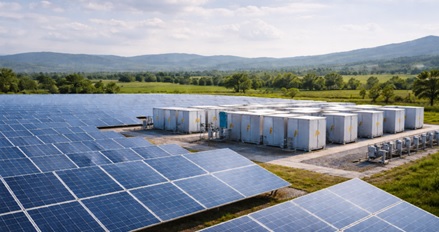
The Sitapur Solar Project is a landmark initiative that brings together renewable energy, energy storage, and defence infrastructure for the first time in India. Developed on around 850 acres of vacant defence land in Uttar Pradesh, the project is expected to become a model for future green energy projects across defence establishments. It reflects India's efforts to strengthen energy security while promoting sustainable development.
One of the most significant features of the project is that it is India's first large-scale solar power project to be built on defence land. Instead of leaving large areas of land unused, the Ministry of Defence is utilizing them to generate clean electricity. This not only reduces the need for acquiring new land but also demonstrates how government-owned assets can be used efficiently to support national development and environmental sustainability.
The Sitapur project is also the first initiative of the Ministry of Defence to combine solar power generation with a Battery Energy Storage System (BESS). Since solar energy is available only during daylight hours, the battery system will store excess electricity generated during the day and supply it whenever needed. This will help ensure a stable and uninterrupted power supply while maximizing the use of renewable energy.
Reliable electricity is essential for modern defence operations. Military facilities depend on continuous power for communication systems, surveillance networks, command centres, and radar installations. The integrated battery storage system will provide backup power during grid failures, natural disasters, emergencies, or periods of high demand. As a result, the project will strengthen India's energy resilience and improve the operational readiness of the armed forces.
The project is an important step towards building greener and more sustainable defence infrastructure. By increasing the use of solar energy, it will help reduce carbon emissions and decrease dependence on conventional sources of electricity. It also aligns with India's broader goals of expanding renewable energy capacity and achieving long-term energy security.
A Battery Energy Storage System (BESS) is a technology that stores electricity for future use. It captures surplus energy generated from renewable sources such as solar and wind power and releases it when required. In simple terms, it works like a giant rechargeable battery that helps ensure a continuous and reliable power supply.
The working of BESS is simple. During the day, solar panels generate electricity. Any excess power that is not immediately consumed is stored in batteries. Later, when solar generation decreases, electricity demand increases, or the grid faces disruptions, the stored energy is released. This ensures that electricity remains available even when renewable energy production fluctuates.
As the share of renewable energy grows, energy storage is becoming increasingly important. Solar power is available only when the sun shines, while wind energy depends on weather conditions. However, electricity demand continues throughout the day and night. BESS helps bridge this gap by storing excess energy and supplying it whenever required. This improves grid stability, reduces energy wastage, enhances energy security, and supports greater use of clean energy.
Besides BESS, several other technologies are used to store energy. Pumped Hydro Storage (PHS) stores energy by pumping water to a higher reservoir and releasing it through turbines when electricity is needed. Compressed Air Energy Storage (CAES) stores energy in the form of compressed air, which is later used to generate electricity. Flywheel Energy Storage stores energy as kinetic energy in a rapidly spinning wheel, while Gravity Energy Storage generates power by lowering heavy masses that were previously lifted using surplus electricity. Together, these technologies play a crucial role in ensuring reliable power supply and supporting the transition towards a cleaner and more sustainable energy future.
The Sitapur Solar Project is not merely a renewable energy project. It represents the convergence of national security, clean energy transition, energy storage technology, and efficient utilization of public assets, making it a significant milestone in India's journey toward sustainable and self-reliant defence infrastructure.
Recently, researchers from Mumbai, Kochi, and Japan used the GRAPES-3 (Gamma Ray Astronomy PeV Energies Phase-3) telescope to study how the temperature of Earth's upper atmosphere and the Sun's magnetic field affect muons, subatomic particles arriving from space.
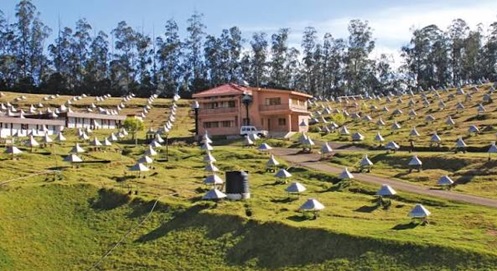
The GRAPES-3 telescope is an important astronomical research project in India, playing a key role in the study of cosmic rays, muons, and space weather phenomena. This helps to better understand cosmic processes, solar activity, and their impacts on Earth's atmosphere.

Our support team will be happy to assist you!

 Contact Us
  New Batch : 9555124124/ 7428085757
  Tech Support : 9555124124/ 7428085757