Why in the news ?
Recently, researchers from Mumbai, Kochi, and Japan used the GRAPES-3 (Gamma Ray Astronomy PeV Energies Phase-3) telescope to study how the temperature of Earth's upper atmosphere and the Sun's magnetic field affect muons, subatomic particles arriving from space.
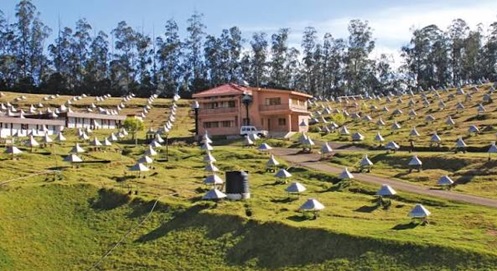
What is the GRAPES-3 Telescope ?
- GRAPES-3 is an advanced astronomical observatory developed to study the origin, acceleration, and propagation of cosmic rays.
Key Features
- Full name: Gamma Ray Astronomy PeV Energies Phase-3 (GRAPES-3)
- It studies high-energy cosmic rays and gamma rays entering the Earth's atmosphere.
- It also analyzes solar activity and geomagnetic storms through cosmic ray muons.
- It is equipped with an array of plastic scintillator detectors and a large-area muon detector.
- Location: Ooty (Tamil Nadu)
- Operation: Tata Institute of Fundamental Research
What are muons ?
- Muons are subatomic particles similar to electrons but with greater mass.
- They are produced when cosmic rays collide with Earth's atmosphere.
- Muons can travel at nearly the speed of light and reach Earth's surface.
What are cosmic rays ?
- Cosmic rays are highly energetic charged particles that travel towards Earth from outer space.
Key Facts
- They were discovered more than 100 years ago.
- They are considered among the most energetic particles in the universe.
- They enter Earth's atmosphere and produce a particle shower.
- This shower includes particles such as electrons, photons, protons, neutrons, and muons.
- Their energy range is approximately 10⁸ eV to 10²⁰ eV.
- They reach Earth continuously from almost all directions.
Significance of the Study
- Helps understand the relationship between Earth's atmosphere and space weather.
- Improves assessment of the impacts of solar activity on Earth.
- Contributes to understanding the nature of cosmic rays and cosmic phenomena.
- Provides a vital research base in the fields of space science and astrophysics.
Conclusion
The GRAPES-3 telescope is an important astronomical research project in India, playing a key role in the study of cosmic rays, muons, and space weather phenomena. This helps to better understand cosmic processes, solar activity, and their impacts on Earth's atmosphere.






 Contact Us
  New Batch : 9555124124/ 7428085757
  Tech Support : 9555124124/ 7428085757