- UPSC Exam
- State PCS
- One Day Exam
- Current Affairs
- PT Quiz
- Downlaods
- About Coaching
- Blog
- Videos

For years, the Arctic remained largely untouched by major global rivalries and was mainly considered a region for scientific studies. But that situation has now changed. Today, the Arctic is emerging as a major centre of geopolitical and strategic competition.
For years, the Arctic remained away from major global rivalries and was mainly seen as a region for scientific research. But now, the region has become an important centre of geopolitical and strategic competition.
The entry of Finland and Sweden into NATO has reshaped the security environment of Northern Europe and increased strategic tensions in the Arctic region.
Growing coordination between Russia and China in the Arctic is creating new geopolitical challenges, pushing India to strengthen its own strategic partnerships in the region.
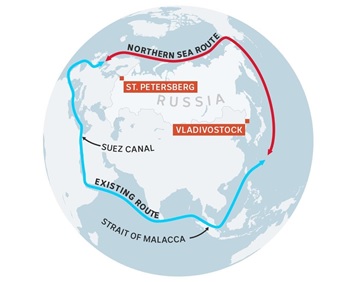
Melting Arctic ice is opening new sea routes like the Northern Sea Route along Russia’s coast. This route can reduce shipping distance between Europe and Asia by nearly 40% compared to the Suez Canal route, making trade faster and more efficient.
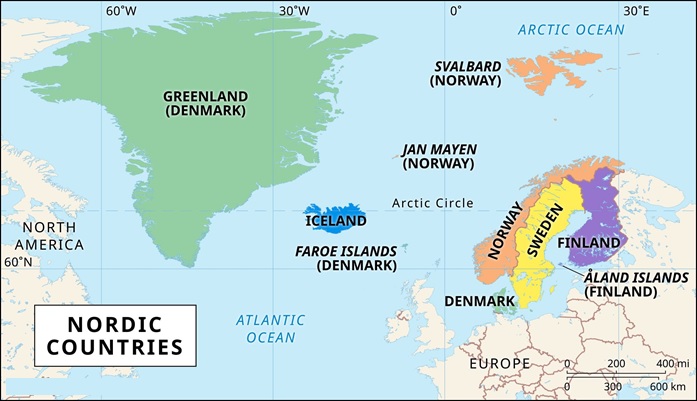
India has been an observer state in the Arctic Council since 2013 and maintains a dedicated scientific footprint through its Himadri research station. However, science alone can no longer safeguard India's national interests.
The Nordics represent a rare diplomatic sweet spot: they offer advanced technology, immense capital, and specialized expertise without the hegemonic pressures or geopolitical baggage of larger global superpowers.
Norway is a global leader in offshore wind, green shipping corridors, and carbon capture and storage (CCS). As India works aggressively to decarbonize its heavy industries, partnering with Nordic firms allows India to scale up localized green technologies. The economic groundwork is already laid; the India-EFTA Trade and Economic Partnership Agreement (TEPA) commits to a massive $100 billion investment into India over the next 15 years.
To reduce its dangerous reliance on China for critical minerals, India can look to the resource-rich Nordic cluster. Norway holds massive deep-sea mining potential, Sweden boasts vast reserves of rare earth elements and iron ore, and Denmark offers unique strategic mineral access via Greenland.
India’s interest in the North is also driven by survival. Accelerating ice loss in the Arctic—particularly in the Barents-Kara Sea—has been directly linked to unpredictable variations in the Indian summer monsoon. Because changes in the Arctic Circle dictate food security and weather patterns in the tropics, deep scientific and ecological collaboration with Oslo is a necessity.
To truly maximize this "northward turn," India’s approach must evolve from episodic diplomatic visits to a sustained, institutionalized alliance. Moving forward, New Delhi should focus on three immediate policy measures:
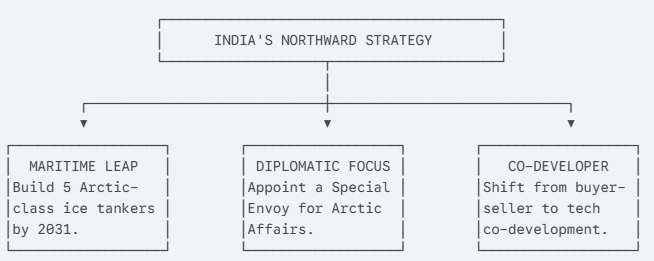
The Strategic Outlook: Engaging deeply with the Nordic countries does not mean India must compromise its long-standing partnership with Russia. In a multipolar world, India’s doctrine of strategic autonomy perfectly accommodates a robust, independent footprint in both Eastern and Northern Europe.
The northern lights may be physically distant from the Indian tropics, but the strategic, economic, and ecological horizons of New Delhi and Oslo are rapidly converging. For the Nordics, India offers unprecedented market scale, economic vitality, and a trusted democratic anchor. For India, the Nordics provide the technological blueprint for a sustainable future.
The Oslo Summit must be the catalyst that transforms historical sambandh (relations) into a hard-nosed, definitive strategic alliance for the 21st century.
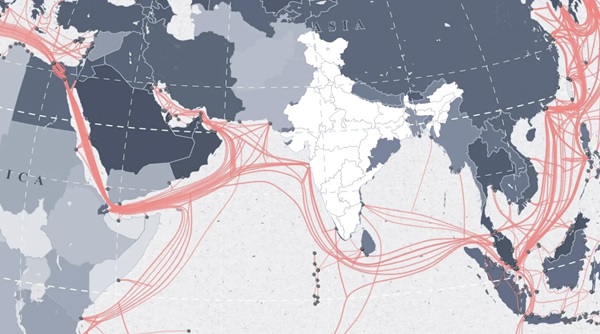
have been mentioned in discussions concerning digital infrastructure control and strategic dependence.
Access to cable traffic could expose financial transactions, government communications, strategic information, and commercial data.
India depends significantly on international connectivity routes passing through West Asia. If cable systems in the Hormuz region are disrupted, traffic would need to be diverted through alternate routes.
Although the internet may not completely fail, users could experience:
The impact would be more visible in sectors dependent on international data transfer.
India’s businesses, startups, financial institutions, and public services increasingly rely on global cloud infrastructure such as:
Disruptions in submarine cables may increase server response times, slow cloud access, and temporarily affect digital platforms.
This could impact e-commerce, online education, payment systems, digital governance, and enterprise services.
Even short disruptions may have wider economic implications.
India’s IT-BPM and outsourcing industry serves clients across the world and depends on uninterrupted digital connectivity.
Disruptions in cable systems may affect:
This could impact operational efficiency and India’s digital services economy.

Our support team will be happy to assist you!

 Contact Us
  New Batch : 9555124124/ 7428085757
  Tech Support : 9555124124/ 7428085757