| Prelims: (History + CA) Mains: (GS 1 – Indian History; GS 4 – Ethics) |
Following a car blast near Red Fort, Delhi Police have tightened security in the area as the heritage site is set to host an event commemorating the 350th death anniversary of Guru Tegh Bahadur, remembered for his supreme sacrifice in protecting religious freedom.

1. Founder of Anandpur Sahib
2. Contribution to Sikh Scriptures
3. Defender of Religious Freedom
|
FAQs Q1: Who was Guru Tegh Bahadur? Ans: The ninth Sikh Guru, known for his spiritual teachings and sacrifice for religious freedom. Q2: Who was the father of Guru Tegh Bahadur? Ans: Guru Hargobind, the sixth Sikh Guru. Q3: Which city was founded by Guru Tegh Bahadur? Ans: Anandpur Sahib in present-day Punjab. Q4: Guru Tegh Bahadur was executed on the orders of which Mughal emperor? Ans: Aurangzeb. Q5: What is Guru Tegh Bahadur most remembered for? Ans: His martyrdom in defense of religious freedom, especially protection of Kashmiri Pandits from forced conversions. Q6: Where is Gurdwara Sis Ganj Sahib located? Ans: In Chandni Chowk, Delhi, marking the site of his execution. Q7: How many hymns did Guru Tegh Bahadur contribute to the Guru Granth Sahib? Ans: Over 100 hymns dealing with spirituality, moral values, and detachment. |
| Prelims: (Economy + CA) Mains: (GS 3 – Economy; GS 2 – Government Policies) |
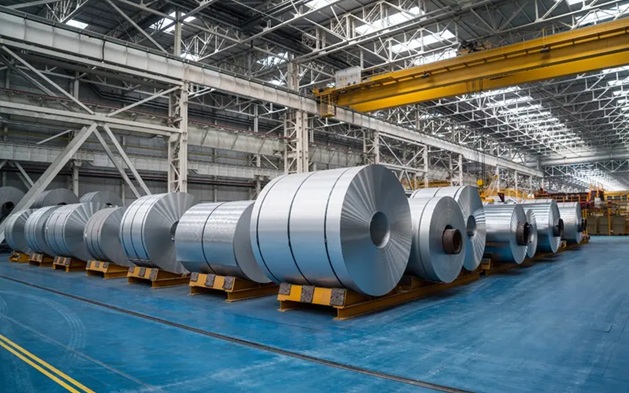
The Ministry of Steel has launched a simplified registration facility called SARAL SIMS under the Steel Import Monitoring System (SIMS). The facility became effective on November 21 and aims to ease import procedures for small consignments and export-oriented shipments.
1. Coverage
2. Single Annual Declaration
3. No Repeated SIMS Number Generation
4. Annual Return Requirement
5. Two Modes of Use
a. SARAL SIMS for Small Imports
b. SARAL SIMS for Export Purposes
|
FAQs Q1: What is the primary purpose of the Steel Import Monitoring System (SIMS)? Ans: To monitor steel imports and provide timely data to the domestic steel industry. Q2: Which ministry launched the Steel Import Monitoring System (SIMS) 2.0? Ans: Ministry of Steel and Heavy Industries. Q3: Who can avail SARAL SIMS? Ans: Importers handling small consignments or using export-linked frameworks like SEZ, EOU, and Advance Authorization. Q4: Does SARAL SIMS replace regular SIMS? Ans: No. It is an additional simplified window for small and export-oriented consignments. Q5: How long is the SARAL SIMS number valid? Ans: For the entire financial year, covering multiple consignments. Q6: Is there a limit for exports under SARAL SIMS? Ans: No quantity limit for imports meant for export production. Q7: Why was SARAL SIMS introduced? Ans: To reduce procedural delays, support MSMEs, and simplify the compliance load within steel import regulations. |
| (Preliminary Examination: Current Affairs) (Mains Examination, General Studies Paper 1: The Role of Anti-State Elements in Threatening Internal Security; Security Challenges and Their Management) |
Nine people were killed and 29 injured in a recent massive explosion at the Nowgam police station in Jammu and Kashmir. The explosion was caused by explosives seized during the investigation of the Red Fort blast case. This incident raises serious concerns about how to follow the Standard Operating Procedure (SOP) for safekeeping and handling of seized explosives.

There are clear guidelines for storing confiscated explosives:
Key laws and regulations governing the storage, transportation, and destruction of explosives in India:
| Prelims: (Economy + CA) Mains: (GS 2 – Governance; GS 3 – Economy) |
The Government of India has officially notified all Four Labour Codes, consolidating 29 labour laws into a unified, modern regulatory framework. This marks one of the most significant labour reforms since Independence, aimed at enhancing labour welfare, workplace safety, social security, and improving the ease of doing business.
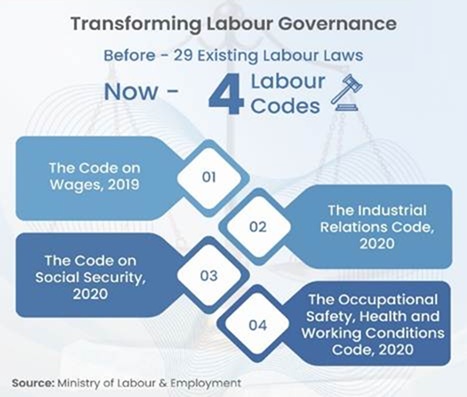
The Four Labour Codes
1. Universal Social Security and Expanded Coverage
2. Wages, Minimum Pay, and Timely Payment
3. Women’s Rights and Workplace Safety
4. Fixed Term Employment (FTE)
5. Simplified Compliance & Ease of Doing Business
Government
Industry (CII, FICCI)
|
FAQs Q1: What is the major objective of implementing the Four Labour Codes? Ans: To simplify India’s labour regulations by consolidating 29 laws, improving worker welfare, social security, and ease of doing business. Q2: Which are the Four Labour Codes notified by the government? Ans:
Q3: When were the Four Labour Codes fully implemented? Ans: They were notified and operationalised by the Government of India recently, marking a major labour reform milestone. Q4: Who benefits from the expanded social security coverage under the Codes? Ans: Gig workers, platform workers, migrant workers, and workers in hazardous industries benefit from expanded ESIC and EPFO coverage. Q5: What is Fixed Term Employment (FTE) as per the Codes? Ans: A system allowing employers to hire workers for a specific duration with full benefits, including gratuity after 1 year. |
|
Prelims: (Polity, Science & Technology + CA) |
The Union Government has proposed new guidelines to define “obscenity” and other restricted categories of digital content under the Information Technology Rules, 2021.
The draft seeks to:
These proposals follow a Supreme Court directive seeking a clearer framework balancing Article 19(1)(a) (free speech) with Article 19(2) (reasonable restrictions).
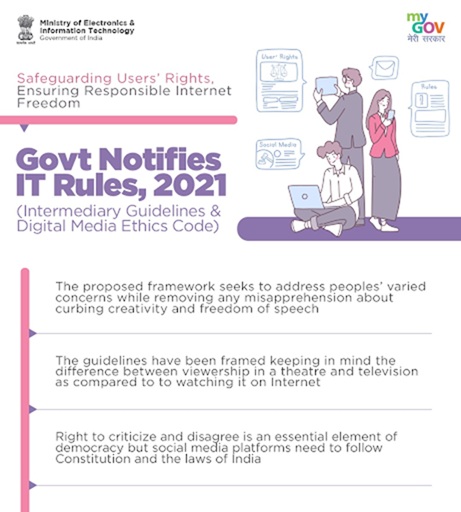
The new guidelines aim to bring greater clarity, uniform standards, and broadcast-level regulation to the digital ecosystem.
For the first time, “obscenity” is explicitly defined within IT Rules using elements from:
This marks a significant expansion resembling broadcast-style content regulation.
A new, detailed “Obscenity” Chapter is proposed.
Digital platforms must avoid content that:
A total of 17 prohibitions have been outlined.
Experts note that the government is importing the Cable TV Programme Code—originally meant for TV broadcasters—into digital regulatory space, raising concerns about overregulation.
OTT platforms may be required to ensure that their content is fit for public exhibition, similar to movies certified under the Cinematograph Act, 1952.
Although officials suggest OTTs are the main target, the draft does not explicitly limit the rule to them.
These provisions (relating to the Code of Ethics) were stayed by the Bombay High Court.
The proposal attempts to revive and expand them, which has raised constitutional concerns.
The Supreme Court’s standard from Aveek Sarkar v. State of West Bengal will be applied.
Under this test, content is not obscene if:
Digital rights groups caution that the broad interpretation could enable arbitrary censorship.
1. Overbroad Definitions
The vague and subjective nature of terms like “good taste” may cover a wide spectrum of legitimate content.
2. Executive Overreach
Critics argue the government is expanding regulatory power through rules instead of Parliamentary law-making.
3. Risk to Free Speech
Ambiguous standards may chill free expression and creative content.
4. Legal Uncertainty
Several IT Rules are sub-judice or stayed by courts, yet similar provisions are being revived.
If the Court approves the guidelines:
For Social Media Platforms
For OTT Streaming Services
For Digital News Publishers
The amendments would move India’s digital regulation closer to a broadcast-style oversight regime, significantly reshaping the online content ecosystem.
|
FAQs 1. What prompted the new obscenity guidelines? A Supreme Court directive in a case involving online objectionable content led to the drafting of detailed regulatory standards. 2. Which platforms will the new rules apply to? Social media networks, OTT streaming services, and digital news platforms. 3. What laws influence the new definition of obscenity? Section 67 of the IT Act, the Cable TV Programme Code, and IPC/Bharatiya Nyaya Sanhita. 4. Will OTT platforms require film-style certification? The proposal suggests alignment with the Cinematograph Act, though officials say this applies primarily to OTTs. 5. What legal test will determine if content is obscene? The Community Standards Test laid down in the Aveek Sarkar judgment. |
| Prelims: (Environment & Ecology + CA) Mains: (GS 3 – Environment; GS 2 – International Relations) |
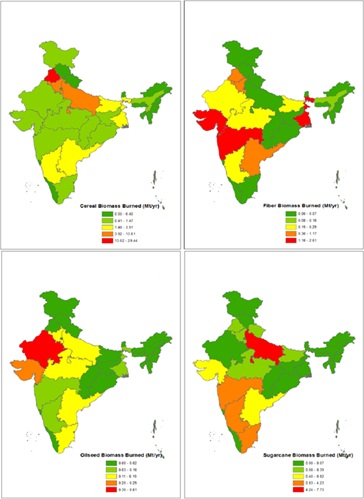
The Global Methane Status Report 2025 warns that crop-residue burning is turning India into a global methane hotspot. The report highlights rising methane concentrations, increasing climate risks, and slow global progress toward mitigation commitments.

1. Methane Levels Rising Rapidly
2. India’s Position
3. Mitigation Potential
|
FAQs Q.1: Why is methane reduction considered a quick-win for climate mitigation? Q.2: Which sectors offer the highest methane mitigation opportunities globally? Q.3: Why is India highlighted as a methane hotspot in the 2025 report? Q.4: How does methane affect human health? Q.5: What role do G20+ countries play in global methane mitigation? |

Our support team will be happy to assist you!

 Contact Us
  New Batch : 9555124124/ 7428085757
  Tech Support : 9555124124/ 7428085757