- UPSC Exam
- State PCS
- One Day Exam
- Current Affairs
- PT Quiz
- Downlaods
- About Coaching
- Blog
- Videos


| Prelims : Polity + CA Mains : GS Paper 2 – Parliament; Constitutional Provisions; Political Ethics |
Recent developments involving the defection of several Members of Parliament (MPs) in the Rajya Sabha have once again brought the Anti-Defection Law into sharp focus, raising questions about its effectiveness, interpretation, and scope in contemporary Indian politics.
Thus, the episode serves as a critical case study to examine the strengths, loopholes, and future trajectory of the Anti-Defection Law in India.
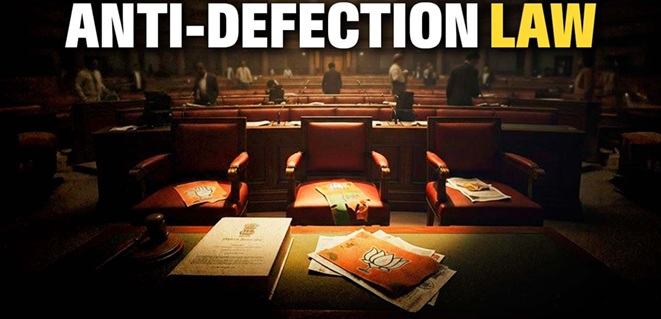
The Anti-Defection Law is a constitutional mechanism designed to curb political defections by elected representatives and to ensure stability and integrity in legislative institutions.
Prelims
Q. Consider the following statements regarding the Anti-Defection Law :
Which of the statements given above is/are correct ?
(a) 1 only
(b) 2 only
(c) Both 1 and 2
(d) Neither 1 nor 2
“The Anti-Defection Law, while ensuring political stability, has also led to erosion of legislative independence.” Critically examine.
FAQsQ1. What is the Anti-Defection Law ? It is a constitutional provision aimed at preventing elected representatives from switching political parties for personal or political gains. Q2. What is the two-thirds rule ? If at least two-thirds of legislators agree to merge with another party, they are exempt from disqualification. Q3. Who decides disqualification cases ? The Speaker of the Lok Sabha or the Chairman of the Rajya Sabha. Q4. What is the main issue in recent defections ? The interpretation of the merger clause and whether it applies to legislators alone or the entire party. Q5. What is the key criticism of the law? It restricts legislative independence and may be misused to legitimise large-scale defections. |
| Prelims : Science & Technology + CA Mains : GS Paper 3 – Science & Technology; Cyber Security; Emerging Technologies; Internal Security |
The emergence of Mythos AI, a highly advanced artificial intelligence model developed by Anthropic, has triggered global concern among governments, regulators, and financial institutions due to its unprecedented cybersecurity capabilities.
Thus, Mythos AI represents a turning point in global AI governance, where technological breakthroughs are outpacing existing regulatory safeguards.
Mythos AI is a next-generation large language model developed by Anthropic, designed with advanced capabilities in coding, reasoning, and autonomous problem-solving.
Thus, Mythos AI represents a shift from AI as a tool to AI as an autonomous cyber-capable agent.
Thus, Mythos exemplifies the dual-use dilemma in emerging technologies.
Prelims
Q. Consider the following statements regarding advanced AI models like Mythos :
Which of the statements given above is/are correct ?
(a) 1 only
(b) 2 only
(c) Both 1 and 2
(d) Neither 1 nor 2
Mains
“Advanced AI systems like Mythos present both opportunities and systemic risks to cybersecurity and financial stability.” Discuss.
FAQsQ1. What is Mythos AI ? It is an advanced AI model capable of identifying and exploiting software vulnerabilities autonomously. Q2. Why is it considered dangerous ? Because it can perform complex cyberattacks and exploit unknown vulnerabilities. Q3. Which sectors are most at risk ? Banking, financial systems, and critical infrastructure. Q4. What is the key regulatory concern ? Balancing innovation with safety and preventing misuse. Q5. What is the broader implication ? Need for global AI governance and stronger cybersecurity frameworks. |
| Prelims : Economy + CA Mains : GS Paper 3 – Indian Economy; Growth; Inflation; External Sector; Economic Development |
The notion that India is currently experiencing a “Goldilocks Economy” has come under scrutiny amid recent economic developments that challenge the perception of a perfectly balanced macroeconomic environment.
Thus, the debate reflects a deeper reassessment of India’s economic resilience and the structural challenges underlying seemingly stable macroeconomic indicators.

A “Goldilocks Economy” refers to a macroeconomic condition where economic growth is neither too hot nor too cold, but “just right”, ensuring stability and sustainability.
However, the Goldilocks phase is often considered temporary and fragile, as it depends on a delicate balance of multiple economic variables that can be disrupted by both domestic and external factors.
Prelims
Q. A “Goldilocks Economy” is best described as :
(a) An economy with high inflation and high growth
(b) An economy with balanced growth, low inflation, and stable employment
(c) An economy facing recession and deflation
(d) An economy driven entirely by exports
Mains
“India’s so-called ‘Goldilocks Economy’ masks underlying structural vulnerabilities.” Critically examine.
FAQsQ1. What is a Goldilocks Economy ? It refers to a situation where economic growth is steady, inflation is low, and macroeconomic conditions are balanced. Q2. Why is India’s Goldilocks phase under scrutiny ? Due to data revisions, external shocks, inflation risks, and structural issues in employment. Q3. What is the biggest risk ? Rising oil prices and global economic uncertainty. Q4. What does this debate indicate ? The gap between headline indicators and real economic conditions. Q5. What is the key takeaway ? Sustainable growth requires strong structural fundamentals, not just short-term stability. |

Our support team will be happy to assist you!

 Contact Us
  New Batch : 9555124124/ 7428085757
  Tech Support : 9555124124/ 7428085757