New
Hindi Medium: (Delhi) - GS Foundation (P+M) : 10th Aug 2026, 3:00 PM Hindi Medium: (Prayagraj) - GS Foundation (P+M) : 18th Aug 2026, 8:00 AM English Medium: (Delhi) - GS Foundation (P+M) : 6th Aug 2026 English Medium: (Prayagraj) - GS Foundation (P+M) : 15th July 2026, 8:00 AM Hindi Medium: (Delhi) - GS Foundation (P+M) : 10th Aug 2026, 3:00 PM Hindi Medium: (Prayagraj) - GS Foundation (P+M) : 18th Aug 2026, 8:00 AM English Medium: (Delhi) - GS Foundation (P+M) : 6th Aug 2026 English Medium: (Prayagraj) - GS Foundation (P+M) : 15th July 2026, 8:00 AM

Current Affairs for 30 July 2026

Scientists Reveal How Extreme Drought Caused the Collapse of Bronze Age Civilisations

Prelims: History (Ancient Civilizations), Geography (Mediterranean Region & Climate), Environment & Ecology (Climate Change, Drought & Water Scarcity), and Current Affairs (Scientific Research).
Mains:
GS Paper I: Indian Heritage and Culture, History and Geography of the World and Society - Factors responsible for the rise and fall of civilizations and the influence of physical geography and climate on human settlements.
GS Paper III: Environment, Ecology, Biodiversity and Climate Change - Climate Change, Drought and Water Scarcity, Environmental Degradation, Disaster Management, and Food Security.

Why is it in the news?

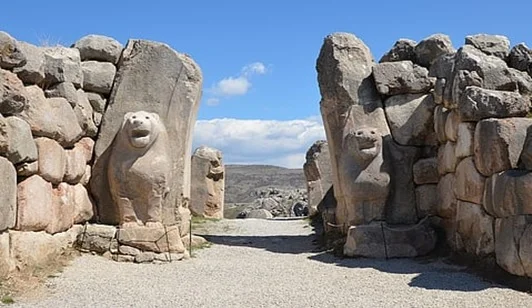
A new study by researchers at Stockholm University has found that the collapse of major Late Bronze Age civilisations—including the Mycenaeans, Minoans, and the Hittite Empire—was caused by extreme droughts triggered by the combined effect of multiple natural climate cycles.
What did the study find?

  • Researchers used advanced climate models to reconstruct the Mediterranean climate over the last 8,000 years
  • They found that the region had been gradually becoming drier due to slow changes in Earth's orbit
  • At the same time, shorter-term climate variations in the Atlantic Ocean and atmosphere also influenced rainfall. 
  • When these natural climate cycles occurred together, they produced exceptionally severe droughts

How did the drought affect these civilisations?

  • Water availability declined sharply across the Eastern Mediterranean. 
  • Agriculture suffered due to prolonged drought. 
  • Food shortages and economic stress increased. 
  • These pressures contributed to the collapse of major Bronze Age civilisations such as the Mycenaeans, Minoans, and Hittite Empire

Key Scientific Finding

  • The study shows that the worst droughts were not caused by a single climatic event
  • Instead, they occurred when multiple natural climate cycles aligned, pushing the region beyond a critical hydroclimatic threshold
  • This significantly reduced water availability and intensified pressure on already vulnerable societies. 

Why is this important today?

  • The Mediterranean is considered one of the world's major climate change hotspots
  • Scientists warn that future droughts may depend not only on human-induced global warming but also on how natural climate variability interacts with long-term warming. 
  • The findings improve our understanding of future drought risks and help policymakers prepare for climate-related challenges.

Conclusion

The study concludes that the collapse of the Late Bronze Age civilisations was driven not by a single drought, but by the combined impact of multiple natural climate cycles that created prolonged and severe water shortages. The findings highlight how climate extremes can destabilize societies and underscore the need to better understand the interaction between natural climate variability and human-induced climate change to prepare for future drought risks.

Prelims Question

Q. Which of the following civilisations were affected by the Late Bronze Age collapse?

  1. Mycenaean
  2. Minoan
  3. Hittite Empire
  4. Roman Empire

Select the correct answer:

  1. 1 and 2 only

  2. 1, 2 and 3 only

  3. 2, 3 and 4 only

  4. 1, 3 and 4 only

Mains Question

Q. Climate has played a significant role in the rise and fall of civilizations. Discuss with reference to the recent findings on the collapse of the Late Bronze Age civilizations.

FAQs: Collapse of the Late Bronze Age Civilisations

Q1. What was the main cause behind the collapse of the Late Bronze Age civilisations?

Answer: According to the recent Stockholm University study, the collapse was primarily caused by extreme droughts triggered by the alignment of multiple natural climate cycles, which severely reduced water availability and agricultural productivity.

Q2. What is the key finding of the Stockholm University study?

Answer: The study found that the most severe droughts occurred when long-term drying caused by changes in Earth's orbit coincided with short-term climate variability in the Atlantic Ocean and atmosphere, leading to exceptionally severe drought conditions

Q3. Why is this study important today?

Answer: The study helps scientists understand that future drought risks depend not only on human-induced climate change but also on the interaction of natural climate cycles, improving climate risk assessment and adaptation planning. 

Q4. Why is the Mediterranean considered a climate change hotspot?

Answer: The Mediterranean is expected to become warmer and drier due to climate change, making it more vulnerable to frequent and intense droughts.

Q5. What is meant by a "critical hydroclimatic threshold"?

Answer: It refers to the point at which water availability declines so significantly that ecosystems, agriculture, and human societies face severe stress, increasing the risk of societal disruption.

Anti-Paper Leak Bill: Background, Key Provisions, Changes and Significance

Prelims: Current Affairs | Polity & Governance | Parliament | Public Examinations Law | Education
Mains: GS Paper II – Parliament: Structure, Functioning, Conduct of Business; Government Policies and Interventions for Education’s Development

Why in News

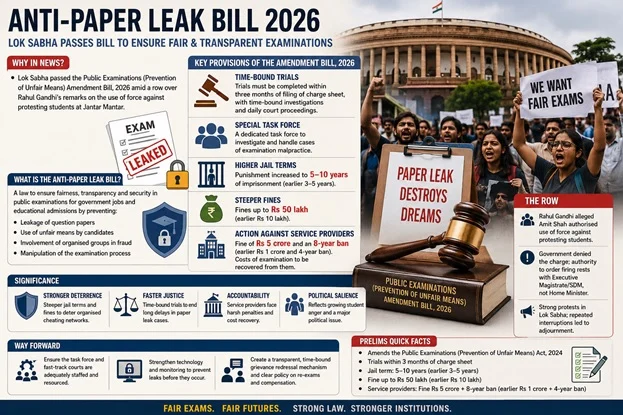
The Lok Sabha recently passed the Public Examinations (Prevention of Unfair Means) Amendment Bill, 2026, tightening the anti-paper leak law, amid repeated disruptions over Leader of Opposition Rahul Gandhi’s allegation that Union Home Minister Amit Shah was responsible for the use of force against students protesting at Delhi’s Jantar Mantar. 

What is the Anti-Paper Leak Bill?

It is a legislative measure designed to ensure fairness, transparency, and security in public examinations conducted for government jobs and educational admissions. It focuses on preventing unfair practices such as:

  • Leakage of question papers before examinations
  • Use of unfair means by candidates
  • Involvement of organised groups in examination fraud
  • Manipulation of the examination process

Background: Why the Bill Was Brought

  • The amendment was introduced following a series of controversies over alleged irregularities in public recruitment examinations, which sparked nationwide protests and concerns about the fairness of the examination system.
  • Student groups organised demonstrations demanding greater transparency, accountability, and stronger safeguards against examination malpractice.
  • The government stated that several cases had been registered under the existing law since its enactment and said the amendments are intended to further strengthen the integrity, transparency, and credibility of public examinations.

What the Amendment Bill Changes

  • The Bill amends the Public Examinations (Prevention of Unfair Means) Act, 2024, introducing stricter timelines and higher penalties following commitments made by the Prime Minister after the student protests.
  • Time-bound trials: Trials must be completed within three months of the filing of a charge sheet, with time-bound investigations and daily court proceedings.
  • Special task force: The amendment provides for a dedicated task force to handle examination malpractice cases.
  • Higher jail terms: Punishment for those convicted has been raised to 5–10 years of imprisonment, up from the earlier 3–5 years.
  • Steeper fines: Fines of up to Rs 50 lakh, compared to Rs 10 lakh earlier.
  • Action against service providers: Entities found involved in malpractice now face a fine of Rs 5 crore and an eight-year ban (up from Rs 1 crore and a four-year ban), with provisions to recover examination-related costs from them.

Key Provisions of the Anti-Paper Leak Bill 2026

  • Strict Punishment for Offenders: The bill provides stringent penalties for individuals involved in paper leaks and examination fraud, including imprisonment, heavy financial penalties, and legal action against organised groups involved in malpractice. 
  • Accountability of Examination Authorities: The bill aims to fix responsibility on examination conducting agencies, private service providers, and officials involved in the examination process.
  • Prevention of Organised Cheating Networks: It targets organised gangs that profit from leaking papers or manipulating examination results.
  • Use of Technology: The bill encourages the adoption of secure digital systems, better data protection mechanisms, and advanced monitoring methods to reduce the chances of malpractice.

Significance

  • Stronger deterrence: Steeper jail terms and fines aim to deter organised cheating rackets behind large-scale paper leaks.
  • Faster justice: Time-bound investigation and trial provisions address long-standing complaints that paper-leak cases drag on for years, leaving affected students in limbo.
  • Accountability of service providers: Sharply higher penalties and cost-recovery provisions target the private exam-conducting agencies often at the centre of leaks.
  • Political salience: The episode reflects how student unrest over examination integrity has become a live parliamentary and political issue, feeding into wider opposition attacks on the government’s handling of law and order.

Way Forward

  • Ensure the new task force and time-bound trial mechanisms are adequately staffed and resourced so the tighter timelines are actually met.
  • Strengthen technological safeguards in examination conduct — secure question-paper logistics, real-time monitoring and forensic audit trails — to prevent leaks before they occur, rather than relying solely on post-facto punishment.
  • Build a transparent, time-bound grievance-redressal mechanism for affected students, including clarity on re-examinations and compensation.

Prelims MCQ

Q. Consider the following statements regarding the Public Examinations (Prevention of Unfair Means) Amendment Bill, 2026:

  1. It amends a law that was originally enacted in 2024.
  2. It raises the maximum prison term for convicted offenders to 5–10 years.
  3. It mandates that trials be completed within three months of the charge sheet being filed.

Which of the above statements are correct?

A. 1 and 2 only

B. 2 and 3 only

C. 1 and 3 only

D. 1, 2 and 3

Mains Practice Question

Q. Examination paper leaks undermine both public trust in the recruitment/admission system and the rule of law. Critically examine the key provisions of the Public Examinations (Prevention of Unfair Means) Amendment Bill, 2026 and assess whether stricter penalties alone can address the problem.

FAQs

1. What does the Public Examinations (Prevention of Unfair Means) Amendment Bill, 2026 do?

It amends the 2024 anti-paper leak law to prescribe tougher jail terms and fines, time-bound investigations and trials, and a special task force to handle examination malpractice.

2. What triggered the political row during the debate?

Rahul Gandhi alleged that Union Home Minister Amit Shah had ordered the use of force against students protesting at Jantar Mantar, which the government strongly denied.

3. What is the increased punishment under the amended law?

Convicted offenders now face 5 to 10 years of imprisonment and fines of up to Rs 50 lakh, up from 3 to 5 years and Rs 10 lakh earlier.

4. What penalty do service providers face under the new law?

A fine of Rs 5 crore and an eight-year ban, compared to Rs 1 crore and a four-year ban previously, with provision to recover examination costs from them.

5. What immediate event preceded the Bill's introduction?

Nationwide student protests over the NEET paper leak controversy, which led to the resignation of Dharmendra Pradhan as education minister.

upsc english
« »
  • SUN
  • MON
  • TUE
  • WED
  • THU
  • FRI
  • SAT
Have any Query?

Our support team will be happy to assist you!

OR