
- UPSC Exam
- State PCS
- One Day Exam
- Current Affairs
- PT Quiz
- Downlaods
- About Coaching
- Blog
- Videos

| Prelims : (Geography + CA) Mains : (GS 1 – Physical Geography; GS 3 – Disaster Management, Internal Security, Infrastructure) |
Recently, a massive snow avalanche struck the Zojila Pass, disrupting traffic and highlighting the vulnerability of high-altitude Himalayan passes to extreme weather events.
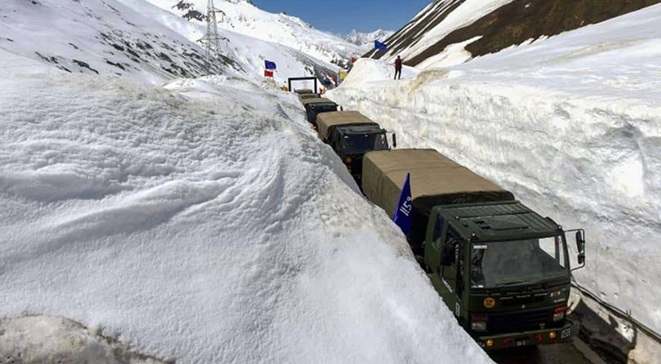
Zojila Pass is one of the most critical mountain passes in northern India, acting as a lifeline between the Kashmir Valley and Ladakh.
An avalanche is a rapid flow of snow down a slope.
FAQs1. Where is Zojila Pass located ?It is located in the Kargil district of Ladakh on the Srinagar–Leh highway, connecting Kashmir Valley with Ladakh. 2. Why is Zojila Pass strategically important ?It is the only major road link supplying essential goods and military logistics to Ladakh. 3. Why does Zojila Pass remain closed in winters ?Heavy snowfall, blizzards, and avalanche risks make the route unsafe for several months. 4. What is an avalanche and why is it dangerous ?An avalanche is a fast-moving mass of snow that can bury or destroy anything in its path, causing significant loss of life and infrastructure. 5. What is the significance of the Zojila Tunnel ?It will provide all-weather connectivity, reduce travel disruptions, and strengthen both economic and strategic capabilities. |
| Prelims: (Environment & Ecology + International Organisations + Current Affairs) Mains: (GS 3 – Environment Conservation, Climate Change, Sustainable Development) |
Recently, WWF-India, in collaboration with the Ministry of Environment, Forest and Climate Change, organized awareness and outreach activities in Gwalior to mark 20 years of Earth Hour, which is celebrated on the last Saturday of March, highlighting growing global concern over climate change and sustainability.

Earth Hour is one of the world’s largest grassroots environmental movements.
Over time, Earth Hour has shifted from a one-hour event to a broader campaign encouraging long-term sustainable practices and policy advocacy.
Draws attention to ecosystem protection and wildlife conservation efforts.
FAQs1. What is Earth Hour ? Earth Hour is a global environmental campaign encouraging people to switch off lights for one hour to raise awareness about climate change. 2. Who organizes Earth Hour ? It is organized by the World Wide Fund for Nature (WWF), a global environmental organization. 3. When is Earth Hour observed ? It is observed annually towards the end of March, typically from 8:30 PM to 9:30 PM local time. 4. What is the purpose of switching off lights ? The “lights-off” act is symbolic, aimed at promoting awareness about energy conservation and environmental protection. 5. Is Earth Hour effective in tackling climate change ? While symbolic, it plays a significant role in raising awareness and encouraging long-term behavioural and policy changes. |
| Prelims : (Government Schemes + CA) Mains : (GS 3 – Energy, Agriculture, Infrastructure; GS 2 – Governance, Policies) |
The government is planning a revamped version of the PM-KUSUM scheme, likely termed PM-KUSUM 2.0, to address implementation gaps, improve efficiency, and integrate battery storage systems for better energy management in agriculture.
The Pradhan Mantri Kisan Urja Suraksha evam Utthaan Mahabhiyan (PM-KUSUM), launched in 2019, aims to :
Component A (Decentralized Ground/Stilt Mounted Solar Power Plants) :
Goal: Setup 10,000 MW of renewable energy-based power plants (REPP) or barren or cultivated land,.
Component B (Standalone Solar Agriculture Pumps) :
Component C (Solarization of Grid-Connected Agriculture Pumps):
Capacity: Individual pumps up to 7.5 HP
However, progress has been slower than expected due to financial, institutional, and technical challenges.
The scheme requires restructuring due to :
The revamped scheme proposes integrating battery energy storage systems.
Purpose :
Battery storage will help :
High upfront costs for solar pumps continue to discourage small and marginal farmers despite subsidies.
Slow loan approvals and financial closure have significantly delayed project execution across states.
Lack of effective coordination between central ministries, state governments, DISCOMs, and financial institutions has hindered implementation.
Solar energy variability creates instability in power supply, especially in regions with weak grid infrastructure.
Solar generation peaks during midday, whereas agricultural demand extends beyond daylight hours, creating operational inefficiencies.
Inadequate local capacity for installation, maintenance, and monitoring affects long-term sustainability.
A balanced approach must be adopted in determining optimal storage capacity to ensure cost-efficiency and grid stability.
Government should expand credit support, interest subvention, and innovative financing models to make solar pumps affordable.
Better coordination between ministries, DISCOMs, and financial institutions is essential for smooth implementation.
Investment in smart grids and transmission networks is necessary to handle renewable energy variability.
Training farmers and local technicians can improve adoption, maintenance, and long-term sustainability.
Involving private players can bring efficiency, innovation, and faster execution.
FAQs1. What is PM-KUSUM scheme ? It is a government scheme aimed at promoting solar energy in agriculture through solar pumps and decentralised power generation. 2. What is PM-KUSUM 2.0 ? It is the proposed revamped version of the scheme focusing on efficiency, battery storage, and faster implementation. 3. Why is battery storage important ? It helps store excess solar energy and ensures power availability even when sunlight is not available. 4. What are the main challenges in the scheme ? Financial constraints, delays in loans, coordination issues, and grid integration challenges. 5. How does the scheme benefit farmers ? It reduces irrigation costs, provides reliable power, and offers opportunities to earn from surplus electricity. |
| Prelims : (Geography + CA) Mains : (GS 1 – Resources Distribution; GS 3 – Economy, Infrastructure, Energy) |
Global copper prices have declined due to weakening demand amid geopolitical tensions in West Asia, raising concerns about global economic slowdown and industrial demand.
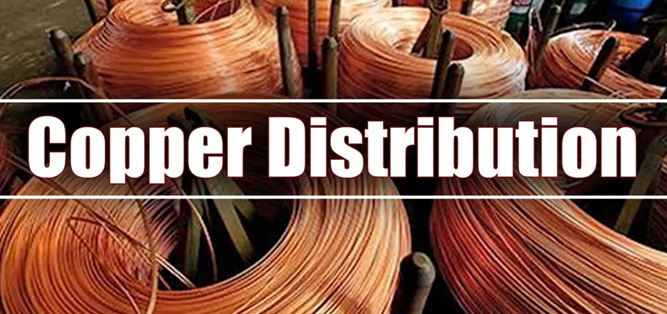
Copper is one of the most essential industrial metals and is often referred to as the “metal of electrification” due to its high electrical and thermal conductivity.
Its demand is closely linked with :
Thus, fluctuations in copper prices are widely considered indicators of global economic health.
Used extensively in :
Critical for:
Essential for :
Widely used in construction, electronics, and manufacturing
Copper prices act as a barometer of global economic activity.
Falling prices may signal weakening global growth.
Export-dependent countries may face revenue losses.
Lower prices may affect investments in renewable infrastructure.
Copper remains critical for future technologies and sustainability goals.
Highlights vulnerability in supply chains and need for domestic capacity.
FAQs1. Why is copper called the “metal of electrification” ? Due to its high electrical conductivity, making it essential for power and energy systems. 2. Which country is the largest producer of copper ? Chile is the largest global producer. 3. Why are copper prices falling recently ? Due to weak global demand and geopolitical tensions. 4. Does India have sufficient copper reserves ? No, India has limited reserves and depends heavily on imports. 5. Why is copper important for the future economy ? It is crucial for renewable energy, electric vehicles, and infrastructure development. |
| Prelims: (Economy + CA) Mains : (GS 3 – Energy Security, Infrastructure, Economy; GS 2 – Governance) |
Disruptions in shipping routes through the Strait of Hormuz due to the ongoing West Asia conflict have significantly impacted India’s energy supplies, with LPG being more severely affected than LNG.
India is highly dependent on energy imports, especially hydrocarbons from West Asia. A major share of these imports passes through the Strait of Hormuz, a critical global energy transit route.
This has forced the government to prioritise domestic consumers and cut supplies to industrial and commercial users.
A larger share of LPG imports flows through the Strait of Hormuz compared to LNG, making it more vulnerable to disruptions.
This makes LPG supply disruption more socially sensitive.
Highlights India’s vulnerability to geopolitical disruptions in critical chokepoints.
Reinforces need to diversify import sources and routes.
Encourages expansion of PNG, renewables, and domestic energy production.
Accelerates investment in pipelines, storage, and gas distribution networks.
Demonstrates balancing act between household welfare and industrial demand.
Accelerate development of nationwide pipeline networks to increase PNG access and reduce LPG dependence.
Explore alternative shipping routes and suppliers to reduce reliance on the Strait of Hormuz.
Build strategic reserves of LPG and natural gas to cushion supply shocks.
Encourage solar cooking, biogas, and electric cooking solutions in rural areas.
Invest in refining capacity and gas exploration to reduce import dependence.
FAQs1. What is the main difference between LPG and LNG ? LPG is a propane-butane mix used mainly for cooking, while LNG is methane-based and used after regasification for multiple purposes. 2. Why was LPG more affected than LNG ? Because a larger share of LPG imports passes through the Strait of Hormuz and it has fewer immediate alternatives. 3. How is LNG used in India ? It is converted into natural gas and supplied as PNG for households and CNG for vehicles and industries. 4. What steps has the government taken ? Promoting PNG, boosting domestic LPG production, managing demand, and encouraging alternative fuels. 5. Why is this issue important for India ? It highlights energy security challenges and the need for infrastructure and policy reforms in the energy sector. |

Our support team will be happy to assist you!


 Contact Us
  New Batch : 9555124124/ 7428085757
  Tech Support : 9555124124/ 7428085757

