Prelims Relevance: Science & Technology, Defence Technology, Semiconductors, DRDO, Electronic Warfare, Radar Systems, Gallium Nitride, MMIC
Mains: GS Paper III Indigenisation of Technology, Defence Technology, Semiconductor Ecosystem, Science and Technology Developments, National Security
Keywords: GaN, Gallium Nitride, MMIC, DRDO, SSPL, Semiconductor, GaAs, SiC, AESA Radar, Electronic Warfare, S-Band, X-Band, Microwave Technology, Defence Indigenisation, Strategic Autonomy |
Why in News?
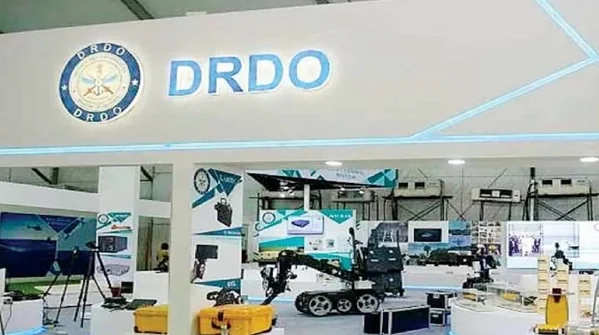
- The Defence Research and Development Organisation (DRDO) has successfully demonstrated and implemented indigenous Gallium Nitride Monolithic Microwave Integrated Circuit (GaN MMIC) technology for high-frequency defence applications.
- According to the Ministry of Defence’s Annual Report 2025–26, the technology can support advanced radar, electronic warfare, communication, satellite and missile systems.
Background
- Modern defence platforms depend heavily on high-frequency electronic components for detecting, tracking, communicating with and countering threats.
- For several years, access to some advanced semiconductor technologies remained restricted because of their strategic and dual-use nature. This increased the importance of developing such technologies within India.
- DRDO developed indigenous GaN MMIC technology in 2024 after years of research. With this achievement, India joined a small group of countries possessing advanced indigenous capability in this field, alongside countries such as the United States, Russia, France, Germany, South Korea and China.
- The development forms part of India’s wider effort to reduce dependence on imported critical defence electronics.
What is Gallium Nitride?
- Gallium Nitride (GaN) is a wide-bandgap semiconductor material capable of operating efficiently under high voltage, high temperature and high-frequency conditions.
- Compared with conventional silicon-based semiconductor technologies, GaN devices can offer higher power density, better thermal performance and improved efficiency in high-frequency applications.
- These properties make GaN particularly useful for modern radar, communication and electronic warfare systems.
What is a GaN MMIC?
- A Monolithic Microwave Integrated Circuit (MMIC) is a compact integrated circuit specifically designed to process microwave and radio-frequency signals.
- In a GaN MMIC, components such as transistors, resistors and capacitors are integrated onto a single semiconductor chip.
- The technology makes it possible to build smaller, lighter and more powerful radio-frequency systems while handling significantly higher power levels.
- This is particularly important in defence platforms where space, weight, power consumption and thermal management are critical factors.
Key Features of India’s Indigenous GaN MMIC Technology
- According to the Ministry of Defence report, an indigenous GaN chip measuring approximately 3.5 × 3 mm can deliver power of up to 30 watts.
- The report also states that GaN technology can support extremely high-speed operations compared with conventional silicon technology.
- Indigenous GaN MMIC technology has been successfully demonstrated and implemented for applications extending up to the X-band frequency range.
- DRDO has also designed, fabricated and demonstrated indigenous S-band GaN High Electron Mobility Transistor-based power devices and MMICs.
What are S-Band and X-Band?
- The S-band generally covers frequencies between approximately 2 GHz and 4 GHz and is widely used in radar, satellite communication and tracking applications.
- The X-band covers approximately 8 GHz to 12 GHz and is particularly important for high-resolution radar, missile guidance, fire-control radar and military surveillance systems.
- The ability to manufacture indigenous components operating across these frequencies is therefore strategically significant.
Role of DRDO’s Solid State Physics Laboratory
- The development has been led by scientists at DRDO’s Solid State Physics Laboratory (SSPL).
- The team associated with the programme has worked extensively on advanced semiconductor technologies such as Gallium Arsenide (GaAs) and Gallium Nitride.
- Research in these areas includes MMIC development, high-frequency semiconductor devices, digital integrated circuits, device modelling, characterisation and fabrication technologies.
- The programme reflects the importance of indigenous semiconductor research for strategic defence applications.
Why is GaN Important for Radar Systems?
- Traditional radar systems require powerful transmitters to send radio-frequency signals over long distances.
- GaN-based transmit-receive modules can generate greater power while occupying relatively less space and operating with higher efficiency.
This can contribute to:
- Longer radar detection ranges
- Improved target tracking
- Higher-resolution surveillance
- More compact radar systems
- Better performance against fast-moving targets
- Greater reliability under demanding operational conditions
GaN technology is especially relevant for Active Electronically Scanned Array (AESA) radars, where hundreds or thousands of small transmit-receive modules operate together.
Importance for Electronic Warfare
- Electronic warfare systems operate in a highly contested electromagnetic environment.
- GaN-based components can support powerful electronic countermeasure and electronic support systems by enabling high-frequency and high-power radio-frequency operations.
- Such systems can be used for functions including threat detection, signal interception, electronic intelligence, radar warning and electronic countermeasures.
- The development could therefore improve India's indigenous capabilities in both defensive and offensive electronic warfare technologies.
Application in Missile and Air Defence Systems
- Modern missile systems require compact and highly reliable electronic components for guidance, seekers, communication and tracking.
- GaN-based MMIC technology can support high-frequency radar seekers and associated electronic systems.
- It can also contribute to ground-based and airborne air-defence radars that must detect small, fast and manoeuvring targets.
- Its high power density becomes particularly valuable where size and weight restrictions are severe.
Importance for Satellites and Communication Systems
- Satellite communication requires efficient radio-frequency amplifiers capable of operating reliably for long durations.
- GaN technology can help reduce the size and weight of communication payloads while increasing power efficiency.
- Such technology could therefore have applications in military satellites, secure communication networks and space-based surveillance systems.
Civilian and Dual-Use Applications
- Although GaN technology is strategically important for defence, it also has significant civilian applications.
- It can contribute to 5G and future 6G telecommunications, satellite communication, electric vehicles, renewable energy systems, high-efficiency power electronics and advanced industrial equipment.
- Investment in strategic semiconductor technologies can therefore generate technological spillovers across the wider economy.
Challenges
- Advanced Fabrication Capability: GaN MMIC fabrication requires sophisticated semiconductor manufacturing facilities and precise process control.
- High Production Cost: Advanced compound semiconductor fabrication can initially be considerably more expensive than established silicon manufacturing.
- Manufacturing Yield: Developing a laboratory prototype and manufacturing thousands of reliable chips at consistent quality are different technological challenges.
- Semiconductor Supply Chain: Substrates, specialised fabrication tools, testing equipment and packaging technologies need a secure domestic supply ecosystem.
- Skilled Workforce: India will require more specialists in semiconductor physics, radio-frequency engineering, fabrication technology, packaging and microwave circuit design.
- Continuous Technological Upgradation: Major military powers are rapidly improving semiconductor materials, radar architecture and electronic warfare capabilities. India will therefore need continuous research rather than treating the current achievement as an endpoint.
Way Forward
- India should expand indigenous GaN fabrication capacity and progressively move from successful demonstration to reliable large-scale production.
- Greater coordination between DRDO laboratories, defence public-sector enterprises, private defence companies, semiconductor manufacturers, universities and start-ups can accelerate the development of a complete domestic ecosystem.
- Investment should also focus on advanced packaging, testing, semiconductor substrates and specialised fabrication equipment.
- Indigenous GaN components should gradually be integrated into future radars, electronic warfare suites, satellites, missile seekers and communication platforms.
- India can also use defence semiconductor development to strengthen commercially important technologies in telecommunications, electric mobility and renewable energy.
Prelims MCQs
Q. With reference to Gallium Nitride (GaN), consider the following statements:
- It is a wide-bandgap semiconductor material.
- It can operate under high-temperature and high-power conditions.
- It has applications in radar and electronic warfare systems.
Which of the statements given above are correct?
(a) 1 and 2 only
(b) 2 and 3 only
(c) 1 and 3 only
(d) 1, 2 and 3
Mains Question
“Indigenous Gallium Nitride semiconductor technology can become a critical enabler of India's future radar, electronic warfare and strategic communication capabilities.” Discuss its technological and strategic significance for India.
|
FAQs
What is GaN MMIC?
GaN MMIC is a microwave integrated circuit manufactured using Gallium Nitride semiconductor technology. It integrates radio-frequency components onto a single chip and is particularly suitable for high-power and high-frequency applications.
Why is GaN important for defence?
GaN provides high power density, thermal tolerance and high-frequency performance, making it suitable for advanced radar, electronic warfare, missile and communication systems.
Which DRDO laboratory developed the technology?
DRDO's Solid State Physics Laboratory (SSPL) has played a major role in developing India's indigenous GaN and other compound semiconductor technologies.
What is the importance of X-band capability?
X-band frequencies are widely used in high-resolution surveillance radar, fire-control systems, missile guidance and several other defence applications.
Can GaN technology be used outside defence?
Yes. GaN technology also has applications in telecommunications, satellite systems, electric vehicles, renewable energy and high-efficiency power electronics.
|






 Contact Us
  New Batch : 9555124124/ 7428085757
  Tech Support : 9555124124/ 7428085757