
- UPSC Exam
- State PCS
- One Day Exam
- Current Affairs
- PT Quiz
- Downlaods
- About Coaching
- Blog
- Videos

| Prelims: (International Relations + CA) Mains: (GS 2 – International Relations, Global Governance, Multilateral Institutions, Sustainable Development) |
The United Nations Economic and Social Council (ECOSOC) will commemorate its 80th anniversary with a special event on 23 January 2026, marking eight decades of its role as the UN’s principal body for coordinating global economic, social, humanitarian, and development cooperation.
The milestone comes at a time when multilateral institutions are under renewed scrutiny amid global challenges such as climate change, inequality, pandemics, debt distress, and sustainable development financing.
The commemoration is expected to reflect on ECOSOC’s historical contributions, assess its contemporary relevance, and outline reforms and priorities for strengthening global governance.
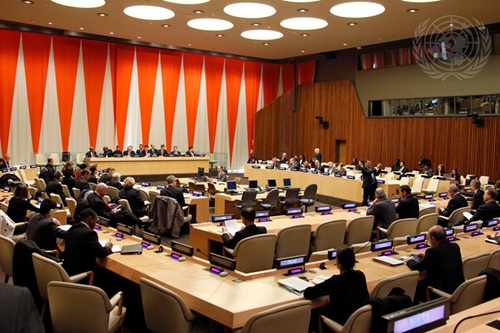
ECOSOC was established in 1945 under the Charter of the United Nations as one of the six principal organs of the UN.
It was designed to serve as the UN’s central mechanism for promoting higher standards of living, full employment, economic and social progress, and solutions to international economic, social, health, and cultural problems.
Over the decades, ECOSOC has evolved into the primary platform linking UN policy-making with implementation across development, humanitarian assistance, and human rights agendas.
ECOSOC coordinates the work of:
14 specialised agencies (e.g., WHO, ILO, FAO, UNESCO),
5 regional commissions, and
8 functional commissions dealing with areas such as human rights, women, population, narcotic drugs, crime prevention, science and technology, and social development.
This coordination function ensures policy coherence across the UN development and humanitarian architecture.
ECOSOC formulates policy recommendations to:
UN member states, and
The broader UN system.
These recommendations shape global agendas on poverty eradication, social inclusion, economic growth, gender equality, health, education, and sustainable development.
ECOSOC serves as the UN’s central forum for discussing international economic and social issues.
It convenes:
to foster multi-stakeholder dialogue and partnerships.
Since the adoption of the 2030 Agenda for Sustainable Development, ECOSOC has played a pivotal role in:
ECOSOC stands at the intersection of:
It has historically contributed to:
In an era of complex global challenges, ECOSOC’s convening power and coordinating mandate are increasingly vital for ensuring collective action and multilateral solutions.
The 80th anniversary is significant because:
The commemorative event is expected to emphasise renewal, innovation, and enhanced coordination within the UN system to meet contemporary global challenges.
FAQsWhat is ECOSOC ? ECOSOC is one of the six principal organs of the United Nations, responsible for coordinating economic, social, humanitarian, and development activities across the UN system. Why is ECOSOC’s 80th anniversary significant ? It marks eight decades of global development coordination and provides an opportunity to assess its role, relevance, and future reforms. How many members does ECOSOC have ? ECOSOC has 54 member states elected by the UN General Assembly for three-year terms. What is ECOSOC’s role in the SDGs ? ECOSOC oversees global follow-up and review of the SDGs and hosts the High-Level Political Forum. Where is ECOSOC headquartered ? ECOSOC is headquartered in New York, USA, at the UN Headquarters. |


Our support team will be happy to assist you!

 Contact Us
  New Batch : 9555124124/ 7428085757
  Tech Support : 9555124124/ 7428085757