Prelims: (Polity & Governance + CA)
Mains: (GS 2 - Governance, Federalism; GS 3 - Internal Security, Disaster Management, Security Preparedness) |
Why in News ?
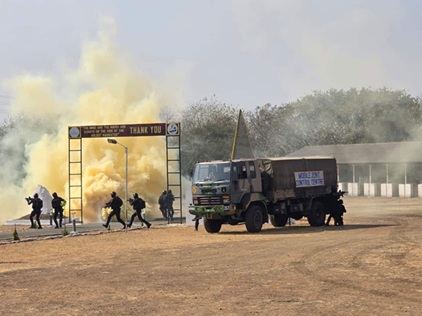
The Indian Army recently conducted Exercise “Sanjha Shakti”, a joint Military–Civil Fusion (MCF) exercise, at the Dighi Hills (Diggi) Range, Khadki Military Station, under the aegis of the Maharashtra, Gujarat and Goa Area of the Southern Command.
The exercise aimed at strengthening coordination between the armed forces and civilian agencies to effectively respond to complex security challenges, disasters, and public safety emergencies.
Background: Civil–Military Cooperation in India
India’s internal security and disaster response framework relies heavily on close coordination between civil administration and the armed forces.
Constitutional and Administrative Context
- Armed forces are frequently deployed in:
- Disaster relief operations
- Internal security support
- Aid to civil authorities
- Increasing urbanisation, climate-induced disasters, and asymmetric threats have necessitated:
- Faster response times
- Seamless interoperability
- Joint training between civil and military institutions
Exercises like Sanjha Shakti are designed to operationalise this coordination in real-world scenarios.
What is Exercise Sanjha Shakti ?
Exercise Sanjha Shakti is a joint Military–Civil Fusion (MCF) exercise conducted to enhance inter-agency coordination, preparedness, and operational synergy.
Organising Authority
- Conducted by the Indian Army
- Under the Southern Command
- Supervised by the Maharashtra, Gujarat and Goa Area
Location and Participating Agencies
Location
- Dighi Hills (Diggi) Range
- Khadki Military Station, Maharashtra
Participating Agencies
- Indian Army
- Maharashtra Police
- Force One (Maharashtra’s elite counter-terrorism unit)
- Fire and Emergency Services
- Other key civil administration stakeholders
Objectives of Exercise Sanjha Shakti
- Strengthening civil–military coordination
- Enhancing interoperability and communication
- Improving decision-making under crisis conditions
- Testing rapid response mechanisms during emergencies
- Validating joint response to security and disaster-related scenarios
Key Focus Areas of the Exercise
1. Interoperability and Communication
- Integration of military and civilian command structures
- Testing communication protocols during high-pressure situations
2. Decision-Making Processes
- Joint planning and execution
- Real-time coordination among multiple agencies
3. Rapid Response and Crisis Management
- Simulation of emergency scenarios
- Swift mobilisation of resources and personnel
4. Disaster Response and Public Safety
- Handling scenarios involving:
- Natural disasters
- Urban emergencies
- Security threats impacting civilians
Operational Significance of the Drill
The exercise was conducted through realistic, mission-oriented scenarios, enabling participants to:
- Identify gaps in coordination
- Validate Standard Operating Procedures (SOPs)
- Improve response time and situational awareness
- Ensure seamless cooperation between civil and military stakeholders
Why Military–Civil Fusion Matters
Internal Security Perspective
- Complex threats increasingly blur the line between:
- Internal security
- Disaster management
- Law and order
- Joint preparedness reduces confusion during crises
Disaster Management Perspective
- Armed forces provide:
- Logistics
- Engineering support
- Rapid mobilisation
- Civil authorities provide:
- Local intelligence
- Administrative control
- Community outreach
Effective fusion ensures complementarity rather than overlap.
Strategic Relevance of Exercise Sanjha Shakti
- Enhances preparedness in densely populated regions
- Builds trust and institutional familiarity among agencies
- Strengthens India’s overall resilience architecture
- Aligns with India’s broader emphasis on whole-of-government and whole-of-society approaches to security
Way Forward
- Regular joint exercises across regions
- Institutionalisation of best practices and SOPs
- Greater use of technology for joint command and control
- Expansion of Military–Civil Fusion frameworks to include health and disaster response agencies
FAQs
1. What is Exercise Sanjha Shakti ?
It is a joint Military–Civil Fusion exercise conducted to enhance coordination between the Indian Army and civilian agencies.
2. Where was Exercise Sanjha Shakti conducted ?
At the Dighi Hills (Diggi) Range, Khadki Military Station, Maharashtra.
3. Which agencies participated in the exercise ?
The Indian Army, Maharashtra Police, Force One, fire and emergency services, and other civil authorities.
4. What was the primary objective of the exercise ?
To improve interoperability, communication, and rapid response during security challenges and emergency situations.
5. Why are such exercises important for India ?
They strengthen civil–military cooperation, enhance disaster response capability, and improve internal security preparedness.
|






 Contact Us
  New Batch : 9555124124/ 7428085757
  Tech Support : 9555124124/ 7428085757